
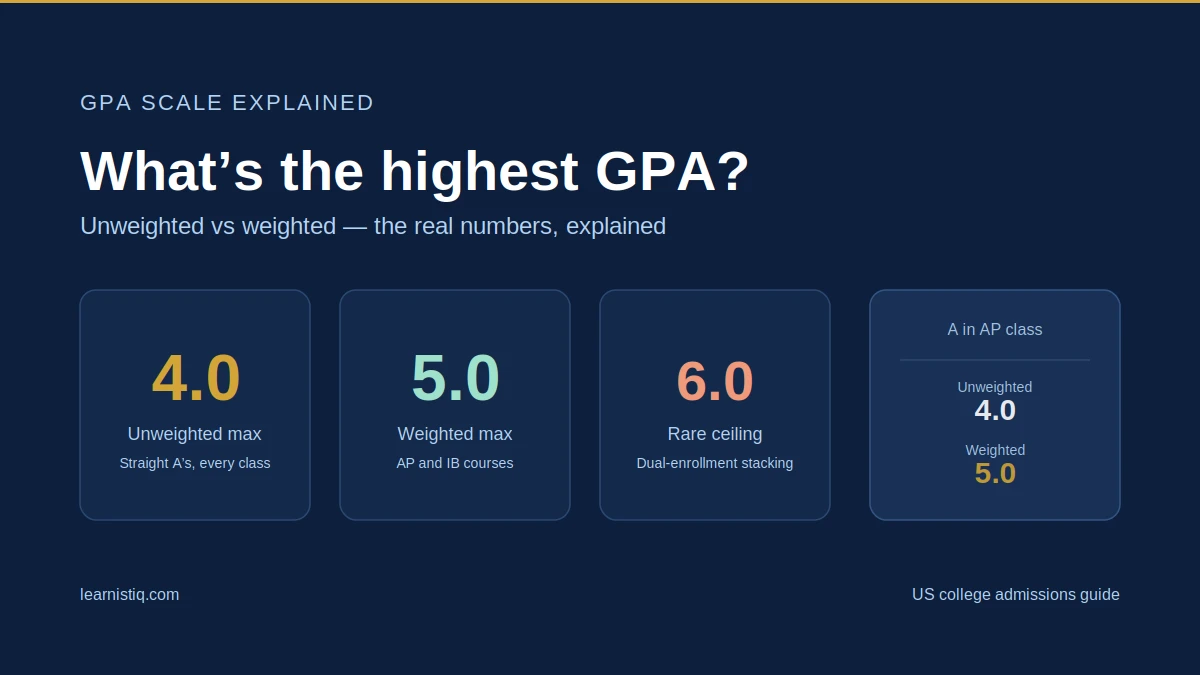
Ask a school counselor what the highest GPA is, and she’ll answer with a question of her own: weighted or unweighted? That’s not her dodging the question. That’s the whole answer.
4.0 caps the unweighted scale, full stop. A weighted scale blows past it, usually landing at 5.0. Sometimes higher than that.
Most students run into this confusion around junior year. A classmate mentions a 4.6 GPA, and suddenly the kid who’s been quietly proud of a 3.9 starts wondering if they’ve been falling behind the whole time. They haven’t. The 4.6 just came from a transcript that hands out bonus points for AP and Honors classes, and the 3.9 didn’t. Same effort, different scoreboard.
This guide covers both scales completely: the high school maximum, the college maximum, and the specific places where this number trips families up during admissions season.
Table of Contents
What GPA Actually Measures
GPA compresses every grade on a transcript into a single number. American schools built it to solve one practical problem, comparing thousands of applicants without reading every transcript line by line.
The conversion is simple. A equals 4 points. B equals 3. C equals 2, D equals 1, F equals 0. Add up the points, divide by the number of classes, and that’s the GPA.
Here’s the part students miss: GPA rewards consistency over brilliance in any single subject. A transcript with five steady B+ grades often beats one with three A’s and two C’s, even when both students arguably know their material equally well. Counselors see this play out every year. The kid acing AP Physics but bombing a required elective ends up with a lower GPA than the one cruising through five mediocre-but-passable classes. It’s not fair, exactly. It’s just how the math works.
The Real Ceiling: Unweighted vs Weighted
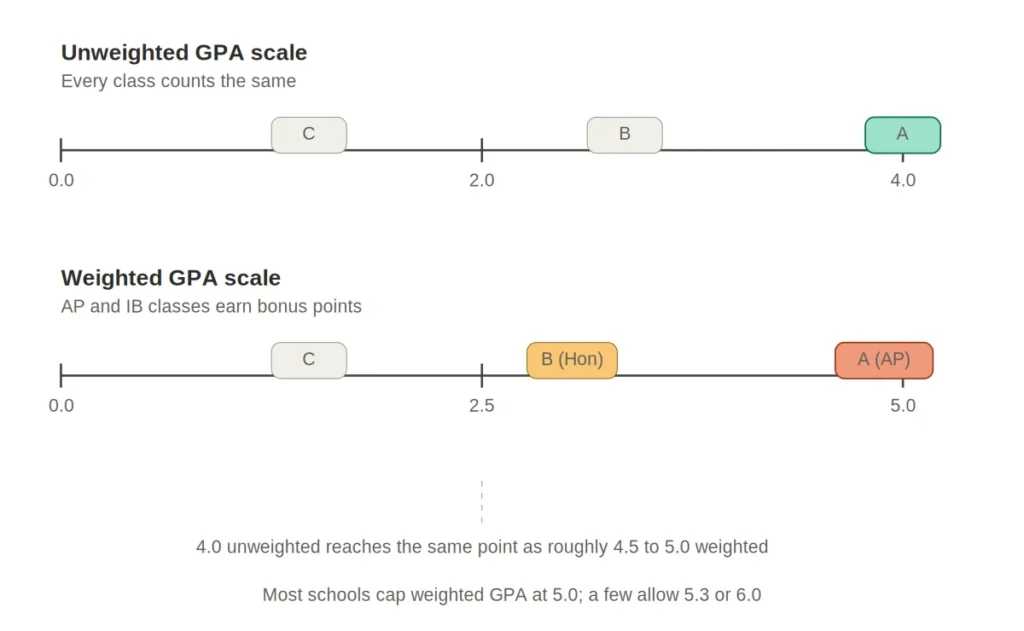
4.0 is the wall on an unweighted scale. Nothing gets through it.
Gym class and AP Chemistry carry the exact same point value here. A transcript stacked with easy electives produces an identical 4.0 to one loaded with the hardest courses a school offers, which frustrated enough school boards over the decades that weighted GPA eventually became the norm in most districts.
Weighted scales add bonus points for difficulty. The standard formula tacks on 1.0 for AP or IB classes and 0.5 for Honors. An A in a weighted AP class becomes a 5.0 instead of a 4.0. That’s the new ceiling, at most schools anyway.
Not all of them stop there. Some districts split the difference between an A and an A+ even at the weighted level, stretching the scale to 5.3. A smaller number layer dual-enrollment college credit on top of AP weighting and land at 6.0. There’s no federal rulebook governing any of this. Each district writes its own formula and buries it in a school profile document that nobody opens until application season forces the issue.
A 6.0 GPA sounds absurd to someone who’s never seen the formula behind it. It’s not a typo, and it’s not the student lying. It’s just a district that decided to weight harder than most.
High School: Where the Numbers Get Messy
Weighted GPA lives almost entirely in high school. That’s where AP, IB, and Honors tracks exist in real volume.
Unweighted ceiling: 4.0, everywhere, no exceptions. Weighted ceiling: usually 5.0, but the real number depends on how many advanced courses a school offers and how aggressively it weights them. A school running 25 AP sections gives ambitious students far more room to climb than one offering three.
And this is where the admissions math gets genuinely unfair, or at least uneven. A 4.6 from a small rural school with three AP classes total doesn’t mean what a 4.6 means at a magnet school running twenty. Admissions offices know this. It’s exactly why schools like Stanford and Harvard quietly strip the weighting off every application before anyone reads it. The number printed at the top of the transcript matters less than students think. The recalculated unweighted figure, sitting next to how many advanced classes a student actually attempted relative to what their school offered, carries more real weight.
This is the part most online GPA guides skip entirely. They’ll tell you the ceiling is 5.0 and move on. They won’t tell you that the number means almost nothing without the school profile sitting next to it.
College: A Simpler, Lower Ceiling
College drops most of this complexity. Weighting mostly disappears, since universities rarely separate an A in a 300-level seminar from an A in an intro survey course the way high schools separate AP from standard track.
4.0 is the maximum for nearly every undergraduate program in the country.
A handful of graduate and professional programs run a 4.33 scale instead, giving an A+ extra value over a flat A. That’s the exception. For almost every student reading this, 4.0 is the number that actually applies.
Graduate admissions committees, especially in law and medicine, take this number seriously. A 3.9 signals four years of sustained, nearly flawless work. A 3.1 doesn’t end anyone’s chances, but the rest of the application, research, recommendation letters, the personal statement, has to do more of the heavy lifting to compensate.
Converting Letter Grades to GPA Points
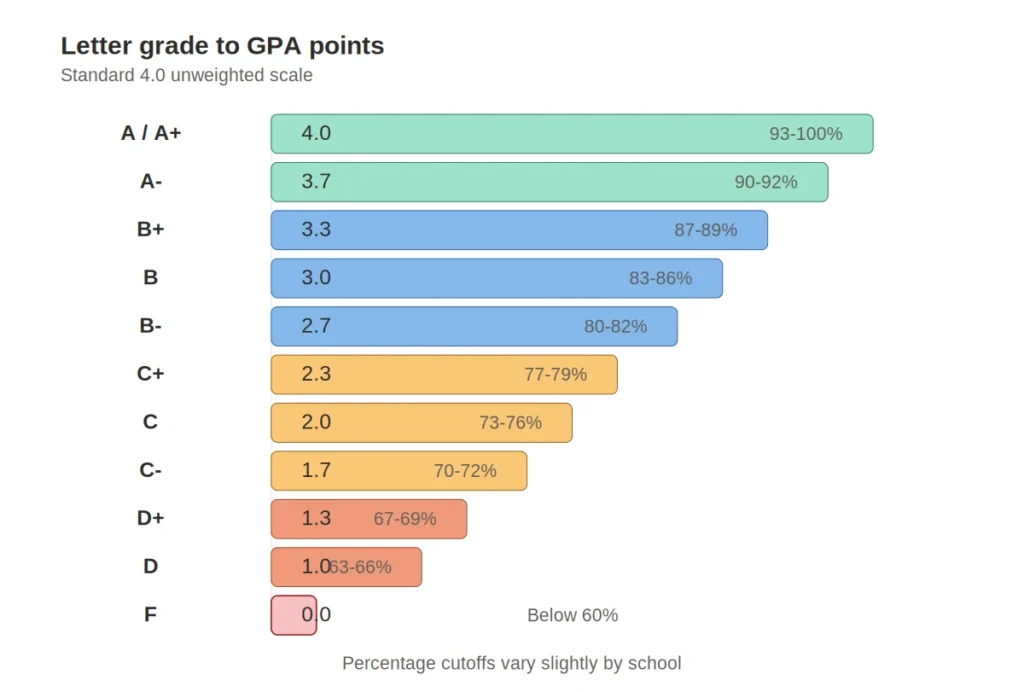
| Letter Grade | GPA Points | Percentage Range |
| A+ / A | 4.0 | 93–100 |
| A- | 3.7 | 90–92 |
| B+ | 3.3 | 87–89 |
| B | 3.0 | 83–86 |
| B- | 2.7 | 80–82 |
| C+ | 2.3 | 77–79 |
| C | 2.0 | 73–76 |
| C- | 1.7 | 70–72 |
| D+ | 1.3 | 67–69 |
| D | 1.0 | 63–66 |
| D- | 0.7 | 60–62 |
| F | 0.0 | Below 60 |
Treat the percentage column as a starting point, not gospel. Some schools draw the line between a B+ and an A- at 88% instead of 90%. Always check the actual handbook before doing anything that matters for an application.
One Transcript, Two Different GPAs
Take five classes from a single semester. Run them through both formulas and watch what happens.
| Course | Level | Letter Grade | Unweighted Points | Weighted Points |
| English | Standard | A | 4.0 | 4.0 |
| Chemistry | AP | A | 4.0 | 5.0 |
| History | Honors | B | 3.0 | 3.5 |
| Spanish | Standard | A | 4.0 | 4.0 |
| Calculus | AP | B | 3.0 | 4.0 |
Unweighted average: 3.6. Weighted average: 4.1. Same five grades. Same student. Half a point of difference, purely from the scoring system giving extra credit for AP Chemistry and AP Calculus over standard-track equivalents.
A 4.1 built this way tells a college something specific: this student chose difficulty and still came through with solid grades. It does not mean this student outperformed a classmate sitting at a flat unweighted 4.0 who never touched an AP course. Both are real, both matter. They’re just not the same achievement, and mixing them up is the exact mistake that confuses half the families going through this process every fall.
Calculating GPA Without a Calculator
Four steps.
Convert every letter grade to its point value. Multiply each by the credit hours that course carries, usually one for high school classes, one to four for college. Add every result together. Divide by the total credit hours.
Weighted GPA follows the same four steps. Only step one changes, AP and IB grades get the extra 1.0, Honors gets the extra 0.5, and the rest of the math runs identically. Calculate weighted and unweighted separately rather than trying to convert one into the other afterward. Rounding errors stack up fast across several semesters, and nobody catches them until the numbers stop matching the school’s official transcript.
Cumulative GPA Carries More Weight Than Any Single Term
Semester GPA covers one term. Cumulative GPA averages every semester a student has completed. Colleges care far more about the second number.
Trajectory matters here, maybe more than the raw average. A student opening freshman year at 2.9 and climbing to 3.7 by senior year tells a completely different story than one who started at 3.7 and slid down to 2.9, even when both four-year averages land in roughly the same place. Counselors notice this immediately. Upward momentum reads as resilience. A downward slide reads as a question someone’s going to ask in an interview, whether it’s fair to ask or not.
The math stays forgiving, at least. One excellent semester lifts a sluggish average. One rough semester rarely sinks an otherwise strong one, since every term carries close to equal weight across four full years.
Why Admissions Offices Care About This Number at All
GPA tracks years. Test scores track one Saturday morning. That gap is the entire reason GPA gets weighted so heavily in admissions, often more than the SAT or ACT.
Ivy League schools publish no official GPA cutoff. Their admitted classes tell the real story anyway. Harvard, Yale, Princeton, and Columbia typically admit students whose recalculated unweighted GPA sits above 3.9. Strong public flagships tend to land in the 3.5 to 3.7 range. Community colleges, open-admission in most states, take students across a far wider spread.
None of this happens in a vacuum, though. A reader checks course rigor against the school profile first, figuring out how many AP or Honors sections were even available before judging whether a student maximized what was in front of them. They track grade trends across four years. They weigh essays, recommendations, and extracurricular depth against the transcript sitting on top of the pile.
A 3.6 built on five AP courses a year often lands better than a 4.0 built entirely on the easiest electives a school offers. That gap, right there, is the whole reason weighted GPA exists.
What Counts as a Good GPA
No single number works everywhere. As a baseline, though: 3.5 unweighted sits comfortably in “strong” territory at most four-year colleges. 3.0 clears the bar at the majority of them.
National average high school GPA hovers around 3.0. Anything meaningfully above that already separates a student from the typical applicant pool. Selective schools push the expectation higher, often past 3.7, and STEM programs at competitive universities push it higher still given how deep the applicant pool runs each cycle.
Scholarships complicate things further. Plenty require a 3.0 or 3.5 minimum, and that requirement doesn’t disappear after the acceptance letter arrives. It has to hold every semester the award stays active. A sophomore-year dip below the line can cost a student funding that took all of freshman year to earn. That’s not a hypothetical. It happens every spring to someone who didn’t realize the requirement was ongoing.
Recovering From a Bad Semester
One weak term doesn’t carve anything in stone. GPA keeps moving with every new grade, which means the worst semester on a transcript matters less with each strong one that follows it.
Go to the teacher before the grade drops, not after. Office hours exist for the student who’s confused in week three, not the one scrambling in week fifteen with a final exam two days away.
Study habits matter as much as raw effort. Rereading notes works fine for a history class. It does almost nothing for a calculus exam that demands practice problems instead, and plenty of students don’t figure that out until a disappointing test result forces the issue.
Choosing a harder class on purpose, instead of retreating to easier electives, tends to pay off twice. It strengthens a weighted GPA directly. It also hands an admissions reader concrete evidence that a student sought out difficulty rather than avoided it. And missed deadlines remain the single most preventable cause of a dropped grade. A basic planner fixes more GPA problems than any tutor ever will.
Frequently Asked Questions
What does GPA stand for?
Grade Point Average. The single number schools use to summarize a student’s performance across every class on a transcript.
What is the highest GPA you can get in high school?
4.0 unweighted. On a weighted scale, most schools cap at 5.0, though the exact ceiling depends entirely on that school’s specific formula.
Is a 6.0 GPA possible?
Yes, at some schools. A 6.0 ceiling only shows up where a district stacks extra weighting on top of standard AP or IB points, usually dual-enrollment college credit. Most weighted scales stop at 5.0. A 6.0 system is the exception, and it says more about that district’s grading policy than it says about the student carrying the number.
Is 5.0 the highest GPA?
For most weighted scales used across the US, yes. 5.0 is the practical ceiling, earned through straight A’s in AP or IB coursework. Some schools set it lower, around 4.5. A few stretch it to 5.3 by separating an A from an A+, or to 6.0 through extra weighting layers. 5.0 is the common ceiling. It’s not a universal one.
Is a 4.5 GPA good for Harvard?
It can be, but the number alone decides nothing. Harvard recalculates every application on an unweighted scale before review, and the typical admitted student clears 3.9 once that happens. A 4.5 earned through a heavy AP or IB course load demonstrates real rigor. The same 4.5 earned with minimal advanced coursework reads very differently once an officer checks it against the school profile.
What GPA is top 1%?
There’s no fixed number. Class size and grading curves shift the threshold from school to school. At most competitive high schools, a near-4.0 unweighted GPA combined with a heavy AP or IB load typically lands a student in the top 1%, but a school with 600 seniors draws that line in a different place than one with 60. The only reliable answer comes from a counselor pulling the actual class rank, not from estimating it off GPA alone.
Learnstiq.com
Every March, parents call me with the same number stuck in their head. A 4.6. Someone mentioned a classmate at another school has it, and now they want to know if their own daughter’s 3.9 means she’s falling behind. She isn’t. A 4.6 sounds impressive until you realize it might mean less than a 3.8 from a tougher school, because the highest GPA depends entirely on whether your scale is weighted or unweighted. Most guides stop at “4.0 is the max” and move on. They don’t tell you that a 4.0 from one school and a 4.6 from another can represent identical performance, just different formulas.
-
What You Actually Pay at Columbia, Harvard, Yale, and Princeton in 2026
Most families look at Columbia University $96,990 annual cost of attendance and close the browser. That reaction is understandable. It is also, for millions of American families, completely wrong. The Ivy League financial aid system does not work the way most people think. These schools award zero merit scholarships — no money for top GPAs, … Read more
-
Yale University: The Complete Guide (2025–2026)
There are universities, and then there is Yale. Sitting in the heart of New Haven, Connecticut, this private research university does not just educate — it shapes the world. As a member of the Ivy League, Yale carries a weight that few institutions can match. Founded in 1701 by Congregationalist clergy of the Connecticut Colony, … Read more
-
The University That Almost Never Existed — And Changed the World Anyway
There is a small detail about Princeton University that most people never think about. When the four founding ministers sat down in 1746 to petition for a college charter, the first governor they approached said no. A flat rejection. If a different man had been in charge that day — if history had turned slightly … Read more




Every article on Learnistiq is written by Shahzaib Khan — an education
researcher who has spent years studying university admissions,
scholarship systems, and online education across Pakistan, the USA,
the UK, and Germany.
Shahzaib started Learnistiq because he saw students making expensive
mistakes — choosing the wrong university, missing scholarship deadlines,
or believing myths about online degrees. This platform exists to fix that.
No AI-generated filler. No copy-paste from official university websites.
Every guide is researched, fact-checked, and written to actually help
you make a better decision.