
Before You Start Reading — An Honest Warning
Most articles about Harvard University are written to impress you, not to inform you.
The letters start with autumn leaves in Harvard Yard they quote a Nobel laureate they list the acceptance rate. They close with something inspirational, about unleashing Harvard potential. Harvard letters are beautifully structured. Harvard letters are mostly useless.
This guide is really different. It is written for people who need to make a decision about Harvard. The decision is about whether to apply to Harvard, whether to pay for Harvard or whether Harvard is worth all the attention it gets. We will talk about things that other top pages do not mention. For example we will discuss the funding problem with Trump that has put billions of Harvard’s research money at risk. We will also talk about the mental health issues on the Harvard campus. Additionally we will look at the financial aid numbers that really change how much Harvard costs for American families.. We will give an honest answer to whether a Harvard degree from Harvard actually gives you what people think it will. We will be honest about what a Harvard degree from Harvard’s really, like.
If you want a cheerleader piece, there are plenty of those. This is something more useful.
Table of Contents
Harvard University at a Glance — Fast Facts 2025–2026
| Detail | Data |
| Location | Cambridge, Massachusetts, USA |
| Founded | 1636 — oldest university in the United States |
| Type | Private Ivy League Research University |
| Undergraduate Enrollment | 7,038 (Fall 2024) |
| Total Faculty | 4,289 |
| Student-to-Faculty Ratio | 7:1 |
| Endowment | ~$53 billion (2024) |
| US News National Ranking | #3 National Universities (2026) |
| QS World Ranking | #4 globally (2025) |
| ARWU Shanghai Ranking | #1 globally — 20+ consecutive years |
| Acceptance Rate | ~3.2% (Class of 2030) |
| Tuition (2025–26) | $57,328–$59,320 |
| Total Cost of Attendance | ~$82,000–$86,000/year |
| Average Net Price (with aid) | ~$15,000–$19,500/year |
| Free for families earning | ≤$100,000/year |
| Tuition-free for families earning | ≤$200,000/year |
What Is Harvard University, Really?
Harvard University is a school that’s private. It is part of the Ivy League. Harvard University is in Cambridge, Massachusetts. It is on the banks of the Charles River. This is three miles west of downtown Boston. Harvard University was started in 1636 by the Massachusetts Bay Colony. The Mayflower arrived at Plymouth sixteen years before that. So Harvard University is the place in the United States where people can get a higher education. Harvard University is really old.
It was named after Reverend John Harvard, a donor. He died in 1638. He left half of his property and 400 books to the college. The library was destroyed in a fire in 1764.. The college grew. Now it has the academic library system. It has over 20 million books in, than 70 libraries.
Today Harvard is a big deal. It has 12 schools that give out degrees. Harvard employs a lot of people. 4,289 Faculty members to be exact. The university also has an endowment of approximately $53 billion, which is the largest in the world. Harvard spends a lot of money on research, more than $1 billion every year. Harvard has produced a lot of successful people including 8 presidents of the United States. Harvard has also produced 188 billionaires, which’s a lot of rich people. Then there are the 162 people who won the Nobel Prize, 48 people who won the Pulitzer Prize and 359 people who are Rhodes Scholars. Harvard is clearly a good school.
Those numbers are not marketing. They are the accumulated output of nearly four centuries of concentrated intellectual activity. And yet — as we will explore honestly throughout this guide — they do not answer the only question that matters for you: is Harvard the right place for your specific goals?
Harvard Rankings 2025–2026 — What the Numbers Actually Mean
Harvard is not at the top of every list just because it is Harvard. It is at the top because of things that can be measured. For example Harvard does a lot of research. It has a lot of research output per faculty member. People around the world think Harvard is a great school so it does well on global academic reputation surveys. Employers also think Harvard is a school so it gets good employer reputation scores.. Harvard faculty members are often cited by other people, which is why it has high faculty citation rates. Harvard is at the top because of these things like its research output, per faculty member and its faculty citation rates.
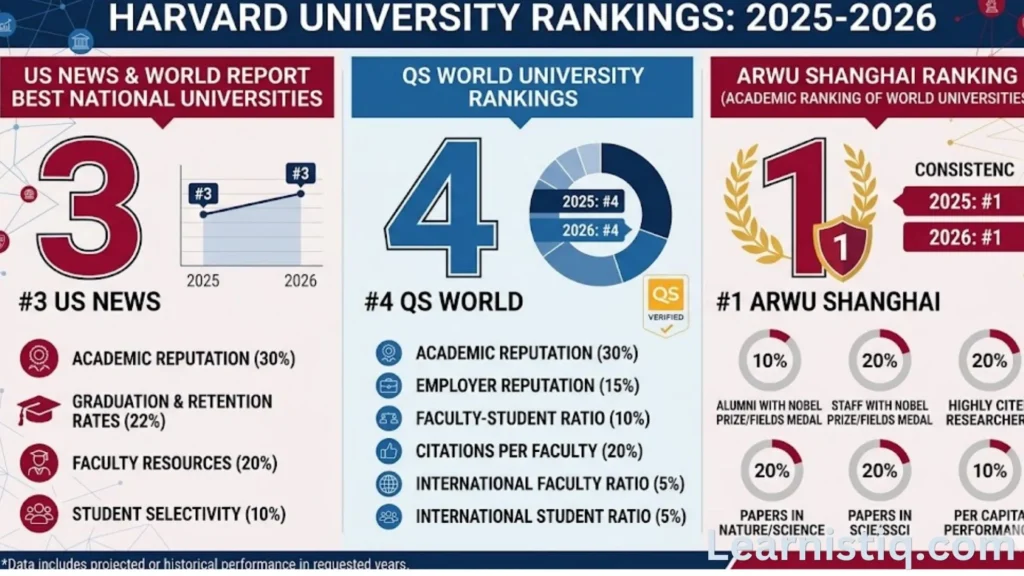
According to US News Best Colleges 2026, Harvard is at the number three spot among National Universities. This is a little lower than its number one spot in the past. The reason for this change is that the system they use to rank schools is different now. It gives importance to Harvard and other schools that help students move up in the world. Harvard is also at the number two spot in Best Value Schools. This is a surprise to a lot of people who think Harvard is a very expensive school. People usually think about the cost of Harvard, not what you get for your money.
In the QS World University Rankings 2025, Harvard ranks number 4 in the world. It is behind MIT, Imperial College London and the University of Oxford. In the Academic Ranking of World Universities. Which many people think is the fair ranking. Harvard has been number 1 for a long time. Over twenty years. This ranking uses things like research papers and studies to make its list, not just what people think. Harvard University keeps getting marks in this ranking every year.
What really sets Harvard apart in rankings is not where it stands overall. How good it is in specific areas. In the QS Subject Rankings for 2025 Harvard is number one in the world for Life Sciences and Medicine Social Sciences and Management and Arts and Humanities. Harvard is also one of the best in the world for Economics, Law, Medicine, Biology, History and Political Science. It is either first or in the three for these subjects. Harvard is really good at a lot of things. This is something that no other university, including MIT or Stanford can do at the same time.
The thing about rankings is that they are really about how good a school’s how much research they do. They do not tell you if you will be happy at that school if the people there are like you or if they teach the things you want to learn in a way. For example if you really love biology you might find that the Scripps Institution of Oceanography is a great place to learn because they have a lot of good research going on. Rankings are one thing to think about; they are not the only answer. Marine biology students might find that the Scripps Institution of Oceanography has a lot to offer and that is something to consider when thinking about marine biology programs.
Harvard Acceptance Rate 2026 — The Real Numbers
Let us be direct about something most articles dance around: getting into Harvard is not just difficult. For most applicants, it is statistically near-impossible, and that reality should inform your strategy from the beginning.
For the Class of 2030, Harvard received 57,786 applications and offered admission to approximately 1,850 students — an acceptance rate of roughly 3.2%. The most recently confirmed acceptance rate, for the Class of 2029, was 4.2%, based on 54,008 applications and 1,970 admissions.
This year, Harvard made news by choosing not to publish official admissions statistics on decision day — the second consecutive year the university has withheld these numbers at the time of decision release. According to Harvard’s own admissions office, statistics are now published once annually in the fall after enrollment is finalized.
The breakdown by applicant type is striking:
For the 2024–2025 cycle, Massachusetts in-state applicants had an acceptance rate of approximately 8% — high by Harvard’s standards, likely attributable to legacy students, children of faculty, and the concentration of elite preparatory schools in the region. Out-of-state domestic applicants faced an acceptance rate of roughly 4%. International students faced the most selective process of all, at approximately 1.9%.
What admitted students actually look like:
To get into Harvard you usually need an SAT score between 1520 and 1580. For the ACT it is between 34 and 36. Most of the time Harvard students are in the 5 percent of their high school class. Harvard does not tell you what the lowest GPA is that you need to get in. This is because Harvard does not really use GPA to decide who gets in.. Most students who get into Harvard are near the top of their class when it comes to grades. The students at Harvard have good grades and very good test scores. These are Harvard grades and Harvard test scores.
What really matters is that Harvard looks at the person when they decide who to let in. They read every application at least two times and they have people who work on this. There is no number that you have to get on a test to get in. The people at Harvard are trying to make a group of students who’re smart and different. They do not just pick the students who got the best scores. If you got a 1580 on the SAT but that is all you did you will probably not get in.. If you got a 1520 on the SAT and you also did something really cool like starting a community group or doing some new research or being a leader in a way that is not typical then you have a good chance of getting into Harvard. Harvard is looking for students like this because they want to make a class that’s interesting and smart.
The admissions committee wants to know one thing: what has this person actually done with the opportunities they had. It is not about what chances they got. It is about what they did with what they had. The admissions committee is looking at what this person did with the opportunities, to them.
Harvard Admissions Process — How to Apply in 2026
Harvard uses the Common Application platform to accept applications. The Harvard Supplement is also used, which has essays and questions that are specific to Harvard. Harvard does this differently than European university systems. At Harvard they do not have ranked lists. They do not have standardized score thresholds or automatic GPA calculators. Harvard uses a review when they look at applications. They review the Harvard applications in a way. Harvard looks at the application for Harvard.
Key application components:
- Common App personal essay
- Harvard supplemental essays (answers to Harvard-specific questions)
- Two academic teacher recommendations
- One secondary school counselor recommendation
- Official high school transcripts
- Standardized test scores — SAT or ACT (Harvard is currently test-flexible, not test-blind)
- Extracurricular activity list and any additional materials
Application timeline:
Harvard offers Restrictive Early Action (REA), with a deadline of November 1. REA is non-binding — you are not committed to attend if admitted — but it restricts you from applying Early Decision or Early Action to other private universities. REA historically carries a meaningfully higher acceptance rate than Regular Decision. Results are released in mid-December.
Regular Decision applications are due January 1. Results are released on Ivy Day in late March/early April, when all Ivy League schools release decisions simultaneously.
One thing that distinguishes competitive Harvard applications is depth over breadth in extracurricular activities. Harvard is not impressed by a list of 15 clubs where a student was a passive member. They want to see sustained, meaningful commitment — ideally leadership, ideally impact — in fewer activities. A student who spent three years building a tutoring program that served 200 students in their community tells a more compelling story than a student who joined every honor society available to them.
Harvard Tuition and Cost of Attendance 2025–2026
The sticker price at Harvard is high, and there is no value in pretending otherwise.For the school year 2025 to 2026 Harvard tuition is around $57,328 to $59,320. When you add the cost of a place to live which’s about $13,532 and the cost of food and Harvard dining and other Harvard student services fees and Harvard health services the total cost of going to Harvard is around $82,000 to $86,000 per year.
The cost of attending Harvard is a lot for families and when they see this number they get upset and they think that Harvard is too expensive for them to afford. That assumption is almost always wrong. And it may be the single most important misconception about Harvard that exists.
Harvard Financial Aid — The Numbers That Change Everything
In March 2025, Harvard University President Alan M. Garber and Dean of the Faculty of Arts and Sciences Hopi Hoekstra announced a significant expansion of Harvard’s financial aid program, effective from the 2025–2026 academic year. The announcement fundamentally changes the financial case for Harvard for most American families.
Harvard’s financial aid thresholds (2025–2026), official:
According to Harvard’s official financial aid announcement:
- Families earning $100,000 or less per year: Harvard is essentially free. Tuition, housing, food, health insurance, and travel are all covered. Students in this bracket also receive a $2,000 grant in their first year and another $2,000 during their junior year.
- Families earning $200,000 or less per year: Harvard is tuition-free. Room and board costs still apply, but the $57,000+ annual tuition is covered entirely by grant.
- Families earning above $200,000: Financial aid is available on a sliding scale based on family income, assets, and household size.
Harvard estimates that approximately 86% of U.S. families qualify for some form of financial assistance under this expanded framework.
The average scholarship or grant that Harvard students get based on need is seventy two thousand eight hundred eighty four dollars. The average price that students have to pay after they get aid is around fifteen thousand dollars to nineteen thousand five hundred dollars every year. This is actually lower than what students have to pay to go to some universities even if they are from the same state as the university. Harvard students get a good deal.
Harvard’s annual budget for helping students with money for the 2025 to 2026 year is 275 million dollars. Harvard has given students over 3.6 billion dollars to help with school costs since the year 2004 through the Harvard Financial Aid Initiative, at Harvard. The program is entirely need-based — Harvard does not award athletic scholarships or merit scholarships of any kind.
Critically, Harvard’s financial aid is delivered as grants, not loans. The university covers 100% of demonstrated financial need without requiring students to take on debt for that assistance.
For international students: Harvard’s need-blind admissions policy extends to international students. All students — domestic and international — pay the same tuition rate regardless of citizenship or country of origin. International students are eligible for the same need-based aid as domestic students.
The truth is, if your family makes more than $200,000 every year the reason that Harvard is too expensive is not really a problem. For families that make more than $200,000 it is a bit harder to figure out.. Harvard still usually costs a lot less than what people think it does.

Harvard vs. Trump Funding War — What Prospective Students Must Know
This is the section you will not find on most Harvard guide pages, because most were written before 2025 or have simply chosen to ignore the biggest story in Harvard’s recent history. If you are considering Harvard right now, you need to understand what has been happening.
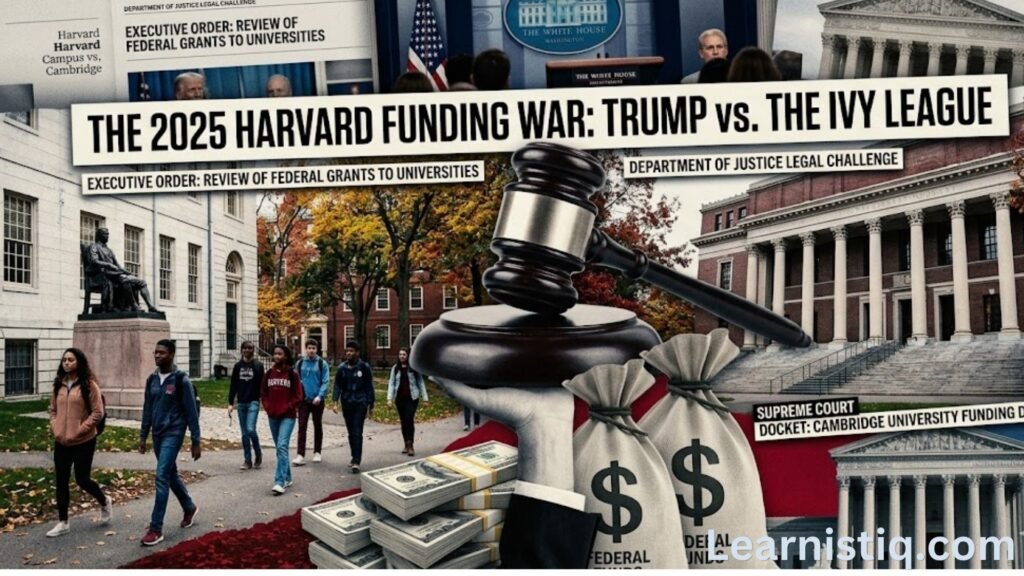
In March 2025, the Trump administration placed $8.7 billion in federal grants and $256 million in contracts for Harvard under review, citing allegations of antisemitism on campus following the Gaza war protests of 2023–2024. According to the Columbia Daily Spectator, by mid-May 2025 the value of Harvard’s frozen or terminated grants had grown to approximately $3 billion.
Harvard’s President Alan Garber did not agree with what the administration asked him to do on April 11 2025. They reportedly wanted him to change some things about how the school’s run, who gets in and what classes are offered. Harvard then took the Trump administration to court on April 21 2025. They said that freezing their funds was not fair because it broke the First Amendment and they did not follow the steps to do it. Harvard and President Alan Garber were really upset about this.
On September 3 2025 U.S. District Judge Allison Burroughs made a decision that was 84 pages long. She decided in favor of Harvard. This decision stopped the Trump administration from holding back more than $2 billion in federal research grants that Harvard was supposed to get. The court said the Trump administration was wrong to single out Harvard like that. The Trump administration did this because Harvard was doing things that the First Amendment says are okay to do. The court said this was not a reason for the Trump administration to withhold the federal research grants from Harvard. Harvard was going to use these research grants to do important research.
The Trump administration appealed that ruling in December 2025. As of this writing, the dispute remains ongoing. CNN reported in February 2026 that Trump demanded a $1 billion settlement payment from Harvard to restore federal funding — a demand Harvard rejected.
What this means for prospective students:
The direct impact on undergraduate programs has been limited so far. Harvard’s $53 billion endowment provides a substantial financial cushion that most universities do not have. However, Harvard Magazine reported that the Faculty of Arts and Sciences has already suspended non-essential capital projects and is restructuring administrative operations to reduce costs. There have been staff layoffs across the university.
The thing is, this situation is really about politics. Harvard is right in the middle of a discussion about how free students and teachers are to say what they think, what people can say on campus and how universities and the federal government work together. This is not something that people talk about, it affects the students. It affects what the campus is like, how much money is available for research in areas like medicine and public health that rely on the government and how tense things are on campus. Harvard and the students are really feeling this.
No other Harvard guide currently addresses this directly. You deserve to know before you apply.
Harvard University Programs — What You Can Actually Study
Harvard operates 12 degree-granting schools and offers more than 3,700 courses across 50+ undergraduate concentrations and 135+ graduate degree programs.
Harvard College — the undergraduate division does not use the word “. It uses “concentrations”. They choose it at the end of their year. This is after they finish two years of education classes. These classes cover humanities, social sciences, natural sciences and math. Harvard wants its graduates to be able to think about subjects. They do not want people who only know one area. They want people who can think across areas.
The most popular and most selective concentrations:
Economics : The Harvard Economics program is really tough to get into. It is the best program that Harvard has to offer. This program is about theory and math. It is very hard. A lot of people who finished the Harvard Economics program have gone on to do big things. They have helped make rules for money around the world, started investment companies and built some of the most important places that deal with money. If you want to know how the people in charge the government and regular people affect the economy then the Harvard Economics program is the place to learn.
Computer Science, centered on the famous CS50 introductory course taught by David Malan — consistently the most-enrolled course at Harvard and one of the most-watched educational courses online — feeds directly into Silicon Valley’s most competitive companies. Harvard CS graduates are routinely hired by Google, Apple, Meta, and early-stage startups at the highest levels.
Government : The Government program at Harvard is what they have for people who like politics. It has turned out a lot of people like senators and secretaries of state and ambassadors and even presidents. The Government program at Harvard has had a lot of people graduate from it like Barack Obama but what the Government program at Harvard does for the world is a lot bigger than just one person, like Barack Obama and the Government program, at Harvard.
Biology and Pre-Med programs at Harvard University are really good at getting students into Harvard Medical School, which’s one of the best medical schools in the world. The Pre-Med program at Harvard is very tough. The students really have to compete with each other to get good grades.. The Biology and Pre-Med programs at Harvard give students a lot of chances to do research and work with great teachers, which helps them get ready for medical school in a way that few other schools can.
Harvard Business School (HBS) —l is really well known. It is probably the most famous business school in the world. Harvard Business School is different from business schools because Harvard Business School wants people to have worked for several years before they can go there. The teachers at Harvard Business School use a way of teaching that involves looking at real business situations. When people graduate from Harvard Business School they usually get high paying jobs. The starting salaries for Harvard Business School graduates are usually among the salaries in the world.
Harvard Law School, Harvard Medical School, and Harvard Kennedy School of Government round out the professional school lineup that gives Harvard its extraordinary breadth across fields.
Harvard Campus Life — The Reality Behind the Brochure
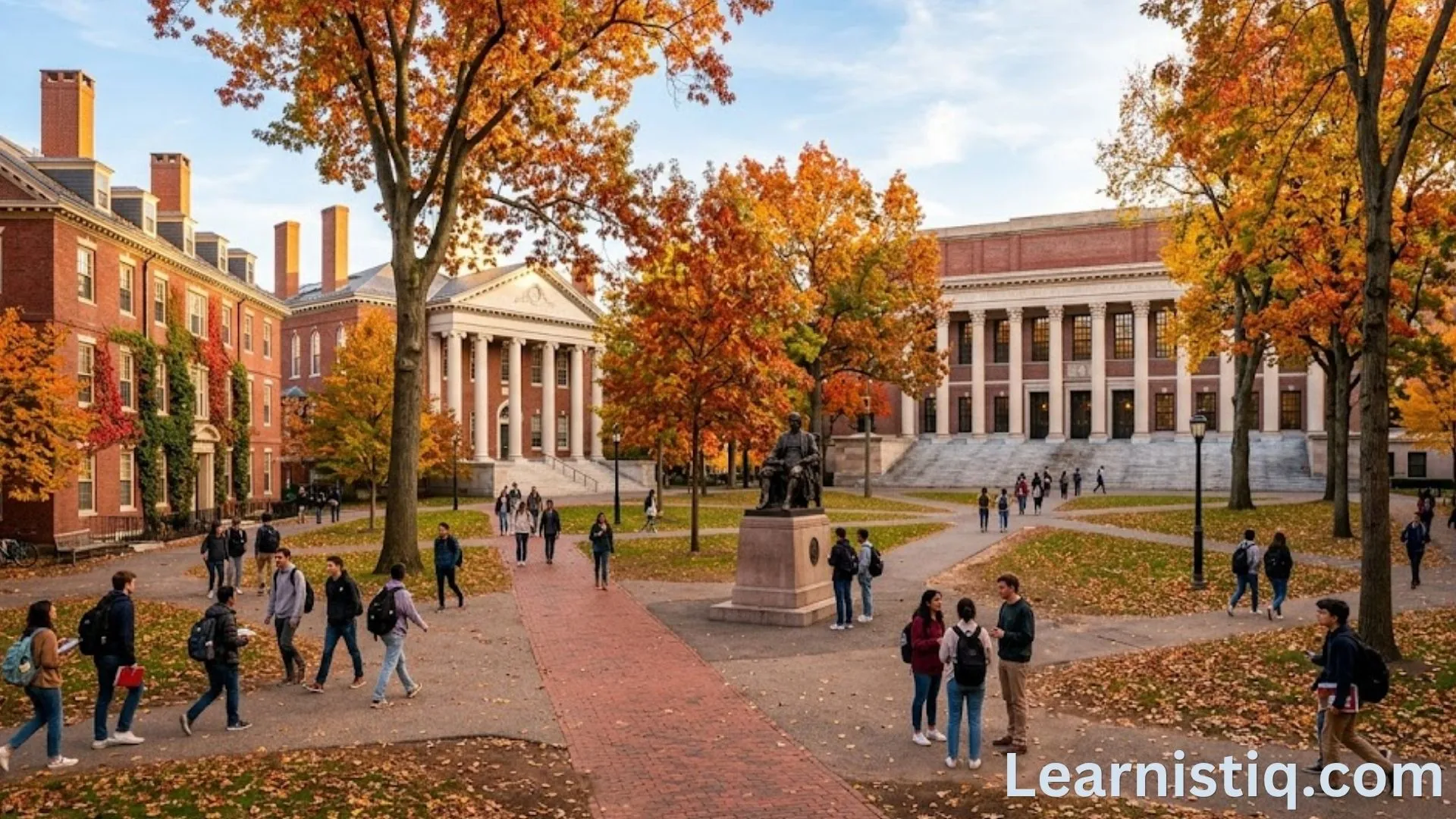
The Harvard campus is really big. It covers 5,603 acres in Cambridge and Boston. Harvard Yard is in the middle of it all. This place is special. It has red brick buildings that were around during the American Revolution. When you see the Harvard Yard in person it is just as amazing as it is in pictures. You will see Harvard students eating lunch and studying on their phones. This makes the Harvard Yard a place that is both very old and very much about people, the Harvard students at the same time.
The house system at Harvard is really something. When students are done with their year in the dorms around Harvard Yard they get to move into one of the 12 houses. These Harvard houses are pretty big. They are located along the Charles River. Each Harvard house has its place to eat and spaces for people to hang out. The people who live in each Harvard house become like a family. There is a big day called Housing Day when the first year students find out which Harvard house they will be living in. This Housing Day is a deal, on campus. The Harvard houses make it feel like people are part of something more close knit within the big university.
The student to faculty ratio at Harvard is 7 : 1 which’s really important, it is not just a number. Harvard has a lot of opportunities for students to do research and they really want students to do it. Students get to work with people who have won the Nobel prize. It is normal for students to do research for their thesis. The faculty members actually have office hours that students attend. You do not find this kind of access to faculty members at a lot of universities that are similar to Harvard.
The Widener Library — Harvard’s main library, located in Harvard Yard — is one of the largest in the world. Students have access to more than 20 million volumes across 73 libraries. For a serious intellectual, this resource is almost difficult to overstate.
The social scene at Harvard needs to be looked at . Harvard has a social system that has been around for a long time and is affected by groups that are very exclusive. Especially the final clubs. These clubs are groups that have been around for centuries. They are not officially part of Harvard. They have a big impact on social life on campus. People have criticized these clubs times for only allowing certain people to join for being elitist and for making it seem like some students are better than others just because of who they are or where they come from. Harvard has tried to limit the power of these clubs with rules but the final clubs are still around. The social landscape at Harvard is shaped by these clubs and by tradition. This is something that Harvard needs to think about.
For students who arrive from modest backgrounds, from first-generation college families, or from outside the American elite-prep-school pipeline, navigating Harvard’s social environment can be genuinely disorienting at first. The intellectual environment is welcoming. The social hierarchy is less straightforwardly so.
Mental health at Harvard is a real conversation. Multiple studies have documented elevated rates of anxiety and depression among Harvard undergraduates, and the Harvard Student Mental Health Task Force has produced detailed reports on the pressure culture. A 2023 survey found that over 60% of Harvard undergraduates reported feeling overwhelmed by their academic workload at some point during the academic year. Harvard Counseling and Mental Health Services (CAMHS) has expanded capacity significantly, but demand consistently outpaces supply.
This is not unique to Harvard — it is a feature of elite universities generally. But the intensity at Harvard, combined with the implicit expectation that you should be thriving because you are at Harvard, can make it harder for students to acknowledge when they are struggling. Knowing this before you arrive matters.
Harvard University Notable Alumni — People Who Changed Everything
The list of Harvard alumni is really long. It makes you wonder: does Harvard’s education make them successful? Are they already super talented when they get in?
The honest answer is probably both.
In politics: The United States has had eight presidents who went to Harvard including John F. Kennedy and George W. Bush. Barack Obama who was the first Black president of the Harvard Law Review. This is a deal because Barack Obama was the first Black person to do this. Barack Obama became the 44th President of the United States. This is important because it shows that things are changing, in a place like Harvard, which is a very elite institution in America. The fact that Barack Obama was able to do this says a lot about how we have come.
In technology: Mark Zuckerberg started Facebook from his dorm room in Kirkland House in 2004. Mark Zuckerberg left Harvard before he finished school just like Bill Gates did. Bill Gates co-founded Microsoft. Made it one of the most successful companies ever. What we can learn from Mark Zuckerberg and Bill Gates is that Harvard is a place for new ideas to grow or that really talented people, like Mark Zuckerberg and Bill Gates will do well no matter what. It is probably a bit of both.
In science: J. Robert Oppenheimer went to Harvard to learn about physics before he was in charge of the Manhattan Project. People who went to Harvard and the teachers at Harvard have won a total of 162 Nobel Prizes, which’s more than a lot of countries. The number of discoveries made by people who studied at Harvard is really amazing and it has never happened before at any other university.
In business: The Harvard alumni network has a lot of people in it. Over 371,000 graduates from 190 countries. This network includes 188 billionaires which’s more than what you can find in any other university in the world. The Harvard alumni network is really useful. It is not a name. The Harvard alumni network actually helps graduates meet each other. This happens across generations and industries. The Harvard alumni network provides advantages to Harvard graduates when it comes to their jobs and careers. The Harvard alumni network is very helpful to Harvard graduates.
Harvard Career Outcomes — What Actually Happens After Graduation
Harvard’s overall graduation rate stands at 97%, placing it in the top 5% of all United States . institutions. The retention rate — students who continue from freshman to sophomore year — is 99%.
Career outcomes are consistently strong across schools. Harvard Business School reports that 95% of graduating students receive job offers, with 90% accepted. Starting salaries for HBS graduates place Harvard consistently among the top schools in median post-graduate earnings.
More broadly, the Harvard credential creates a floor of professional opportunity that is real and documented. Employers in finance, consulting, technology, law, and medicine recruit at Harvard with intensity. The brand recognition opens doors before a conversation even begins.
The important caveat: a Harvard degree does not guarantee a meaningful career. It creates access. What you do with that access is entirely your own decision.
Honest Pros and Cons of Harvard University
| What Works in Your Favor | What You Should Weigh Honestly |
| Alumni network of 371,000+ graduates across 190 countries — real mentorship and real doors, not just a name on a resume. | The competition is psychologically intense. Most students have never not been the smartest person in the room. That changes fast. |
| Undergraduate research access that most universities reserve for grad students. Working with world-leading researchers here is routine, not exceptional. | Final clubs and social hierarchies sit awkwardly against an institution that claims to select on merit. First-gen and non-prep-school students notice this. |
| Financial aid is more generous than the sticker price suggests. For families under $100K, it’s effectively free. 86% of American families pay less than the listed cost. | Federal research funding is genuinely uncertain right now. If you’re heading into medicine, public health, or basic sciences at the graduate level, this matters. |
| Real interdisciplinary breadth. A computer scientist takes humanities. A historian learns quantitative reasoning. The curriculum is designed to widen how you think, not just deepen one track. | Cambridge is expensive. Aid covers tuition and official costs — it doesn’t fully account for what life in the Boston area actually costs day to day. |
| The intellectual culture is hard to replicate. Being surrounded by people who take ideas seriously changes how you think about ideas. | The Harvard name follows you permanently — as motivation or as pressure, depending on who you are. Worth being honest with yourself about that before you commit. |
Harvard vs. MIT vs. Stanford — The Honest Comparison
This question comes up constantly, and the honest answer is: it depends entirely on what you want to study and what kind of environment you want to live in.
MIT dominates STEM fields — particularly engineering, computer science, and applied sciences — in ways that Harvard does not. MIT’s culture is intensely technical and deeply practical. If your goal is to build things, solve engineering problems, or work at the intersection of technology and science, MIT is the most competitive environment on earth for that purpose.
Stanford occupies a unique position at the intersection of academia and Silicon Valley entrepreneurship. Stanford’s proximity to the tech industry creates a startup culture that Harvard cannot replicate from Cambridge. If your goal is to found a company in tech, Stanford’s network and culture provide advantages that are specific and real.
Harvard dominates in fields where breadth, writing, and intellectual range matter most: law, government, medicine, business, economics, history, and the humanities. Harvard produces more Rhodes Scholars, more U.S. Senators, more Fortune 500 CEOs, and more published authors than either MIT or Stanford.
The oversimplified version: MIT and Stanford have deeper roots in technology and entrepreneurship. Harvard has broader roots across more fields, with particular strength wherever leadership, writing, and interdisciplinary thinking matter most.
Is Harvard University Worth It? A Real Answer
Every prospective student eventually asks this question, and deserves a real answer rather than an inspirational non-answer.
The financial question: If your family qualifies for need-based aid — and with the new $200,000 income threshold, most American families do — then the financial case for Harvard is genuinely strong. You are receiving the most credentialed undergraduate education in the world at a net price that is competitive with many state universities.
If you are paying the full sticker price of $82,000–$86,000 per year without aid — roughly $330,000 for four years — the calculation is more complex. Harvard graduates do command higher lifetime earnings on average than graduates of most other institutions. But the premium over a strong public university, calculated honestly over a lifetime, is narrower than the prestige gap implies. The $330,000 question is real.
The fit question: Harvard’s environment rewards students who are intellectually curious, self-directed, resilient under pressure, and comfortable competing at the highest level. Students who arrive primarily because of the brand, without genuine intellectual engagement or a clear sense of what they want to do there, tend to get less from the experience than those who arrive ready to use every resource the institution offers.
The realistic probability question: With a 3.2% acceptance rate, the statistical reality for most applicants is that Harvard will not admit them regardless of how exceptional they are. A student who builds their entire college list around Harvard and treats all other applications as backup plans is making a strategic mistake. Harvard should be one option on a well-constructed list that includes multiple schools where you would genuinely thrive.
The honest summary: Harvard is worth it when the fit is right, the financial aid makes it accessible, and the student arrives with clear intentions and genuine intellectual hunger. It is not the right choice simply because the name is the most recognizable one on earth. The name opens doors. Your choices determine what you find behind them.
Frequently Asked Questions
What is Harvard’s acceptance rate in 2026?
Approximately 3.2% for the Class of 2030. The most recently confirmed figure (Class of 2029) was 4.2%.
What GPA do you need to get into Harvard?
No minimum GPA exists officially. In practice, admitted students rank in the top 5% of their high school class.
Is Harvard free for low-income students?
Yes. Starting 2025–2026, Harvard is essentially free for students from families earning $100,000 or less annually, including tuition, housing, food, health insurance, and travel.
What is Harvard’s tuition in 2025–2026?
Tuition is $57,328–$59,320. Full cost of attendance including housing and living expenses is approximately $82,000–$86,000. With need-based aid, the average net price is $15,000–$19,500 for aid recipients.
Does Harvard give merit scholarships?
No. All financial aid at Harvard College is strictly need-based.
What is the Harvard vs. Trump lawsuit about?
In 2025, the Trump administration froze approximately $3 billion in Harvard’s federal research funding over allegations of campus antisemitism. Harvard sued the administration, and a federal judge ruled in Harvard’s favor in September 2025. The case is under appeal as of mid-2026.
Can international students get financial aid at Harvard?
Yes. Harvard’s need-blind policy and financial aid program apply to international students. All students pay the same tuition regardless of citizenship.
How does Harvard’s campus life compare to other Ivy League schools?
Harvard has a larger campus and more graduate schools than most peers. The residential house system creates a strong community. Social life is heavily influenced by final clubs and informal hierarchies that some students find welcoming and others find exclusionary.
Useful Official Links
- Harvard College Official Website
- Harvard Admissions — Apply
- Harvard Financial Aid Office
- Harvard Net Price Calculator
- Harvard Common Data Set 2024–2025
- QS World University Rankings — Harvard Profile
- US News Harvard Profile
- Harvard Crimson — Student Newspaper
- Harvard CS50 — Free Online Course
- Common Application
-
The University That Almost Never Existed — And Changed the World Anyway
There is a small detail about Princeton University that most people never think about. When the four founding ministers sat down in 1746 to petition for a college charter, the first governor they approached said no. A flat rejection. If a different man had been in charge that day — if history had turned slightly … Read more
-
Stanford University: Is It Free for Most Families? (2026)
There is a moment in Stanford’s founding story that most university guides skip entirely. It is June 1893. Leland Stanford — railroad baron, former Governor of California, United States Senator — dies at his estate. He is 68 years old. He leaves behind a university that is only two years old, an estate buried under … Read more
-
Stanford University Free Online Courses 2026: Which Are Actually Worth Your Time?
Stanford university has hundreds of free online courses in 2026, and most people who start one never finish — not because the course is bad, but because nobody told them upfront what they were signing up for, which certificate actually matters, or whether they chose the right course for their goal in the first place. … Read more


Every article on Learnistiq is written by Shahzaib Khan — an education
researcher who has spent years studying university admissions,
scholarship systems, and online education across Pakistan, the USA,
the UK, and Germany.
Shahzaib started Learnistiq because he saw students making expensive
mistakes — choosing the wrong university, missing scholarship deadlines,
or believing myths about online degrees. This platform exists to fix that.
No AI-generated filler. No copy-paste from official university websites.
Every guide is researched, fact-checked, and written to actually help
you make a better decision.