
There is a moment in Stanford’s founding story that most university guides skip entirely.
It is June 1893. Leland Stanford — railroad baron, former Governor of California, United States Senator — dies at his estate. He is 68 years old. He leaves behind a university that is only two years old, an estate buried under federal lawsuits worth more than $15 million, and frozen assets that immediately cut off all income to the institution he built in memory of his dead son.
Every advisor around Jane Stanford tells her the same thing: shut it down temporarily. Wait for the legal proceedings to settle. Protect what is left.
Jane Stanford goes into seclusion for two weeks. Then she calls the university’s first president, David Starr Jordan, into a meeting and says four words that would define the next century: “The university will continue.”
She proceeds to fund the entire institution — faculty salaries, operations, construction — out of her personal monthly allowance of $10,000 granted by the probate court. She does this for five years, until the federal lawsuit is resolved and the estate is freed. Not a single department closes. Not a single professor leaves. The woman who never attended a university herself keeps one of America’s most ambitious educational institutions alive through pure force of will.
That story is not in most Stanford brochures. But it is the story that explains everything about what Stanford became.
Quick Reference: Stanford University 2025–2026
| Category | Detail |
| Full Name | Leland Stanford Junior University |
| Location | Stanford, California (near Palo Alto, Silicon Valley) |
| Type | Private Research University |
| Founded | 1885 — first students enrolled October 1, 1891 |
| Campus Size | 8,180 acres |
| Total Students | ~17,000 |
| Undergraduate Enrollment | ~7,200 |
| Graduate Enrollment | ~10,000+ |
| Number of Schools | 7 |
| Acceptance Rate | 3.61% (Class of 2028) |
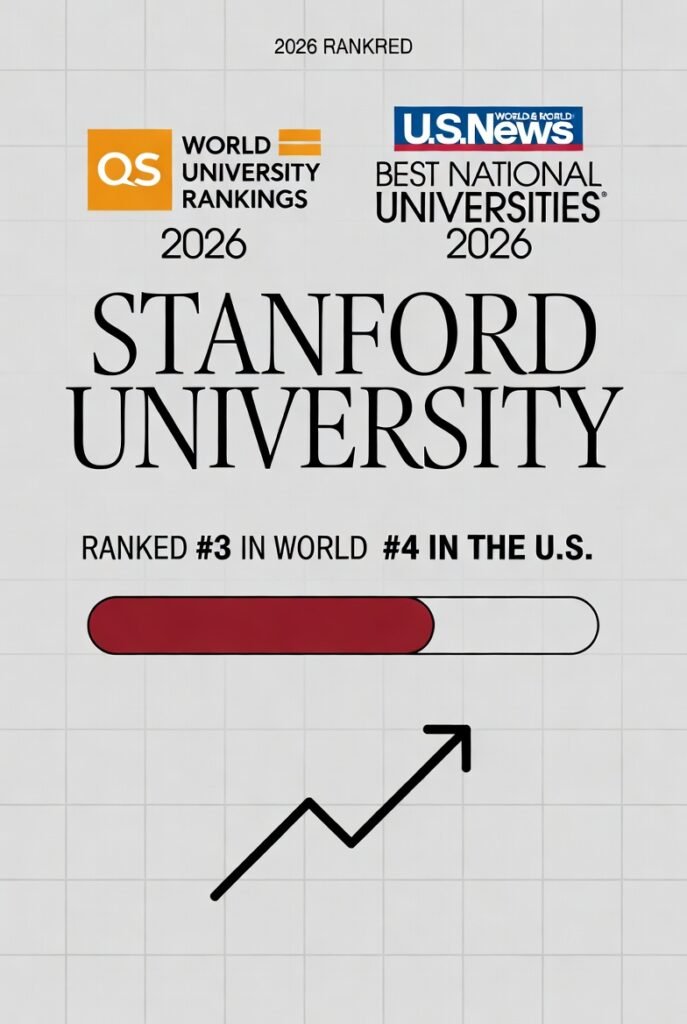
| QS World Ranking (2026) | #3 |
| U.S. News National Ranking (2026) | #4 |
| Student-to-Faculty Ratio | 6:1 |
| Undergraduate Tuition (2025–26) | $64,890/year |
| Total Cost of Attendance | ~$91,400–$96,513/year |
| Families Earning Under $100K | $0 — no tuition, no room, no board |
| Average Grant Aid | $70,349/year |
| Students Receiving Scholarship | ~60% |
| Nobel Laureates (faculty/alumni) | 36+ |
| Motto | Die Luft der Freiheit weht (“The wind of freedom blows”) |
Table of Contents
The History: From a Grieving Family to a Global Powerhouse
A University Born From Loss
Leland Stanford Jr. died in Florence in 1884. He was fifteen years old, traveling Europe with his parents, when typhoid fever killed him. His parents had no other children.
His father was one of the most powerful men in America at the time. He had helped build the transcontinental railroad — the Central Pacific line that met the Union Pacific at Promontory Summit in 1869. He had served as Governor of California and was a U.S. Senator when his son died. The money, the influence, the connections — none of it was useful in that moment.
Leland and Jane Stanford decided to build a university in their son’s memory. They signed the founding grant in 1885. The institution was named Leland Stanford Junior University — after the boy, not the father.
From the beginning, two things separated it from most universities of that era. It had no religious affiliation and imposed no denominational requirements on students. And it admitted women alongside men from the very first class. In 1891, when the doors opened, those were not common policies at major American universities.
The first class had 555 students. One of them was Herbert Hoover, who would later serve as the 31st President of the United States. On that first day, he was simply one of hundreds of young people walking into a university that two parents had built because they had lost their son and needed somewhere to put their grief.
The Architecture of a Dream
To design their campus, the Stanfords hired Frederick Law Olmsted — the same landscape architect who had designed New York’s Central Park and the Cornell University campus. But Olmsted and Leland Stanford did not agree on much. Olmsted proposed an informal, park-like setting with curving roads and separate buildings tucked into the natural landscape. Stanford wanted something more monumental — a place that announced itself.
The result was a compromise that became iconic. The campus was built in California Mission Revival style: rough-hewn sandstone quarried locally, deep red-tiled roofs, arched colonnades connecting building to building, and a Main Quadrangle framing Memorial Church as its focal point. Leland Stanford specified the vision in the founding grant with unusual precision — he wanted buildings “like the old adobe houses of the early Spanish days; one-storied, with deep window seats and open fireplaces, and roofs covered with familiar dark red tiles.”
The Inner Quad’s twelve single-story buildings were completed in time for the 1891 opening. The Outer Quad was completed between 1898 and 1906 — after the estate finally cleared probate, thanks to Jane’s years of personal financial management.
Then, on April 18, 1906, the San Francisco earthquake struck. It was one of the most powerful earthquakes in recorded American history. At Stanford, Memorial Church was nearly destroyed. The newly built library — which had never been used — collapsed completely. The gymnasium fell. The Memorial Arch, a 100-foot landmark at the entrance to the Quad, was reduced to rubble. Most buildings of the Inner Quad survived due to the deep foundations Senator Stanford had specified during construction, but the university’s physical identity was shattered almost overnight.
Rebuilding took years and reshaped the campus permanently. Some original features of the Quad and the Church were never restored to their pre-earthquake form. The destruction also forced Stanford’s engineers to understand seismic risk more rigorously — lessons that influenced California construction standards for decades afterward.
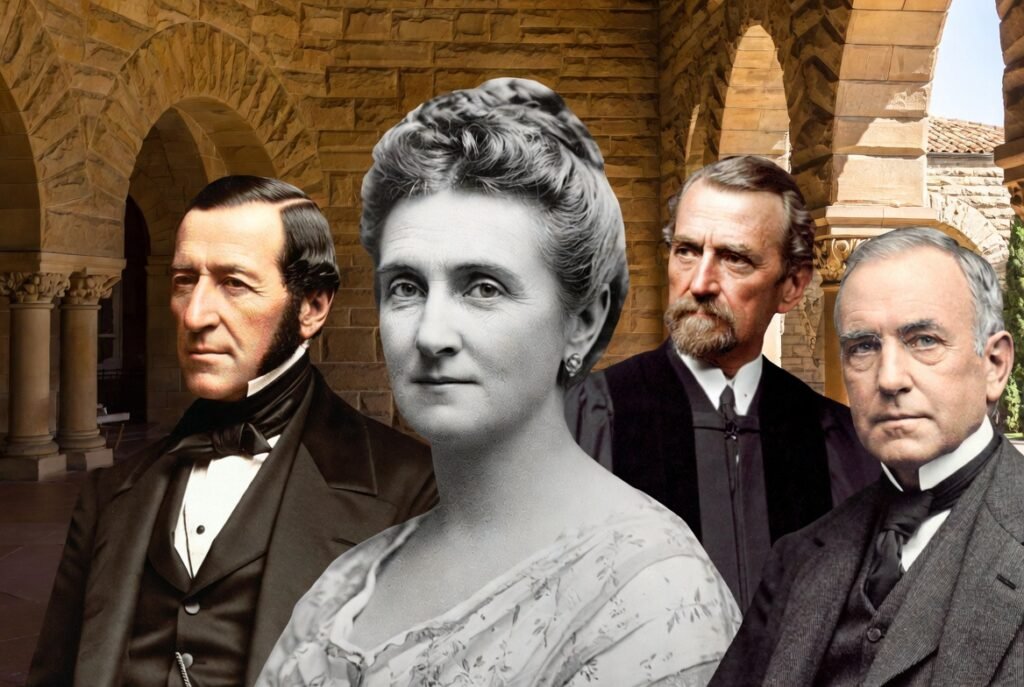
Jane Stanford: The University’s Real Founder
History often tells the Stanford story as Leland’s story. The fuller picture is more complicated — and more interesting.
Jane Elizabeth Lathrop Stanford was born in Albany, New York in 1828, the daughter of a shopkeeper. She had no formal higher education. She married Leland Stanford at 22 and spent her adult life managing their household, traveling, and raising their son. After Leland Sr. died in 1893, she found herself in charge of an estate that appeared vast on paper but was in reality debt-laden, legally encumbered, and unable to provide income to the university both Stanfords had built.
The federal government was suing the estate for over $15 million — attempting to recover loans the government had made to the Central Pacific Railroad. If the lawsuit succeeded, it could have forced the estate into bankruptcy. The university’s trustees seriously debated temporary closure.
Jane Stanford refused. She sold her jewelry. She lived on her monthly allowance from the probate court, turning most of it over to President Jordan for faculty salaries. She personally supervised construction on campus, pushing forward even as legal proceedings ground on. She defied an all-male board of trustees when she believed they were wrong.
As the university’s second president later wrote: Jane Stanford was “the school’s real founder and greatest benefactor.”The Stanford that exists today — the one that trained Larry Page and produced 36 Nobel laureates — almost did not survive its first decade.
Leland Stanford died in 1893. The federal government immediately moved to seize the university’s assets over a railroad debt dispute. For six years, Jane Stanford personally funded the entire institution out of her own pocket — her jewelry, her household staff, everything she could liquidate. She had no formal education herself. She kept the university open anyway. In February 1905, she was found dead in a Honolulu hotel room. The cause was strychnine poisoning. No one was ever charged. The case was never officially solved.
She was 76 years old and had spent the last decade of her life making sure a university survived. That university is now one of the most influential institutions on earth. Her death remains one of the stranger, darker footnotes in American academic history — a woman who saved something extraordinary, and whose own ending was never properly explained.
Wallace Sterling and the Rise to National Prominence
By the late 1940s, Stanford was still considered a solid regional university — respected, well-attended, but not in the same conversation as Harvard, Yale, or MIT. Wallace Sterling, who became president in 1949, spent the next two decades systematically changing that.
Under Sterling, Stanford moved its medical school from a cramped San Francisco campus to a purpose-built facility fully integrated into the main Stanford campus. Sterling launched the Stanford Industrial Park — now Stanford Research Park — on university land in Palo Alto, leasing space to high-technology companies and creating one of the first university-affiliated commercial research parks in the world. He increased financial aid recipients from less than 5% of students to more than one third. He grew the faculty from 322 tenured professors to 974. He launched the largest university fundraising program the country had seen to that point.
By the time Sterling stepped down in 1968, Stanford was no longer the “Cornell of the West.” It had become what its founders had always promised: a rival to the finest universities anywhere.
Frederick Terman and the Birth of Silicon Valley
Frederick Terman grew up on the Stanford campus. His father Lewis was a psychology professor there — the man who developed the Stanford-Binet Intelligence Scale. So Stanford was not just a school Frederick attended. It was literally where he was raised. He studied chemistry as an undergraduate, picked up an electrical engineering degree, then went to MIT for his doctorate under Vannevar Bush. In 1925 he came back to Stanford to teach. He had a job lined up at General Electric on the East Coast and fully planned to leave that fall. Then a medical condition kept him in Palo Alto through most of the following year. He never really left after that.
What bothered him during the 1930s was straightforward. Stanford was producing good engineers and those engineers were leaving California to find work at established companies back East. The talent was going somewhere else. Terman thought that was a problem worth solving, and his solution was direct — he started pushing his best students to stay and build something locally instead. Bill Hewlett and Dave Packard were two of those students. Terman mentored both of them, made introductions, and gave them a $538 loan to get started. They founded Hewlett-Packard in a Palo Alto garage in 1939. Their first customer was Walt Disney, who needed audio equipment for Fantasia.
In 1951, Terman created the Stanford Industrial Park. The university had land. He leased portions of it to technology companies, starting with Varian Associates. Hewlett-Packard came next. Then General Electric, Eastman Kodak, Lockheed. One by one, the university’s land filled up with companies that wanted to stay close to where the ideas were coming from. The hills north of the Santa Cruz Mountains quietly became something nobody had quite seen before — a dense pocket of semiconductor and electronics firms all feeding off the same research culture. People started calling it Silicon Valley sometime in the late 1950s. The name came from silicon, the element sitting at the heart of every transistor being built there. Terman later pointed to three reasons it worked the way it did. The California climate kept people from leaving. The university kept producing people worth hiring. And the engineers themselves — unlike their counterparts back East — actually wanted to start things rather than join things. He never made a big deal of his own role in any of it. Other people did that for him. He never claimed credit for Silicon Valley. It came to him regardless.
The Traitorous Eight and the Semiconductor Revolution
One story within this larger story deserves its own section, because it reshaped the entire technology industry.
In 1956, William Shockley — Nobel laureate in Physics for his co-invention of the transistor, and later a professor at Stanford — moved to Palo Alto and founded Shockley Semiconductor Laboratory. He recruited what was probably the most talented group of young PhD engineers in the country. Among them were Gordon Moore and Robert Noyce.
Shockley was a scientific genius and a catastrophically poor manager. He micromanaged. He redirected projects arbitrarily. He ran lie-detector tests on employees when things went wrong. His paranoia and erratic behavior made productive work nearly impossible.
In 1957, eight of his researchers — Julius Blank, Victor Grinich, Jean Hoerni, Eugene Kleiner, Jay Last, Gordon Moore, Robert Noyce, and Sheldon Roberts — decided they had had enough. They approached venture capitalist Arthur Rock and, through him, connected with Sherman Fairchild. On September 18, 1957, they founded Fairchild Semiconductor. Shockley, furious, called them the “Traitorous Eight” — and the name stuck.
Fairchild went on to develop the integrated circuit — the single innovation that made modern computing possible. Within a decade, the Traitorous Eight had scattered again, founding or co-founding companies that became the backbone of the technology industry. Gordon Moore and Robert Noyce co-founded Intel. Eugene Kleiner co-founded Kleiner Perkins, one of the most influential venture capital firms in history. The ripple effects were staggering: today, an estimated 70% of publicly traded Bay Area companies can trace their corporate lineage directly or indirectly to Fairchild Semiconductor.
None of this would have happened without Stanford’s campus being there — and without Frederick Terman having spent twenty years building an ecosystem where talent stayed local rather than moving east.
Stanford’s Campus: 8,180 Acres and Its Own Zip Code
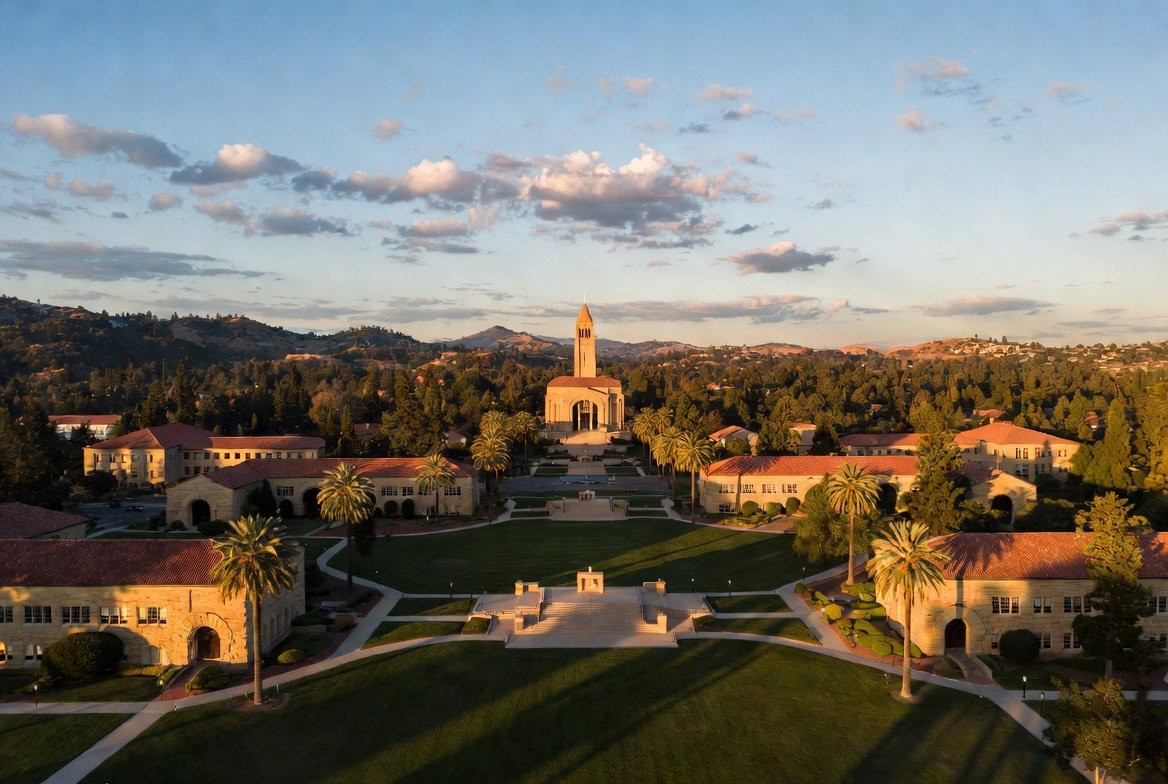
Stanford’s campus is one of the most distinctive physical environments of any university in the world. At 8,180 acres, it is larger than the city of San Francisco’s land area within its boundaries — and it has its own postal zip code (94305) recognized by the U.S. Postal Service.
The Main Quad — the heart of the campus, with its sandstone arches, terracotta roofs, and Memorial Church at its center — opened in 1891 and remains largely intact today despite two major earthquakes (1906 and 1989). Memorial Church, finished in 1903, seats 1,700 people. Its mosaics, stained glass, and ornate stonework represent some of the most elaborate religious architecture in California.
The campus includes the Jasper Ridge Biological Preserve — 1,189 acres of protected natural land used for ecological research. It includes the SLAC National Accelerator Laboratory, a two-mile particle accelerator facility operated by Stanford for the U.S. Department of Energy, on whose grounds three Nobel Prize-winning experiments have been conducted. It includes the Hopkins Marine Station in Pacific Grove, one of the oldest marine biological research stations on the West Coast.
The Dish — a 150-foot radio telescope set into the hills above the main campus — has become a cultural landmark. The 3.5-mile walking trail around it is used daily by thousands of students, faculty, and local residents.
Stanford’s campus was designed so that no building is more than a 10-minute walk from any other. Students describe the physical environment as one of the most powerful aspects of their experience — a place where the outdoor life, the California light, and the sense of space create a working environment genuinely unlike any urban university.
Seven Schools, One University
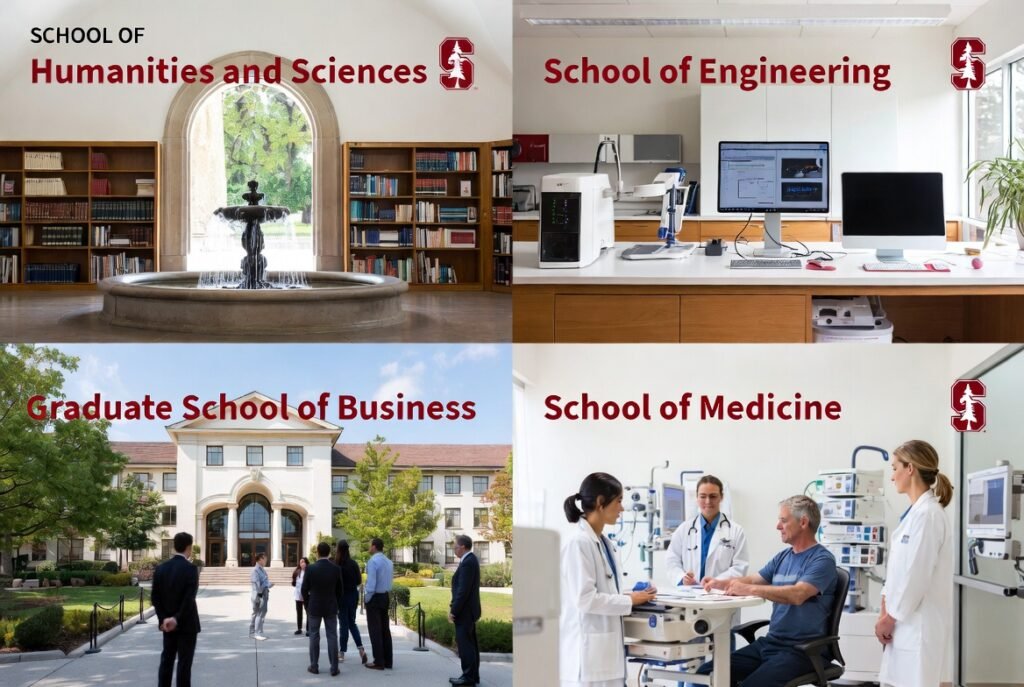
Most universities organize themselves around departments. Stanford organizes around schools — seven of them — and the distinction matters more than it sounds. Each school has its own dean, its own culture, its own admissions process for graduate students. But they share a campus where a computer scientist and a public policy student and a medical researcher might all eat lunch at the same table, take the same design thinking workshop, and end up building something together. That cross-pollination is not accidental. That is the whole point.
The School of Humanities and Sciences is where most undergraduates land first. It covers everything from molecular biology to comparative literature — more than 40 departments under one roof. Students do not declare a major immediately; they explore. Stanford’s founders built this breathing room deliberately. They wanted graduates who could think broadly, not just perform narrowly.
The School of Engineering is what most of the world associates with Stanford, and for good reason. Computer Science here is the most competitive undergraduate major in the university. The AI Lab, established in 1962, was building machine learning systems before the term existed in mainstream conversation. Today, research collaborations with Google, NVIDIA, Apple, and Meta run continuously — not as PR partnerships, but as actual ongoing scientific work where faculty and industry researchers publish together.
Then there is the Graduate School of Business, where the MBA program accepts fewer than 7% of applicants and the average incoming GPA is 3.77. The GSB is unusual among elite business schools for one reason that surprises people: its most discussed course has nothing to do with finance. “Interpersonal Dynamics” — called “Touchy Feely” by every student who has taken it since the 1960s — is a required first-year course that puts students in small groups to examine how they interact with other people. Stanford’s view is that understanding yourself is a leadership skill. Fortune 500 companies and venture capital firms consistently describe GSB graduates as being different in this specific way.
The School of Medicine ranks in the top three nationally. It moved from San Francisco to the main Stanford campus in 1959 and has been integrated into the university’s research fabric ever since. Stanford medical researchers contributed foundational work to recombinant DNA technology, CRISPR-related gene editing approaches, and immunotherapy techniques that are now used in cancer treatment globally.
Stanford Law sits in the top-5 in the country. It is smaller than most peer law schools — around 180 students per class — which means students get unusual access to faculty. Sandra Day O’Connor graduated from here in 1952. So did William Rehnquist. The school’s emphasis on technology and policy law reflects where its campus sits.
The Doerr School of Sustainability launched in 2022 with a $1.1 billion endowment and a single organizing question: how do we actually solve the climate problem? It is the newest school but perhaps the most watched — a bet by Stanford that the challenges of the next fifty years require a dedicated institutional home, not just scattered research projects.
The Graduate School of Education rounds out the seven. Less visible publicly than engineering or business, it does serious work in learning sciences and education policy that shapes how schools around the world teach.
Admissions: What Does It Actually Take?
Over 56,000 students applied to Stanford’s most recent freshman class. About 1,950 got in. That is a 3.61% acceptance rate — lower than Harvard, lower than Princeton, lower than every school most people think of as impossible to get into.
Most students see that number and stop. That is a mistake.
Here is what the acceptance rate actually means: Stanford receives an enormous number of applications from students who are not genuinely competitive. When you look only at applicants who meet the academic threshold — rigorous transcripts, strong test scores, real intellectual depth — the admitted percentage is meaningfully higher than 3.61%. The number reflects volume, not an iron wall.
What does the academic threshold look like? Admitted students typically have a GPA of 3.9 or above, built from the hardest courses their school offered — AP, IB, dual enrollment, honors. A 3.8 in six AP courses regularly outperforms a 4.0 from a student who avoided rigor. Stanford reinstated standardized testing requirements starting Fall 2026, after a test-optional period. Competitive applicants score in the 1500–1580 range on the SAT or 35–36 on the ACT.
But scores and grades are the entry condition. They are not the decision.
What Stanford’s admissions readers are actually trying to figure out is simpler and harder than any checklist: who is this person, and what do they bring that nobody else in this class of 7,200 students already brings? The supplemental essays — Stanford’s are notably personal, asking what you love to do intellectually, what you care about, and how you actually spend your time — are where this question gets answered or not. Students who write about leadership and community service in the way that sounds right tend to be the ones who do not get in. Students who write about the specific, sometimes odd thing they have genuinely spent years thinking about tend to be the ones who do.
Applying early matters. Stanford’s Restrictive Early Action deadline is November 1, with results in mid-December. Stanford reports higher admission rates for early applicants. REA means you cannot apply early to other private universities simultaneously — but public universities and non-restrictive programs are fine. If Stanford is genuinely your first choice, applying early is the right move.
International students apply through the same process. Stanford admits students from more than 70 countries. TOEFL or IELTS is required for most international applicants whose primary instruction language is not English.
Cost and Financial Aid: The Numbers That Change Everything
The sticker price stops most families before the conversation starts. It should not, because the sticker price is not what most families pay.
–2026 Cost of Attendance
| Expense | Annual Estimate |
| Tuition | $64,890 |
| Student Fees | ~$2,200 |
| Room & Board | ~$20,000–$22,000 |
| Books & Supplies | ~$840 |
| Personal & Transportation | ~$3,500–$5,000 |
| Total | ~$91,400–$96,513 |
Stanford’s Financial Aid Promise Stanford meets 100% of demonstrated financial need for every admitted undergraduate student — domestic and international. There are no loans in Stanford’s financial aid packages. Every dollar of aid is a grant: money that never needs to be repaid.
Income-Based Aid (What Families Actually Pay)
| Family Income | Expected Contribution |
| Under $100,000/year | $0 — tuition, room, and board fully covered |
| $100,000–$150,000 | No tuition; some room/board contribution may apply |
| $150,000–$250,000 | Reduced cost based on full financial picture |
| Above $250,000 | Partial aid still possible; use Net Price Calculator |
The average scholarship and grant for the Class of 2027 was $70,349 — including a Stanford-funded scholarship of $62,898 plus federal, state, and other sources. After all aid, students receiving need-based support pay an average of approximately $14,000 per year toward total expenses.
Around 60% of Stanford undergraduates receive the Stanford Scholarship. Nearly 50% receive need-based grants.
Stanford’s Net Price Calculator is available at stanford.edu. Families are frequently surprised by the results — the actual cost is often lower than the price of in-state tuition at a public university.
For International Students Aid is available but limited. About 25% of international undergraduates receive need-based assistance. For those who do qualify, Stanford’s policy is the same: 100% of demonstrated need, entirely in grants. The critical requirement: international students must declare their intent to apply for financial aid at the time of application. This cannot be requested after admission.
Scholarships: Beyond Need-Based Aid
The most important scholarship at Stanford is the one most people have never heard of.
The Knight-Hennessy Scholars Program is fully funded — tuition, fees, a living stipend, books, transportation, and one round-trip international travel allowance per year. It is open to students in any graduate program at Stanford: law, medicine, MBA, engineering, public policy, humanities. Not STEM only. Not even primarily. John Hennessy, the former Stanford president who co-created the program with Phil Knight, said the intention was to find people who wanted to use their education to do something that mattered in the world. Selection is based on civic mindedness, leadership, and a certain quality of intellectual seriousness that is hard to fake in an application. It is among the most generous graduate fellowships anywhere.
For PhD and Master’s students in science and engineering, Stanford Graduate Fellowships cover full tuition plus a living stipend and research funds. Combined with Research Assistantships and Teaching Assistantships available across departments, most PhD students at Stanford are fully funded regardless of where they come from. This is the norm, not the exception.
Stanford students also capture an outsized share of external fellowships — Fulbright, NSF Graduate Research Fellowships, Marshall Scholarships, Rhodes Scholarships, Gates Cambridge Scholarships. The quality of Stanford recommendation letters and the institution’s name carry real weight in those processes.
One honest note about Master’s programs: unlike PhD programs, most standalone Master’s degrees at Stanford do not come with automatic funding. If you are applying to a Master’s program, budget for full tuition unless you proactively secure a TA, RA, or fellowship position — all of which exist but require work to find and win.
Learnistiq tracks active scholarship opportunities at Stanford and other top US universities. Subscribe to our alerts to be notified when new fully funded or partially funded awards open.
Stanford Online: What You Can Actually Study Without Moving to California
Stanford Online gets overlooked in most university guides, which is a shame because it is more substantial than people expect.
The free tier is real. Stanford puts courses on Coursera and edX that are taught by actual faculty — not adjuncts, not TAs. Andrew Ng’s machine learning course, which originated at Stanford, became the most enrolled online course in history. Statistics, cryptography, game theory, human-computer interaction, medicine — these are available to anyone with an internet connection, at no cost. No certificate comes with free audit access, but the instruction itself is Stanford-grade.
For people who want credentials, the picture changes. Stanford offers professional certificates in data science, AI, electrical engineering, product management, and cybersecurity. These are credit-bearing programs — they require an application, cost money, and involve actual academic work. In technology fields specifically, employers recognize these certificates. In fields where the Stanford engineering brand carries less weight, the ROI is less clear.
The part-time online Master’s degrees through Stanford Engineering are probably the most undervalued option in the entire catalog. Same faculty. Same courses. Same degree. Completed remotely over two to four years while you keep your job. Up to 18 credits earned through certificate programs can transfer in, shortening the time and cost. The credential you receive is identical to what students who spent years on the Palo Alto campus receive. That matters.
There is also non-degree enrollment — a way for qualified individuals to take individual credit-bearing graduate courses without committing to a full degree program. Professionals use this to fill specific knowledge gaps without going back to school full-time.
About 1,200 Stanford students were studying online or in hybrid formats in 2025. That number will grow.
Student Life: What Rankings Don’t Capture
Talk to Stanford students long enough and a pattern comes up. Nobody mentions the weather first, or the buildings, or even the research opportunities. They talk about the people. Sitting next to someone at lunch who has already started a company, or published research, or done something that makes your own goals feel suddenly smaller. Most students find that push useful. Some find it quietly exhausting after a while.
Keeping up here takes genuine work. And when everyone around you looks like they have it figured out, falling behind feels personal in a way it might not somewhere else. Stanford has put more resources into mental health over the years — additional counselors, walk-in hours, support programs. Students say it has gotten better. They also say the need still outpaces what is there. That gap is real and worth knowing about before you arrive.
What the same environment produces on the other side is a campus that rewards people who actually want to build things. The d.school runs design workshops across all seven schools, and what gets taught there has shown up in hospitals, companies, and nonprofits far outside California. Over 700 student organizations exist on campus — robotics, Bhangra, chess, things in between. BASES has helped students go from ideas to funded companies while still enrolled. A lot of people arrive as students and leave as founders without quite noticing when the shift happened.
The hills above campus have a trail that loops around a radio telescope called the Dish. Students walk it when they need to clear their heads, which at Stanford is often. The Main Quad at night is one of those places that gets brought up by alumni years later — Memorial Church at the far end, quiet, lit up. Simple things that stick.
The traditions were never handed down from administration. Freshmen jump into campus fountains during orientation, which sounds pointless until you are there and realize it might be the only moment all year where nobody is performing for anyone. Full Moon on the Quad happens every year at midnight, same as it has for generations. The Big Game against Berkeley goes back to 1892. The Tree — an unofficial mascot costume rebuilt from zero each year by a student in the Stanford Band — has never been officially recognized. It keeps showing up anyway.
What Stanford Actually Built
Larry Page and Sergey Brin were not founders when they met. They were PhD students, arguing about everything, sharing a server room at Stanford in 1995. What came out of that room became Google — the most used software product ever built.
That kind of story should feel like an exception. At Stanford, it reads more like a pattern.
Go back further. The 1930s. A professor named Frederick Terman noticed something in two of his undergraduates — Bill Hewlett and Dave Packard — and decided to actually do something about it. They ended up in a Palo Alto garage, twelve minutes from campus. Small space. No obvious destiny. Today that garage has a California Historical Landmark plaque on it.
Yahoo, LinkedIn, Netflix, Instagram, Snapchat, Sun Microsystems, NVIDIA — the founders of all of these passed through the same campus. And then there is the Fairchild story, which is really where Silicon Valley begins. Eight researchers with Stanford connections walked out on Nobel laureate William Shockley in 1957. The companies that grew from that walkout — directly and indirectly — are worth trillions today. One act of professional defiance, and an entire industry followed.
Technology gets most of the attention. But Stanford has sent people into rooms that had nothing to do with code.
Herbert Hoover graduated in 1895 and became the 31st President. Condoleezza Rice — faculty member, provost, and eventually National Security Advisor and Secretary of State. Sandra Day O’Connor finished Stanford Law in 1952 and became the first woman to sit on the U.S. Supreme Court. William Rehnquist rose to Chief Justice. The Hoover Institution, which started in 1919 as an archive for World War I documents, became one of the most cited policy research centers on the planet.
Here is what actually sets Stanford apart though. This is not a history that the university frames and hangs on a wall. The alumni who built these companies still recruit from Stanford. They still fund labs there. They still call faculty. The relationship never became nostalgic because it never stopped being useful. It is not a legacy. It is infrastructure.
The SLAC National Accelerator Laboratory — a two-mile particle accelerator on Stanford’s land, operated for the U.S. Department of Energy — has hosted three Nobel Prize-winning physics experiments. Stanford faculty have made foundational contributions to recombinant DNA technology, immunotherapy, and the mathematical frameworks now used in machine learning systems worldwide.
Amanda Brown, who spent time observing students at Stanford Law, wrote the novel that became Legally Blonde — the film and the Broadway musical both.
Application Deadlines and Requirements
Undergraduate
| Deadline Type | Date | Notes |
| Restrictive Early Action (REA) | November 1 | Results mid-December; higher admission rate |
| Regular Decision | January 2 | Results early April |
| Transfer Applications | Open August 2026 | — |
| Midyear Transcript Submission | February 15 | Required for all applicants |
What to Submit
- Common Application or Coalition Application
- Two teacher recommendations + one school counselor recommendation
- Official transcripts
- SAT or ACT scores (required from Fall 2026)
- TOEFL or IELTS for most international applicants
- Optional arts portfolio
- Application fee: $90 (fee waivers available for eligible students)
Graduate
- Application fee: approximately $125
- Deadlines vary by program — typically October through January for fall enrollment
- Requirements: statement of purpose, resume/CV, letters of recommendation, GRE or GMAT (program-dependent)
- MBA applications: three rounds; international applicants are encouraged to apply in Rounds 1 or 2 to allow visa processing time
Frequently Asked Questions
Is Stanford free for most families?
For families earning under $100,000 a year, Stanford covers tuition, room, and board entirely — no loans, nothing to repay. Families up to $150,000 pay no tuition. These are grants, not loans. Around 60% of undergraduates receive Stanford Scholarship, and the university meets 100% of demonstrated financial need for every admitted student. Run the numbers on Stanford’s Net Price Calculator before you assume you cannot afford it.
How hard is it to get into Stanford?
The acceptance rate is 3.61%, but that number includes everyone who applied — including students who had no realistic chance. Competitive applicants typically show a GPA above 3.9 in rigorous coursework and SAT scores between 1500 and 1580. The harder question is whether your application communicates something specific and genuine about who you are. That is what separates admitted students from equally qualified students who were not.
What actually makes Stanford different?
Its location puts students physically inside the industry that has shaped the last forty years of the global economy. Its financial aid program makes it affordable to families across a much wider income range than the sticker price suggests. And something harder to quantify — a culture that has, for over 130 years, pushed people to translate what they know into something that works in the world — runs through every school on campus.
Can I study at Stanford without moving to California?
Yes. Stanford Online offers free courses, credit-bearing certificates, and part-time online Master’s degrees in engineering and related fields. The Master’s degree credential is identical to what on-campus students receive.
Do international students get financial aid?
Yes, for undergraduates who demonstrate financial need and declare their intent to apply for aid when they apply to the university — this cannot be requested after admission. About 25% of international undergraduates receive need-based grants. PhD students are almost universally funded through assistantships regardless of nationality.
What is the Knight-Hennessy Scholarship?
Stanford’s flagship fully funded graduate award — open to students in any graduate program, covering all costs plus a living stipend and travel allowance. One of the most generous graduate fellowships in the world, and not limited to STEM.
Scholarship Deadlines Move Fast
Stanford’s scholarship landscape shifts every cycle. The Knight-Hennessy application opens and closes on its own timeline. Departmental fellowships fill quietly. External awards like Fulbright and NSF have deadlines that do not wait.
Learnistiq.com tracks these — Stanford and other top US universities — and sends alerts when new fully funded or partially funded opportunities open. If you want to know when something relevant to your profile becomes available, subscribe at learnistiq.com or reach out to our team directly. We also answer questions about financial aid documentation and how to position an application before you submit it.
-
The University That Almost Never Existed — And Changed the World Anyway
There is a small detail about Princeton University that most people never think about. When the four founding ministers sat down in 1746 to petition for a college charter, the first governor they approached said no. A flat rejection. If a different man had been in charge that day — if history had turned slightly … Read more
-
Stanford University Free Online Courses 2026: Which Are Actually Worth Your Time?
Stanford university has hundreds of free online courses in 2026, and most people who start one never finish — not because the course is bad, but because nobody told them upfront what they were signing up for, which certificate actually matters, or whether they chose the right course for their goal in the first place. … Read more
-
Harvard University Is Free for Most Families — Here’s the Proof (2026)
Before You Start Reading — An Honest Warning Most articles about Harvard University are written to impress you, not to inform you. The letters start with autumn leaves in Harvard Yard they quote a Nobel laureate they list the acceptance rate. They close with something inspirational, about unleashing Harvard potential. Harvard letters are beautifully structured. … Read more


Every article on Learnistiq is written by Shahzaib Khan — an education
researcher who has spent years studying university admissions,
scholarship systems, and online education across Pakistan, the USA,
the UK, and Germany.
Shahzaib started Learnistiq because he saw students making expensive
mistakes — choosing the wrong university, missing scholarship deadlines,
or believing myths about online degrees. This platform exists to fix that.
No AI-generated filler. No copy-paste from official university websites.
Every guide is researched, fact-checked, and written to actually help
you make a better decision.