
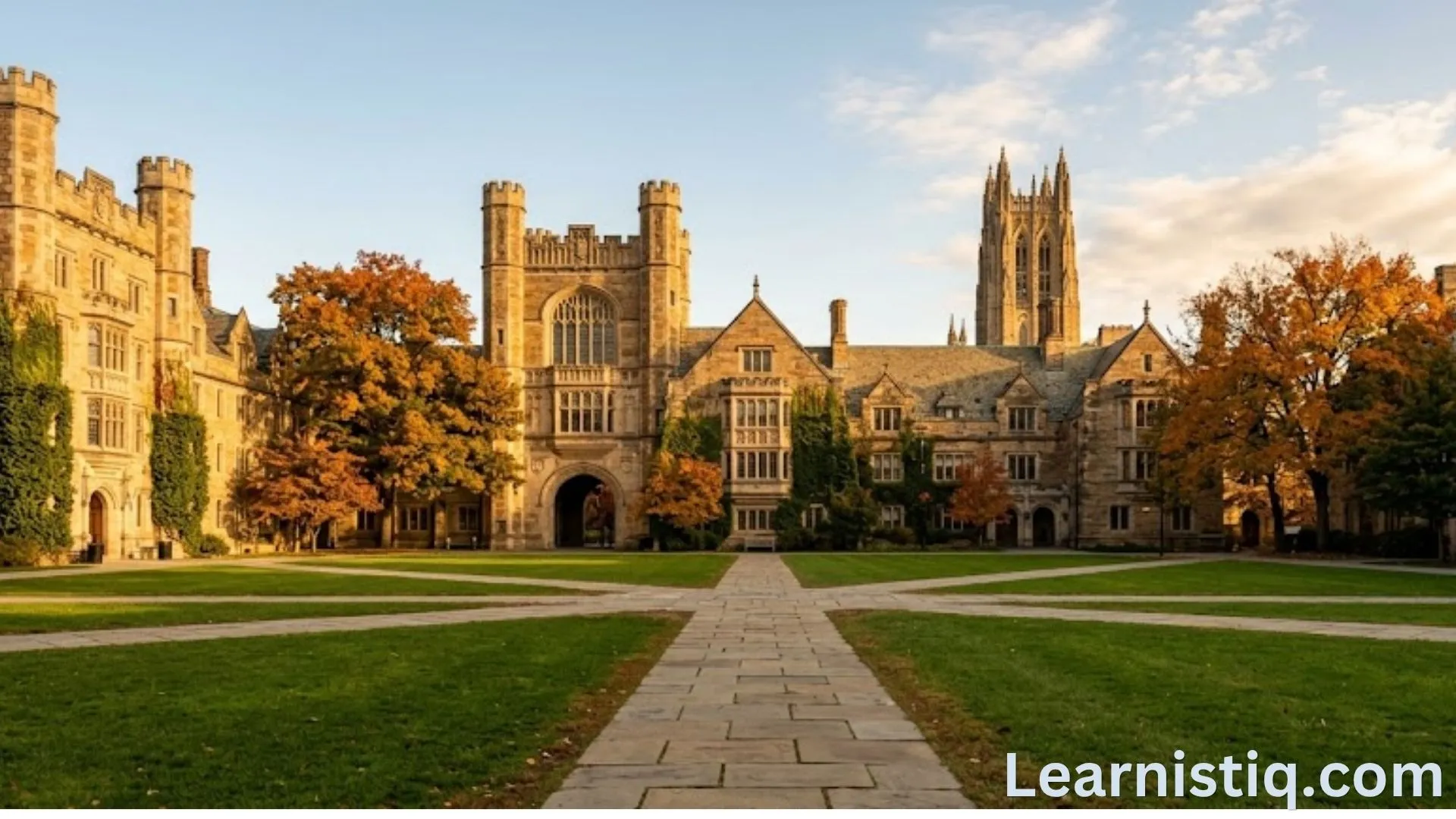
There are universities, and then there is Yale. Sitting in the heart of New Haven, Connecticut, this private research university does not just educate — it shapes the world. As a member of the Ivy League, Yale carries a weight that few institutions can match. Founded in 1701 by Congregationalist clergy of the Connecticut Colony, it stands today as the third-oldest institution of higher education in the United States — older than the nation itself. The motto Lux et veritas — Light and truth — is not just carved into stone. It is lived, debated, and sometimes fiercely challenged within these walls.
Walk across Old Campus on any given afternoon and you will feel it: a place where the New York metropolitan area meets colonial brick, where Yale Blue flies above buildings that have seen empires rise and fall, and where the Yale Bulldogs — with their beloved mascot Handsome Dan, believed to be the first college mascot in America — carry a century of tradition on their shoulders. Yale is not just a prestigious university. It is, by almost every measure, a cultural capital of Connecticut and one of the most consequential academic addresses on earth, organized across 14 schools including the original undergraduate college and twelve professional schools, each one a world unto itself.
Yale University at a Glance
| Detail | Data |
| Location | New Haven, Connecticut, USA |
| Founded | 1701 |
| Type | Private Research University (Ivy League) |
| Undergraduate Tuition (2024–25) | $67,250/year |
| Total Cost of Attendance | ~$91,950/year |
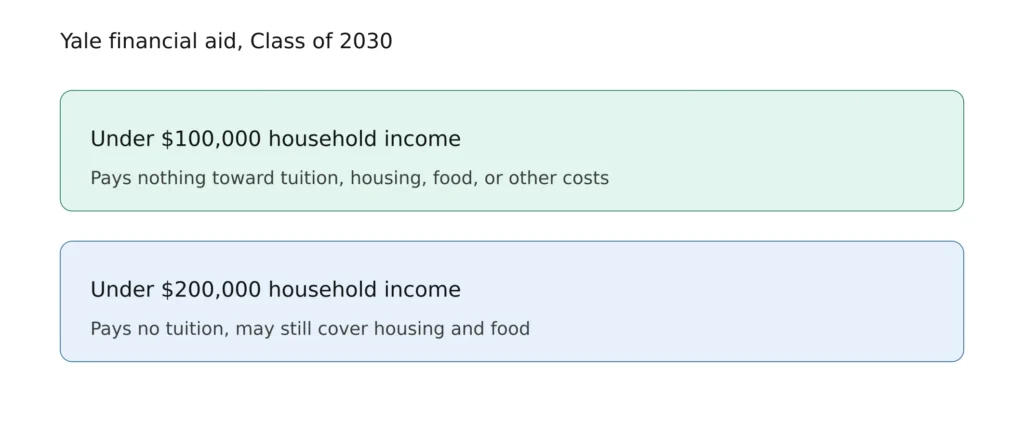
| Acceptance Rate | 4.2% (Class of 2030) |
| Total Enrollment | 15,185 students |
| Endowment | $44.1 billion |
| US News Ranking | #4 National Universities |
| QS World Ranking 2026 | #21 |
| Financial Aid Budget | $257 million (2023–24) |
Table of Contents
History and Origins
Every great institution has a founding myth, but Yale’s is unusually human. It did not begin with grand buildings or royal charters — it began in a study. In 1701, a group of ten Congregationalist ministers, all Harvard alumni, gathered in Branford and donated books from their personal collections to form what was first called the Collegiate School. The school’s first rector, Abraham Pierson, ran classes from his home in Killingworth — a detail that feels almost impossible given what Yale would become.
By 1703, the institution had moved to Saybrook, thanks to land donated by Nathaniel Lynde, and eventually settled in New Haven in 1716. The name change came in 1718, when Boston-born merchant Elihu Yale — who had made his fortune in Madras working for the East India Company as governor of Fort St. George — donated nine bales of goods worth over £560. Cotton Mather suggested naming the school after him, and the rest is history.
What followed was not a smooth, linear ascent. The early Yale was pulled between orthodoxies — between Puritan religious orthodoxy championed by Increase Mather and the new intellectual currents arriving from England. When a shipment of 500 books arrived in 1714 representing the best of modern English science, philosophy, and theology, the effect was seismic. Young Jonathan Edwards discovered John Locke. Debates over Calvinism, Arminianism, and the Church of England shook the faculty.
Thomas Clapp tried to restore Calvinist orthodoxy; the Great Awakening and the Enlightenment pulled students in opposite directions simultaneously. Ezra Stiles, president from 1778 to 1795, made Hebrew compulsory for freshmen alongside Greek and Latin — a requirement that would feel radical even today. British forces occupied New Haven in 1779 and threatened to destroy the college entirely; it was saved only by the intervention of Yale graduate Edmund Fanning.
The Yale Report of 1828 became a landmark defense of classical education against modernizers who wanted to replace Latin and Greek with practical subjects — a debate that never fully ended. By 1887, under an act of the Connecticut General Assembly and the presidency of Timothy Dwight V, the institution was formally renamed Yale University, joining the Association of American Universities and beginning its transformation into the research powerhouse we know today.

Schools and Constituent Colleges
What most people picture when they think of Yale is Yale College — the undergraduate experience, the residential quads, the dining halls echoing with argument at midnight. But Yale is architecturally far more complex than that. It is built around fifteen constituent schools, each with its own faculty, culture, and in some cases, its own legend.
The Yale Graduate School of Arts and Sciences, established in 1847, awarded the first PhD in the United States in 1861 — a fact that tends to silence a room. The Yale Law School, consistently ranked among the most selective graduate programs on earth, has sent more people to the U.S. Supreme Court than perhaps any other institution. The Yale School of Medicine, Yale Divinity School, Yale School of Fine Arts, Yale School of Music — now tuition-free thanks to a landmark gift — Yale School of Architecture, Yale School of Nursing, David Geffen School of Drama (also now tuition-free), Yale School of Management, Yale School of Public Health, Yale School of Forestry, and the newest addition, the Jackson School of Global Affairs established in 2022, complete a picture of an institution that has been systematically building expertise across every domain of human knowledge for over three centuries.
The story of Milton Winternitz, who led the Yale School of Medicine as dean from 1920 to 1935, is worth knowing. He pioneered the Yale System of teaching — fewer lectures, fewer exams, more independent thinking — and created the psychiatry department while dreaming of an Institute of Human Relations where biological and social scientists would work side by side. His vision was decades ahead of its time. The culture he built around social medicine still echoes in how Yale trains doctors today.
The liberal arts curriculum that underlies all of Yale College is perhaps the institution’s most deliberate philosophical statement: learn across disciplines first, choose a major later, because the world’s hardest problems do not respect departmental boundaries.
Academic Programs
Yale’s academic breadth is, simply put, staggering. At the undergraduate level alone, the university offers over 80 bachelor programs spanning every conceivable field. Students can pursue a B.A. in Ethics, Politics, and Economics or a B.A. in Computing and the Arts — combinations that signal Yale’s commitment to refusing false choices between the technical and the humanistic. The sciences are equally rich: B.S. Astrophysics, B.S. Biomedical Engineering, B.S. Electrical Engineering and Computer Science, B.S. Geology and Geophysics, and B.A./B.S. Molecular Biophysics and Biochemistry sit alongside B.A. Near Eastern Languages and Civilizations, B.A. Judaic Studies, and B.A. Theater Studies.
At the graduate level, Yale offers 54 master programs and 76 PhD programs. The Master of Laws (LLM), Master of Architecture, Master of Divinity, Master of Public Health, MS in Computational Biology and Bioinformatics, Master of Environmental Management, and Executive MBA represent just a fraction of what is available. The doctoral programs — PhD in Neuroscience, PhD in Computational Biology and Bioinformatics, PhD in Statistics and Data Science, PhD in Ecology and Evolutionary Biology, Doctor of Medicine (MD), Doctor of Nursing Practice (DNP), Doctor of Musical Arts, and the rare Doctor of the Science of Law (JSD) — collectively represent Yale’s deepest investment in original knowledge creation. Many of these are combined PhD programs that cross departmental lines, reflecting the university’s genuine belief that the most important scholarship happens at the intersections.
Tuition, Fees, and Cost of Attendance
Yale’s sticker price is high — that is the honest starting point. For the 2024–2025 academic year, undergraduate tuition stands at $67,250. Add housing ($11,300), food ($8,600), and indirect costs like books, transportation, and personal expenses, and the total cost of attendance reaches approximately $91,950 per year. Over four years, you are looking at a projected figure close to $377,000.
Those numbers are real. But they describe what almost nobody at Yale actually pays.
Yale Law School tuition runs $78,961 per year. Yale School of Medicine sits at $75,985. Graduate programs vary by school — the School of Environment charges $51,760 for full-time study; the Divinity School charges $29,976. PhD students in the Graduate School of Arts and Sciences operate under a completely different model, which the financial aid section below covers in detail.
For international students, the tuition figure is identical to domestic students — Yale does not charge a premium for being from another country. The total cost of attendance, however, will include additional expenses like travel and health coverage.
The 4% annual tuition increase at Yale has been consistent over the past decade — something worth building into multi-year financial planning if you or a family member is considering enrollment.
Financial Aid and Scholarships
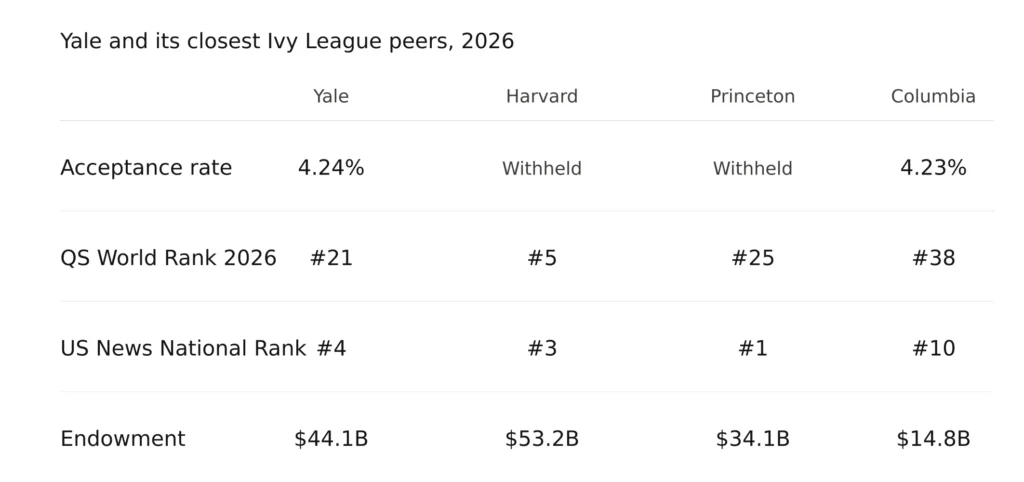
Yale announced a sweeping financial aid expansion in January 2026, and it changes the calculus for thousands of American families. The university confirmed that families earning less than $200,000 a year will pay no tuition starting with the Class of 2030. Families earning under $100,000 annually will pay nothing toward the full cost of attendance. This single policy shift reshapes who can realistically consider Yale.
The Yale Scholarship remains the engine behind this aid. It is need-based gift aid, and students never repay it. Yale maintains need-blind admissions for both domestic and international applicants. The university does not factor a family’s ability to pay into any admissions decision.
Under the prior policy, the average Yale grant already exceeded $62,000 per year. That figure covered tuition outright for most recipients. Over half of Yale undergraduates received need-based aid before this expansion. The new $200,000 threshold pulls in a much larger band of upper-middle-class households, many of which previously assumed they earned too much to qualify.
Yale also provides a $2,000 start-up grant to first-year students from families with no expected parental contribution. These students receive free Yale hospitalization insurance as well. The university expects students to contribute through term-time and summer earnings. Yale’s hourly minimum wage starts at $15.69.
Applicants must submit both the FAFSA, using school code 001426, and the CSS Profile, using code 3987. Yale automatically grants fee waivers to low-income applicants. The financial aid office processes these waivers without requiring separate documentation.
Beyond the Yale Scholarship, students can access Area Yale Club awards, endowed scholarships, and alumni-funded gift aid. Graduate funding works on a different model entirely. PhD students in the Graduate School of Arts and Sciences receive full funding in nearly all cases. This funding includes tuition coverage, a hospitalization fellowship, and an annual stipend. Master’s and professional students access department-specific fellowships and assistantships instead.
Yale students also compete for major external fellowships, including Rhodes, Marshall, Churchill, Schwarzman, and Fulbright awards. These awards add another layer of funding on top of Yale’s own aid programs.
The practical impact is stark. A family earning $150,000 a year may now send a child to Yale without paying tuition. This is not a projection or a marketing claim. As of the Class of 2030, it is Yale’s stated policy.
Admissions Requirements
Getting into Yale is, by any honest measure, extraordinarily difficult. The acceptance rate for the Class of 2030 dropped to 4.2% — from a pool of 54,919 applicants, the second largest in Yale’s history. Only 2,328 students were admitted. The Yale Law School accepts approximately 4% of applicants. The School of Medicine admits around 5%. The Graduate School of Arts and Sciences for PhD admissions sits at 5.7%.
For undergraduate applicants, the baseline expectations are formidable: SAT 1450+, IELTS 7+, TOEFL 100+, Duolingo English Test 120+. Graduate applicants face GPA 3.92+, GRE 317+, GMAT 690+. An extraordinary 97% of admitted students ranked in the top 10% of their high school class.
The student body reflects genuine diversity: 55% attended public schools, 45% private or international schools, 50% are women, over 39% are ethnic minority U.S. citizens, and 10.5% are international students — drawn from virtually every country on earth. Yale also maintains the Eli Whitney Students Program specifically for non-traditional students who return to education after significant life experience, a detail that says something important about what the university actually values. Total enrollment stands at 15,185 students, supported by 4,379 faculty staff, with a 98% six-year graduation rate.
What the acceptance rate alone does not tell you is this: the students Yale turns away include many with perfect SAT scores and 4.0 GPAs. What distinguishes the admitted class is harder to quantify — intellectual curiosity that shows up across an application, not just in test scores; demonstrated impact, not just extracurricular participation; and writing that sounds like a specific person rather than a college application.
Rankings and Reputation
Numbers never tell the whole story — but Yale’s are worth sitting with. In the QS World University Rankings 2026, Yale sits at #21 globally, backed by a consistent top-25 presence across the past decade. In QS WUR Ranking By Subject, Yale reaches #4 — a figure that reflects extraordinary depth across disciplines. The QS Sustainability Ranking places it at #251, an area where the university acknowledges room for growth.
Within the United States, U.S. News ranks Yale #4 among national universities, tied with Stanford — while Forbes places it at #9, WSJ College Pulse at #3, and Washington Monthly at #31. Internationally, the Academic Ranking of World Universities (ARWU) places Yale #11, and the Times Higher Education (THE) ranking has it at #10. Niche ranks it the 2nd best university in America, while Time magazine and Statista named it the 2nd best university in the world in 2026.
The university carries R1 doctoral university status — the highest Carnegie classification for very high research activity — and the National Science Foundation ranked Yale 16th among American universities for research and development expenditures in 2024, with spending reaching $1.52 billion.
One ranking worth noting separately: Yale Law School has held the #1 position in U.S. News law school rankings for so many consecutive years that it became, in 2023, the first law school to withdraw from the rankings entirely — a decision that itself generated national news coverage and prompted Harvard and Stanford to follow.
Research and Intellectual Life
Yale’s intellectual identity is impossible to separate from its research culture — and that culture runs deeper than citation counts. The university’s current faculty includes 73 members of the National Academy of Sciences, 55 members of the National Academy of Medicine, 8 members of the National Academy of Engineering, and 200 members of the American Academy of Arts and Sciences.
As of 2025, 72 Nobel laureates, 5 Fields medalists, 4 Abel Prize laureates, and 3 Turing Award winners have been affiliated with Yale — numbers that place it in a category occupied by perhaps five institutions globally. The university’s $44.1 billion endowment is the second largest among all educational institutions worldwide, providing the kind of long-term financial security that allows genuinely risky, genuinely important research to happen without constant anxiety about funding cycles.
The intellectual traditions Yale has incubated are specific and traceable. The New Criticism movement in literary studies — shaped by Yale faculty Robert Penn Warren, W.K. Wimsatt, and Cleanth Brooks — fundamentally changed how English literature is taught globally. Later, the Yale school of deconstruction emerged around Jacques Derrida, Paul de Man, J. Hillis Miller, Geoffrey Hartman, and Harold Bloom, making Yale’s comparative literature department the center of one of the most consequential theoretical debates in 20th-century humanities.
In history, C. Vann Woodward and David Brion Davis launched an entire generation of southern historians, while David Montgomery shaped the field of labor history. The Journal of Music Theory was founded at Yale in 1957; Allen Forte and David Lewin were among the most influential music theorists of their era. The Yale Institution for Social and Policy Studies has been producing social sciences and policy research since the late 1960s.
Approximately 1,200 postdocs from across the world work in Yale’s laboratories at any given time, supported by a dedicated Office for Postdoctoral Affairs and the Yale Postdoctoral Association. Beyond the main campus, the Yale West Campus in West Haven focuses specifically on biotechnology, pharmaceuticals, and life sciences. The translational medicine partnership with University College London and the Yale-NUS College in Singapore — a liberal arts institution built jointly with the National University of Singapore — reflect a university that has consistently understood that the boundaries of knowledge extend well past New Haven.
Libraries and Collections
There is a moment, when you first walk into Sterling Memorial Library — Yale’s main library, holding approximately 4 million volumes — when the scale of the institution’s intellectual ambition becomes physically real. The Yale University Library system as a whole holds over 15 million volumes, making it the third-largest academic library in the United States.
The Beinecke Rare Book and Manuscript Library, designed by Gordon Bunshaft of Skidmore, Owings and Merrill, is one of the largest buildings in the world dedicated exclusively to the preservation of rare books and manuscripts. Its walls are made of translucent Vermont marble panels that filter light into warm hues without exposing fragile texts to direct sun — an architectural solution as elegant as anything Yale has built. Near it, the sculptures of Isamu Noguchi in the sunken courtyard of Hewitt Quadrangle represent time, the sun, and chance — a quietly profound installation that most visitors walk past without realizing what they are seeing.
The Harvey Cushing/John Hay Whitney Medical Library holds rare historical medical texts alongside the instruments that shaped modern surgery. The Lewis Walpole Library contains the largest collection of 18th-century British literary works in existence. The private Elizabethan Club — technically independent of Yale — makes its Shakespeare Folio, Shakespeare Quartos, and a first edition of Milton’s Paradise Lost available to qualified researchers.
The Yale University Art Gallery, the country’s first university-affiliated art museum, holds over 200,000 works including Old Masters and major collections of modern art, housed partly in Louis Kahn’s first large-scale American building. The Yale Center for British Art — another Kahn building — is the largest collection of British art outside the UK, grown from a gift by Paul Mellon. The Peabody Museum of Natural History and the Yale University Collection of Musical Instruments round out a portfolio of collections that would make many standalone institutions envious.
And there is the matter of Machu Picchu: artifacts brought to the United States by Yale history professor Hiram Bingham in 1912 were held at Yale for a century before finally being restored to Peru in 2012 — a story that touches on questions of academic ethics, national heritage, and institutional responsibility that Yale has had to grapple with publicly.
Campus and Architecture
Yale’s campus is, depending on who you ask, either the most beautiful in America or the most theatrical — and the distinction says something interesting. The central campus covers 260 acres in downtown New Haven, with a separate medical campus adjacent to Yale-New Haven Hospital. Athletic facilities occupy another 500 acres in western New Haven, including the Yale Golf Course. The Yale West Campus in West Haven — the former Bayer HealthCare complex of 136 acres and 17 buildings — now serves as laboratory and research space for the life sciences.
The dominant architectural language of the central campus is Collegiate Gothic — buildings constructed primarily between 1917 and 1931, financed largely by Edward S. Harkness and designed mostly by James Gamble Rogers, who famously acid-aged new buildings, deliberately broke their leaded glass windows and repaired them in Middle Ages style, and created niches left empty to simulate centuries of loss. The effect is a campus that looks older than it is, with a theatrical conviction that either charms or unsettles.
Louis Kahn’s Yale Art Gallery and Center for British Art stand as landmarks of 20th-century modernism. Eero Saarinen designed Ingalls Rink, Ezra Stiles College, and Morse College — the latter two modeled after the medieval Italian hill town of San Gimignano. Paul Rudolph’s Art and Architecture Building is among the most discussed — and most controversial — buildings in American architectural education. Connecticut Hall, built in 1750, is the oldest surviving building on campus and sits in the Georgian style that also characterizes Timothy Dwight College, Pierson College, and Davenport College.
Harkness Tower rises 216 feet and houses the Yale Memorial Carillon. Charles Dickens, visiting the United States in the 1840s, called Hillhouse Avenue — lined with Yale-owned 19th-century mansions — the most beautiful street in America. Travel + Leisure and Condé Nast have both named Yale’s campus among the most beautiful in the United States, the latter as recently as 2025.
The campus is not merely beautiful — it is alive. Barack Obama’s presidential portrait, painted by Yale alumnus Kehinde Wiley, was unveiled to global attention. Public art fills courtyards, plazas, lobbies, and lecture halls. The Tony Award-winning theater, Yale Cabaret run entirely by students, a packed arts calendar, and world-class museums and galleries make the campus feel less like an institution and more like a city with very good admissions standards.
Yale is also New Haven’s largest taxpayer and largest employer, funding the New Haven Promise program which pays full tuition for eligible students from New Haven public schools — a tangible expression of the university’s responsibility to the community that hosts it. On sustainability, the university has committed to reducing greenhouse gas emissions to 10% below 1990 levels and is a member of the Ivy Plus Sustainability Consortium, with eleven buildings pursuing LEED design and certification.
Student Life and Campus Culture
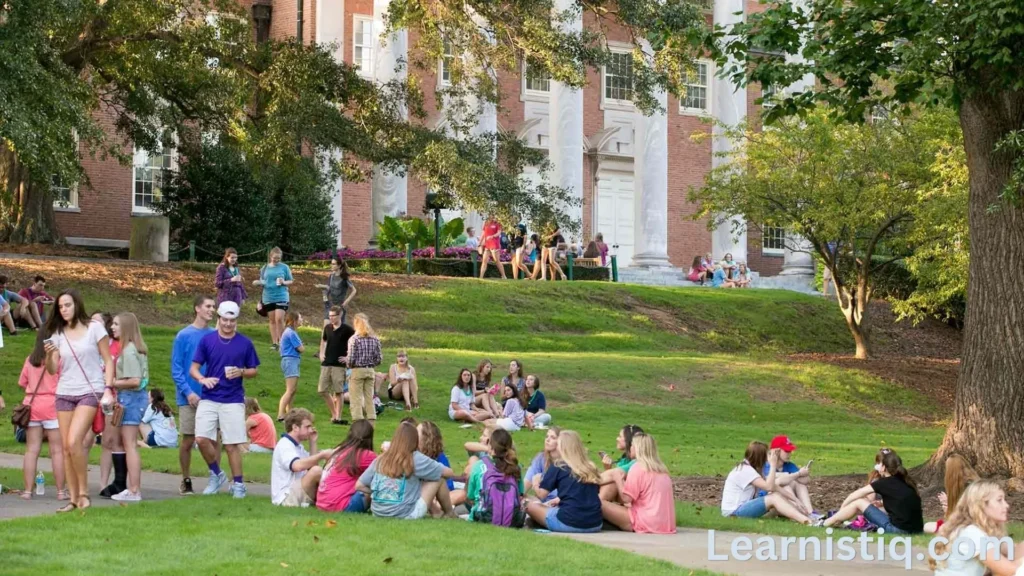
Yale undergraduates do not simply attend a university — they inhabit one. The residential college system, established in 1933 by Edward S. Harkness, who admired the Oxford and Cambridge model, organizes every undergraduate into one of fourteen colleges. Each college has its own courtyard, dining hall, library, common room, head of college, and academic dean. Each hosts its own seminars, social events, and the distinctly Yale institution of Master’s teas — informal conversations between students and visiting figures that have featured everyone from Nobel laureates to sitting heads of state.
The colleges — Jonathan Edwards, Branford, Saybrook, Berkeley, Trumbull, Silliman (the largest), Timothy Dwight, Pierson, Davenport, Morse, Ezra Stiles, Benjamin Franklin, Pauli Murray, and Hopper (renamed from Calhoun in 2017 to honor Grace Hopper) — give 85% of undergraduates a home within a home. The Faculty of Arts and Sciences teaches all undergraduate courses, open to members of any college, meaning that while residential life is intimate, intellectual life is genuinely shared.
Beyond the colleges, Yale hosts 526 registered undergraduate student organizations, plus hundreds more for graduate students. Dwight Hall coordinates over 2,000 Yale undergraduates working across 70 community service initiatives in New Haven. The Yale College Council governs campus-wide student services. The Yale Dramatic Association and Bulldog Productions serve theater and film communities. WYBC Yale Radio broadcasts online. The Yale Political Union, founded in 1934, is one of the most consequential undergraduate debate societies in the country.
The Yale International Relations Association runs a globally recognized Model UN program. Fraternities, sororities, and at least 18 a cappella groups — the most famous being the Whiffenpoofs, founded in 1909 — complete a social landscape of remarkable density. Yale’s secret societies — Skull and Bones, Scroll and Key, Wolf’s Head, Book and Snake, Elihu, Berzelius, St. Elmo, Manuscript, and others — occupy their own architectural and mythological space on campus. Student publications include the Yale Literary Magazine (founded 1836, the oldest student literary magazine in the United States), the Yale Record (the world’s oldest college humor magazine, founded 1872), the Yale Daily News (first published 1878), the Yale Herald, and the Yale Globalist.
Graduation traditions — seniors smashing clay pipes underfoot, the banned-then-revived game of Bladderball — speak to a culture that takes its rituals seriously while never quite taking itself too seriously. The student body’s median family income of $192,600, with 57% coming from the top 10% of earning families, reflects persistent socioeconomic stratification that Yale continues to address through its financial aid commitments.
Mental Health and Student Wellbeing
No honest account of Yale can skip this section. In 2018, the Ruderman Family Foundation ranked Yale as having the worst mental health policies in the Ivy League — a finding that was painful for an institution that otherwise leads in almost everything. The core problem was structural: Yale’s policies effectively penalized students for seeking help, because seeking help could trigger a medical withdrawal that carried a $50 reapplication fee, uncertain readmission prospects, and a ban on all extracurricular activities and campus visits while away. Students described routinely lying to their counselors to avoid being removed from school.
The suicide of Luchang Wang in 2015 — who posted on Facebook that she needed time to work through her mental health but could not bear the prospect of forced withdrawal — brought the crisis into painful public focus.
Changes have come, though the process has required consistent external pressure. After a Washington Post investigation in 2022, Yale increased the number of mental health clinicians on campus from 51 to 60 and committed to further changes. In 2023, following a discrimination lawsuit, the university renamed medical withdrawal to medical leave of absence, allowing students on leave to remain on Yale’s health insurance, participate in extracurricular clubs, and visit campus — none of which were previously permitted. The $50 reapplication fee was eliminated. Students now receive 5–6 additional days to make decisions about medical leave.
The organization Elis for Rachael — formed after the death of undergraduate Rachael Shaw Rosenbaum — continues to advocate for deeper reforms. For therapy waitlists that stretch months and individual sessions that run only 30 minutes, the advocacy continues. This section of Yale’s story matters not because it defines the institution, but because any student or family considering Yale deserves to know the full picture — and because the gap between Yale’s public excellence and its internal student support systems is a tension the university is still actively working to close.
Athletics and Sports
Yale competes at the NCAA Division I level across 35 varsity teams as a member of the Ivy League conference — and like all Ivy schools, offers no athletic scholarships, a policy that shapes both who comes to play and what athletic culture feels like. The Yale Bulldogs carry real historical weight: Yale crew is the oldest collegiate athletic team in America, winning Olympic Games gold medals in the men’s eights in 1924 and 1956. Over 200 Yale alumni have competed in the Olympic Games, winning more than 110 medals including 55 gold.
The Yale Corinthian Yacht Club, founded in 1881, is the oldest collegiate sailing club in the world. The Yale Bowl — the country’s first natural bowl stadium — served as the prototype for the Los Angeles Memorial Coliseum and the Rose Bowl. The Payne Whitney Gymnasium is the second-largest indoor athletic complex in the world.
Recent competitive highlights include the men’s lacrosse team’s first-ever NCAA Division I championship in 2018, defeating Duke — the first Ivy League school to claim that title since Princeton in 2001 — and the men’s basketball team’s first Ivy League Championship in 54 years in 2016, followed by a first-ever NCAA tournament win over Baylor. The Harvard-Yale football rivalry dates to 1875, making it one of the oldest in American college football.
Notable Yale athletes across history include figure skaters Sarah Hughes and Nathan Chen, Olympic swimmer Don Schollander, Olympic runner Frank Shorter, football pioneers Calvin Hill and Amos Alonzo Stagg, and Walter Camp — known as the Father of American Football. Yale students claim to have invented the Frisbee, tossing empty Frisbie Pie Company tins across campus. The official fight song, Bulldog, was written by Cole Porter during his undergraduate days.
Notable Alumni and Faculty
The list of people Yale has sent into the world is, at this point, almost surreal in its breadth. Five U.S. presidents attended Yale: William Howard Taft, Gerald Ford, Bill Clinton, and George W. Bush as undergraduates or law students, with George H.W. Bush completed his undergraduate degree here. Ten Founding Fathers were Yale alumni. 19 U.S. Supreme Court justices have Yale connections, including current sitting justices Sonia Sotomayor, Samuel Alito, Clarence Thomas, and Brett Kavanaugh. JD Vance graduated from Yale Law School.
On the diplomatic and cabinet front: Hillary Clinton, John Kerry, Cyrus Vance, and Dean Acheson served as Secretaries of State; Janet Yellen and Robert Rubin as Secretaries of the Treasury. Senators including Amy Klobuchar, Cory Booker, Richard Blumenthal, and Sheldon Whitehouse are Yale alumni. Sargent Shriver founded the Peace Corps. Robert Moses reshaped American urban planning.
Globally, Mario Monti served as Italian prime minister, Tansu Çiller as Turkish prime minister, Ernesto Zedillo as Mexican president, and Karl Carstens as German president.
In literature, Sinclair Lewis won the Nobel Prize in Literature; Thornton Wilder and David McCullough won Pulitzer Prizes. In film and performance: Jodie Foster, Paul Newman, Meryl Streep, Lupita Nyong’o, Oliver Stone, and Frances McDormand are all Academy Award winners. Cole Porter defined Broadway. Maya Lin designed the Vietnam Veterans Memorial and won the Presidential Medal of Freedom. Norman Foster won the Pritzker Prize. Eero Saarinen designed the Gateway Arch and Dulles Airport. Kehinde Wiley painted Barack Obama’s presidential portrait. Anderson Cooper, Fareed Zakaria, and William F. Buckley Jr. all studied here.
In business: William Boeing founded Boeing and United Airlines; Henry Luce co-founded Time Magazine; Stephen Schwarzman built Blackstone Group; Frederick W. Smith created FedEx; Ben Silbermann built Pinterest; Indra Nooyi led PepsiCo. 31 living billionaires are Yale alumni.
In science: Paul Krugman won the Nobel Prize in Economics; Grace Hopper transformed computer science; Harvey Cushing pioneered brain surgery; Francis S. Collins led the Human Genome Project; Samuel F.B. Morse invented the telegraph; Eli Whitney invented the cotton gin; Noah Webster compiled the first American dictionary. Yale alumni also founded or co-founded Dartmouth, Cornell, Johns Hopkins, and the University of Chicago.
The total haul: 263 Rhodes Scholars, 123 Marshall Scholars, 99 MacArthur Fellows, 102 Guggenheim Fellows, 81 Gates Cambridge Scholars, and 1,244 Fulbright Scholars — numbers that, taken together, describe not just a university but a civilization-shaping institution that has been quietly running for over three centuries.
Administration and Governance
Yale is formally governed by the Yale Corporation — officially the President and Fellows of Yale College — a board of trustees consisting of 19 members: three ex officio members, ten successor trustees, and six elected alumni fellows, organized across thirteen standing committees. The current president is Maurie McInnis and the provost is Scott Strobel, overseeing an institution with 5,744 academic staff as of fall 2024, 6,740 undergraduates, and 8,750 postgraduate students.
The Yale Provost’s Office has functioned as a leadership incubator for American higher education: Hanna Holborn Gray became the first woman president of the University of Chicago; Judith Rodin became the first permanent female president of an Ivy League institution at the University of Pennsylvania; Susan Hockfield became president of MIT; Andrew Hamilton became vice-chancellor of the University of Oxford.
Yale’s labor history is less celebrated but equally real. Staff are represented by Local 34 (clerical and technical workers) and Local 35 (service and maintenance workers), both affiliated with UNITE HERE. The university has consistently refused to recognize its graduate student union, Local 33 — a stance criticized by the American Federation of Teachers. Yale has experienced at least eight strikes since 1968, earning a reputation, according to the New York Times, as having the worst labor relations record of any university in the United States. The AFL-CIO has accused Yale of failing to treat workers with respect.
These tensions — between institutional excellence and institutional accountability, between global prestige and local labor relations — are as much a part of Yale’s identity as any of its rankings or alumni lists. Understanding Yale fully means holding both realities at once.
Frequently Asked Questions
What is Yale’s acceptance rate in 2025?
Yale’s acceptance rate for the Class of 2030 is 4.2%, down from previous years. From a record-setting pool of 54,919 applicants, only 2,328 students were admitted. Yale Law School and Yale School of Medicine are even more selective, with acceptance rates around 4% and 5% respectively.
How much does it cost to attend Yale?
For 2025–2026, Yale’s undergraduate tuition is $67,250. Total cost of attendance — including housing ($11,300), food ($8,600), and other expenses — comes to approximately $91,950 per year. The projected four-year total is around $377,000. However, 55% of Yale students receive need-based financial aid, and the average Yale grant exceeds $68,000 per year.
Does Yale give financial aid to international students?
Yes. Yale is one of the few universities in the world that meets 100% of demonstrated financial need for international students on the same terms as domestic students. International students are evaluated through the same need-blind admissions process, and the Yale Scholarship — which is pure gift aid, never repaid — is available to them regardless of country of origin.
What GPA and test scores do you need to get into Yale?
Admitted Yale undergraduates typically present SAT scores of 1450 or higher, with a median around 1540. GPA expectations sit above 3.9 on an unweighted scale. 97% of admitted students ranked in the top 10% of their high school class. For graduate admissions, GPA expectations are 3.92+ and GRE scores of 317+. Strong numbers are necessary but not sufficient — Yale evaluates the full application.
Is Yale need-blind for admissions?
Yes, for both domestic and international applicants. Yale does not consider an applicant’s ability to pay when making admissions decisions. Families earning under $75,000 annually with typical assets pay nothing toward tuition, room, or board.
What is special about Yale compared to other Ivy League schools?
Yale is distinguished by its residential college system (modeled after Oxford and Cambridge), the breadth and depth of its professional schools — particularly Yale Law School and Yale School of Medicine — and its extraordinary arts and humanities programs. The Yale School of Music and David Geffen School of Drama are now tuition-free. Yale’s $44.1 billion endowment, the second largest of any educational institution globally, underpins financial aid generosity that rivals Harvard. Its alumni network spans every major field of American public and professional life in a way few institutions can match.
What is Yale’s ranking in 2026?
Yale ranks #4 in U.S. News national university rankings (tied with Stanford), #21 in QS World University Rankings 2026, #10 in Times Higher Education, and #11 in the Academic Ranking of World Universities. Time magazine and Statista named Yale the 2nd best university in the world in 2026.
How much does 1 year at Yale cost?
Yale’s total cost of attendance for the 2024–2025 academic year runs $91,950. That figure covers tuition of $67,250, housing at $11,300, food at $8,600, and indirect expenses including books and transportation. Most students never pay the full amount. The average Yale need-based grant exceeds $68,000 per year, and 55% of undergraduates receive aid.
Is Yale better than Harvard?
Neither university is objectively better — the answer depends entirely on what a student intends to study. Harvard ranks higher globally, sitting at #4 in QS World Rankings versus Yale’s #21, and leads in business, medicine, and STEM research. Yale holds the stronger position in law, drama, music, and the liberal arts, and its residential college system produces a tighter undergraduate community than Harvard’s larger, more diffuse campus structure.
What GPA do you need to get into Yale?
Yale does not publish a minimum GPA cutoff, but admitted students typically present unweighted GPAs above 3.9. The university accepted only 4.2% of applicants for the Class of 2030, and 97% of those students ranked in the top 10% of their high school class. A perfect GPA alone does not guarantee admission — Yale evaluates the full application.
Does Yale offer free online courses?
Yale offers over 1,100 free online courses through Coursera and its Open Yale Courses platform. Students worldwide can audit courses at no cost, covering subjects from psychology and financial markets to political philosophy and classical music. The university enrolled 1.62 million online learners in 2023. Paid certificates are available but entirely optional.
External Links :
Undergraduate Admissions: https://admissions.yale.edu/ Affordability / Financial Aid overview: https://admissions.yale.edu/affordability Financial Aid for International Applicants: https://admissions.yale.edu/financial-aid-international-applicants Applying for Financial Aid: https://finaid.yale.edu/apply
-
The University That Almost Never Existed — And Changed the World Anyway
There is a small detail about Princeton University that most people never think about. When the four founding ministers sat down in 1746 to petition for a college charter, the first governor they approached said no. A flat rejection. If a different man had been in charge that day — if history had turned slightly … Read more
-
Stanford University: Is It Free for Most Families? (2026)
There is a moment in Stanford’s founding story that most university guides skip entirely. It is June 1893. Leland Stanford — railroad baron, former Governor of California, United States Senator — dies at his estate. He is 68 years old. He leaves behind a university that is only two years old, an estate buried under … Read more
-
Stanford University Free Online Courses 2026: Which Are Actually Worth Your Time?
Stanford university has hundreds of free online courses in 2026, and most people who start one never finish — not because the course is bad, but because nobody told them upfront what they were signing up for, which certificate actually matters, or whether they chose the right course for their goal in the first place. … Read more


Every article on Learnistiq is written by Shahzaib Khan — an education
researcher who has spent years studying university admissions,
scholarship systems, and online education across Pakistan, the USA,
the UK, and Germany.
Shahzaib started Learnistiq because he saw students making expensive
mistakes — choosing the wrong university, missing scholarship deadlines,
or believing myths about online degrees. This platform exists to fix that.
No AI-generated filler. No copy-paste from official university websites.
Every guide is researched, fact-checked, and written to actually help
you make a better decision.