

Most families look at Columbia University $96,990 annual cost of attendance and close the browser. That reaction is understandable. It is also, for millions of American families, completely wrong.
The Ivy League financial aid system does not work the way most people think. These schools award zero merit scholarships — no money for top GPAs, no money for perfect SAT scores, no money for athletic excellence that does not reach recruited-athlete status. What they award instead is need-based grant money, and they award it at a scale that makes Columbia cheaper than the University of Michigan for a family earning $80,000 a year. That is not a marketing claim. The numbers below prove it.
This guide does three things no other article on this topic has done together: it builds a side-by-side income table showing exactly what a family pays at Harvard, Princeton, Yale, Columbia, and NYU across 5 income levels; it explains the single policy difference between schools that changes everything for international applicants; and it answers the question every rejected applicant has — what actually comes next.
The Number That Stops Everyone — And Why It Should Not
Columbia’s official 2025–2026 cost of attendance for a first-year student living on campus breaks down like this: tuition runs $70,170, fees add $4,010, housing costs $11,900, food costs $6,780, books and supplies run $1,282, local transportation adds $1,044, and personal expenses add $1,804. The total reaches $96,990.
That number represents what Columbia charges a family with zero financial need — roughly the top 30% to 50% of American households by income and assets combined. For everyone else, Columbia’s financial aid office rebuilds that number from scratch based on what the family can actually contribute. The gap between the sticker price and the real price, for qualifying families, runs into the tens of thousands of dollars per year.
Columbia’s own published data confirms it: about half of Columbia’s incoming first-year students receive institutional grants, with an average first-year grant of $77,908. The average net price — what a student actually pays after all grant aid — runs roughly $20,000–$21,000 per year. Not $96,990. Not $70,000. Closer to $20,000. And that average includes students across all income levels, meaning families in lower income brackets pay considerably less than that average.
Table of Contents
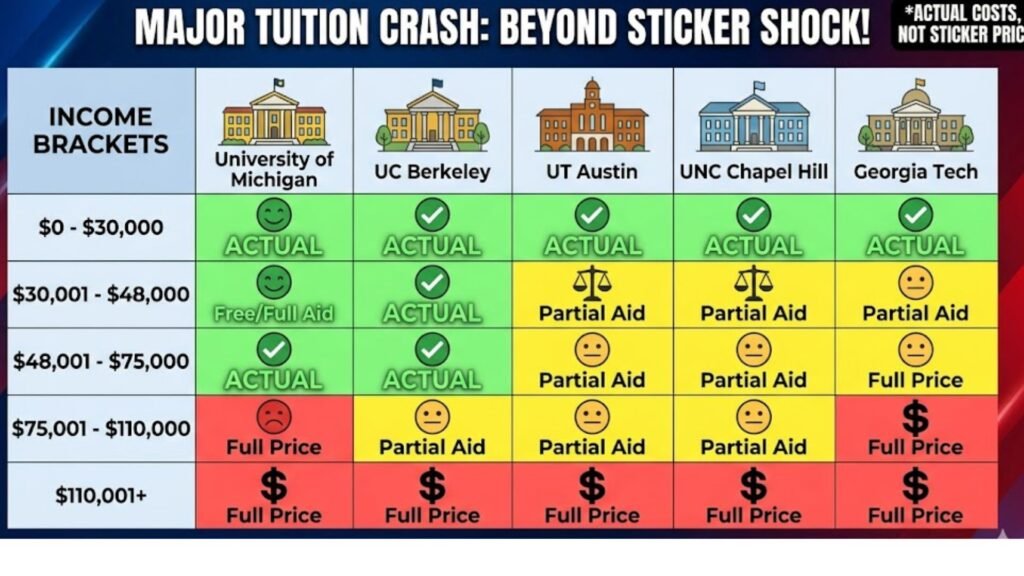
The Income Table Every Family Needs — Harvard vs Princeton vs Yale vs Columbia vs NYU
This comparison does not exist in this form anywhere else. Every figure below comes from official university financial aid publications, federal net price data, and the 2025–2026 policy announcements from each school.
Family earns $0 – $65,000 per year: Harvard covers the full cost of attendance — tuition, housing, food, fees, health insurance, and travel. The family contribution is $0. Princeton covers the full cost of attendance with no loans. Yale covers the full cost of attendance. Columbia covers full tuition plus waives the first-year summer earnings requirement and provides a $2,000 start-up grant — room and board costs remain, though additional grants reduce them significantly. NYU provides substantial aid but meets only 60–70% of demonstrated financial need, leaving a meaningful gap even at this income level.
Family earns $65,001 – $100,000 per year: Harvard continues to cover full cost of attendance — the zero-contribution threshold sits at $100,000. Princeton covers full cost of attendance, as its threshold for zero parent contribution also reaches $100,000. Yale covers full cost of attendance, matching Harvard’s $100,000 threshold for the 2026–2027 cycle. Columbia covers full tuition (the $150,000 tuition-free threshold encompasses this bracket), with room and board requiring some contribution. NYU provides partial aid with a meaningful out-of-pocket requirement remaining.
Family earns $100,001 – $150,000 per year: Harvard provides free tuition — the March 2025 expansion extended tuition coverage to all families earning under $200,000. Room, board, and fees require a modest sliding-scale contribution. Princeton covers full tuition and most additional costs for families earning up to $150,000, with all costs covered for many families in this bracket depending on assets and family size. Yale provides free tuition for families earning under $200,000 starting with the 2026–2027 academic year, with room and board on a sliding scale. Columbia provides free tuition — the $150,000 tuition-free threshold covers this entire bracket — with room and board requiring a family contribution. At this income level, Columbia’s total annual cost typically runs $15,000–$25,000. NYU typically runs $25,000–$40,000 per year after partial aid.
Family earns $150,001 – $200,000 per year: Harvard provides free tuition with modest room and board contributions on a sliding scale. For most families in this bracket, total annual cost runs $15,000–$25,000. Princeton covers full tuition for families earning up to $250,000 — room and board contributions apply, typically running $10,000–$20,000 total annually. Yale provides free tuition for families earning under $200,000, with room and board on a sliding scale. Columbia’s free-tuition policy ends at $150,000, so families above that threshold pay tuition on a partial basis. Total annual cost at Columbia in this bracket typically runs $30,000–$50,000. NYU typically runs $40,000–$65,000 per year with partial aid.
Family earns $200,001 – $250,000 per year: Harvard’s free-tuition threshold ends at $200,000. Families above this threshold may still qualify for need-based aid depending on assets, number of children in college, and other circumstances, but the university does not publish fixed rates for this bracket because calculations are individualized. Princeton covers full tuition for families earning up to $250,000 — many families in this bracket pay only room and board, running approximately $20,000–$25,000 per year total. Yale families above the $200,000 threshold pay tuition on a sliding scale with additional aid possible depending on circumstances. Columbia families in this bracket pay significant tuition on top of room and board, with total annual costs often running $60,000–$80,000. NYU families in this bracket typically pay full or near-full sticker price.
The pattern that emerges from this table explains why Princeton consistently reports one of the lowest average net prices among all Ivy League schools — roughly $15,000 per year — compared to Harvard at around $17,500, Yale slightly higher, and Columbia at roughly $20,000–$21,000. Princeton’s policy of no loans since 2001, combined with the highest tuition-free income threshold in the Ivy League at $250,000, produces the most generous outcomes across the widest range of family incomes.
The Policy Difference That Changes Everything for International Applicants
Every Ivy League school presents itself as generous with financial aid. For domestic US students, that generosity is largely consistent across the group. For international students, a single policy distinction separates the schools into 2 fundamentally different categories.
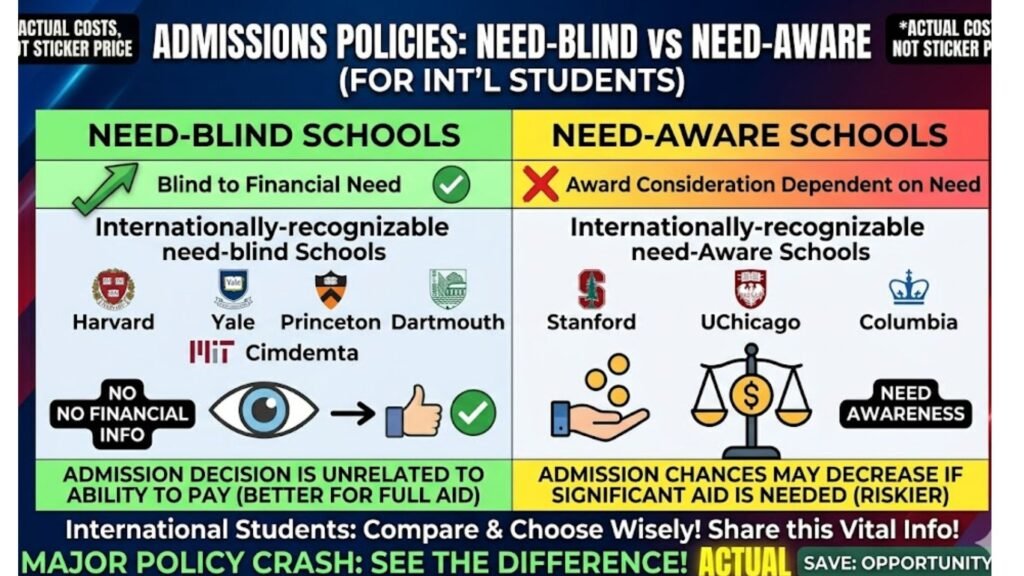
Harvard, Princeton, Yale, Dartmouth, and Brown now practice need-blind admissions for international undergraduate applicants. Need-blind means the admissions committee reviews an international application without any knowledge of whether the student has applied for financial aid. The financial need plays zero role in the admission decision. If the school admits the student, it then commits to meeting 100% of demonstrated financial need through institutional grants — no loans included.
Columbia, Penn, and Cornell practice need-aware admissions for international applicants. The admissions committee knows whether an international applicant has requested financial aid, and that information can influence the admission decision. Columbia is direct about this: the admissions process for international students considers how much financial aid a student requires when evaluating the application.
Columbia does meet 100% of demonstrated need for every international student it admits — the distinction is not in the generosity of aid for admitted students but in whether the need can affect admission itself. The complication is that reaching admission as a need-aware international applicant carries a higher barrier than reaching admission as a need-blind international applicant at Harvard, Princeton, or Yale.
The strategic implication is clear. International students who require significant financial aid should build their applications around the 5 need-blind schools — Harvard, Princeton, Yale, Dartmouth, and Brown — as their primary targets. Columbia remains worth applying to for international students who need aid, but the admission probability for high-need international applicants is lower than at need-blind peers.
One additional rule at Columbia specifically affects international applicants: the financial aid declaration must happen at the time of application submission, not after. An international student admitted to Columbia without requesting financial aid cannot subsequently apply for it, except in cases of severe and unforeseen changes in family circumstances reviewed individually. Columbia cannot guarantee aid in later years for students not awarded it at admission. This policy has significant consequences for international families who underestimate their need during the application process.
Columbia vs. NYU — The Real Cost Comparison in 2026
Students admitted to both Columbia and NYU face a comparison that looks simple on paper — both schools sit in New York City, both charge roughly $92,000–$97,000 in sticker price — but resolve very differently once financial aid enters the calculation.
On net price, Columbia wins clearly for most aid-eligible domestic students. Columbia’s average net price runs roughly $20,000–$21,000 per year. NYU’s average net price runs notably higher, often estimated around $30,000 per year. The gap runs close to $10,000 per year, or close to $40,000 over 4 years. More Columbia students receive grant aid than NYU students do, and Columbia’s average grant award is also larger. Columbia meets 100% of demonstrated financial need. NYU meets approximately 60–70%.
For a domestic family earning $100,000 per year, Columbia’s aid formula produces tuition-free status plus partial room and board coverage. NYU’s aid formula produces partial aid that still leaves a significant annual gap. A student choosing NYU over Columbia for financial reasons, without running both schools’ net price calculators, almost certainly makes the wrong financial decision.
The academic and campus experience comparison runs in a different direction. Columbia is an Ivy League school with a defined residential campus covering 36 acres in Morningside Heights, a mandatory Core Curriculum that occupies roughly one-third of total course load, and an acceptance rate of around 4% for the Class of 2030, which received approximately 57,000 applications. NYU admits a higher percentage of applicants, operates without a traditional campus across Greenwich Village, runs the largest private university enrollment in the United States, and maintains extensive global campuses in Abu Dhabi, Shanghai, and other cities.
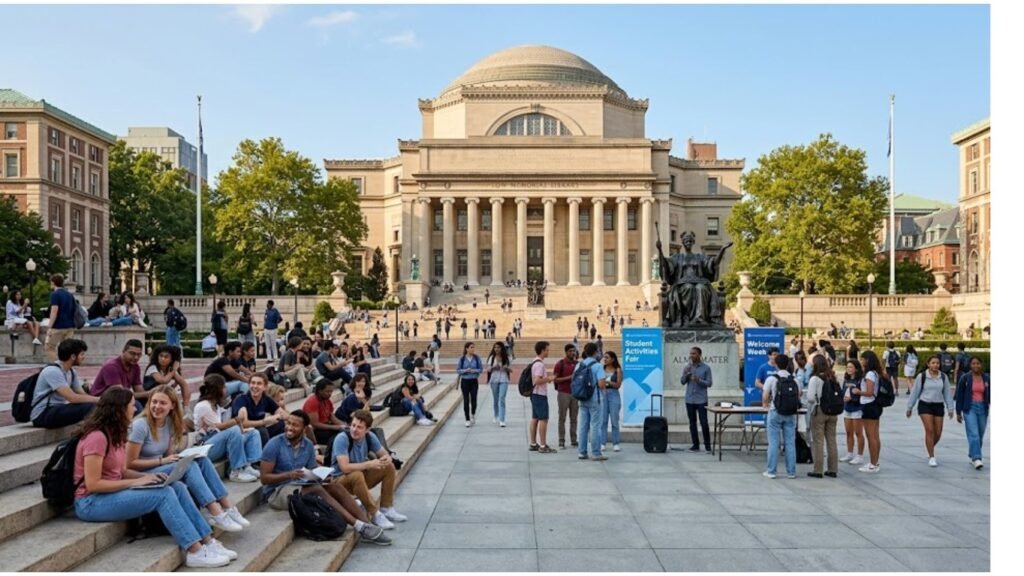
For a student who qualifies for substantial need-based aid and wants an Ivy League residential experience in New York City, Columbia at roughly $20,000–$25,000 per year in net cost is a more financially sound choice than NYU at $30,000–$40,000 per year. For a student paying full price at both, the decision comes down entirely to program fit, campus environment, and career outcome data specific to the intended field.
What Students Who Attend Columbia Actually Pay — In Their Own Words
The income tables above give the policy picture. Real student accounts give the experience.
A Columbia engineering graduate who received financial aid described a tuition bill of approximately $80,000 per year with around 80% covered by Columbia’s institutional grant, leaving an out-of-pocket annual cost near $16,000 before work-study earnings. That student qualified for work-study and used campus employment to reduce the remaining balance further. The experience aligned closely with Columbia’s stated policy for families in the $65,000–$100,000 income range.
A student sharing off-campus housing near Columbia’s Morningside Heights campus reported splitting a 2-bedroom apartment with 2 other graduate students at $3,400 per month total — approximately $1,133 per person. That figure represents a below-average rent for the Columbia neighborhood, achieved through shared housing. Students living in Columbia’s guaranteed on-campus housing pay $13,222 per year for room — roughly $1,102 per month — which Columbia’s financial aid formula accounts for in calculating family contribution.
A chemical engineering student described the course curriculum as practical and industry-relevant, updated to reflect where the field is moving rather than where it has been, and noted the TA employment opportunities in the second semester as a meaningful source of income during the academic year. Columbia’s work-study program runs an average of 7 hours per week for participating students, allowing campus employment without significant disruption to academic workload.
These accounts reflect a consistent pattern: for students who receive Columbia aid, the experience is financially manageable in a way the sticker price does not suggest. For students who do not receive aid and pay near-full price — whether because family income exceeds the aid thresholds or because they are international students admitted without a financial aid declaration — the cost is genuinely large, and the debt load requires careful consideration against expected post-graduation earnings.
What Happens When Columbia Rejects You — The Honest Roadmap
Columbia’s roughly 4% acceptance rate means the overwhelming majority of applicants receive a rejection. That is not a reflection of individual inadequacy — it is arithmetic. With around 57,000 applications and approximately 2,400 admission spots, even a perfect applicant profile carries better odds of rejection than admission in any given year.
Columbia does not offer appeals for denied applicants. A rejection in the regular decision round closes the file for that admissions cycle. Two options remain for students who want to pursue Columbia specifically: reapply as a first-year applicant in the following admissions cycle with a materially stronger application, or apply as a transfer student after one or more years at another institution. Columbia welcomes over 125 transfer students annually.
For students who applied Early Decision and received a deferral rather than an outright rejection, the path differs. Columbia has historically admitted around 10% of deferred Early Decision applicants in the regular decision round. A Letter of Continued Interest submitted promptly after deferral, filled with Columbia-specific reasons — not generic statements that could apply to any university in New York — strengthens the deferred application. Specificity matters: references to particular faculty members, specific Columbia programs, research centers, or aspects of the Core Curriculum that connect directly to the applicant’s stated academic interests carry more weight than general statements of enthusiasm.
For students who had Columbia as a top choice and received a rejection, the practical reality is that peer institutions with comparable academic quality exist across the selectivity spectrum. NYU, Boston University, Northeastern, Georgetown, Tulane, and the University of Michigan all produce graduates who enter the same industries — finance, law, technology, consulting, medicine — with strong outcomes. The Columbia brand carries genuine weight in certain industries and graduate school admissions. It does not carry exclusive access to outcomes that other strong institutions cannot also produce.
Students on the Columbia waitlist in 2025 experienced an unusually active notification period. The yield rate at Columbia dropped as some admitted students chose competitor schools amid campus unrest and federal funding uncertainty, creating additional waitlist movement. That pattern may or may not continue for the Class of 2030.
The CSS Profile — What the Application Actually Requires
Understanding financial aid starts before submitting an application, because the financial aid documentation process runs parallel to admissions and carries its own deadlines that differ by school.
Every Ivy League school requires the CSS Profile for institutional need-based aid consideration. The College Board’s CSS Profile collects detailed financial information beyond what the FAFSA captures: home equity, retirement account balances, business ownership and valuation, unusual medical expenses, and other factors that affect a family’s true financial picture. Columbia’s CSS school code is 2116, specifically for Columbia College and The Fu Foundation School of Engineering and Applied Science — using the wrong school code means the financial aid office does not receive the materials.
Domestic US applicants submit both the FAFSA and CSS Profile. The FAFSA becomes available October 1 each year for the following fall enrollment. Columbia uses prior-prior year income — meaning a student enrolling in fall 2026 submits 2024 tax year income data. International applicants submit the CSS Profile only, since FAFSA eligibility requires US citizenship, permanent residency, refugee visa status, or DACA status.
Columbia requires financial information from both biological or adoptive parents in cases of divorce or separation, with a petition process available for cases where parental contact is genuinely impossible. The university reviews special circumstances individually and adjusts financial aid calculations when documentation supports it — job loss, major medical expenses, significant decline in business income, or other events that materially change what a family can contribute.
The CSS Profile itself costs $25 for the first school and $16 for each additional school. Columbia provides automatic fee waivers to qualifying domestic applicants at the time of CSS submission. International applicants who find the fee burdensome can email Columbia’s financial aid office to discuss the fee waiver process.
The One Step Most Families Skip That Changes the Entire Decision
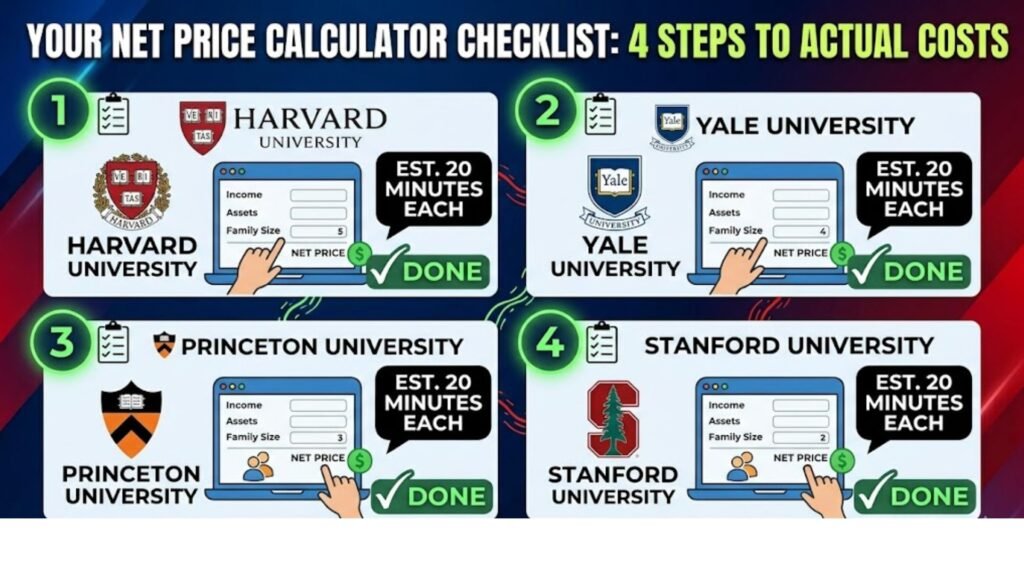
Columbia’s net price calculator, along with calculators at Harvard, Princeton, and Yale, produces an individualized estimate of what a family would actually pay. The process takes approximately 20 minutes per school and requires access to the family’s most recent tax return. The results, in most cases, reveal a number dramatically lower than the sticker price.
The families who benefit most from Ivy League financial aid are consistently those who look at $96,990 and never run the calculation. A family earning $85,000 per year that never uses Columbia’s net price calculator because the sticker price looks unaffordable misses an outcome where Columbia costs the family roughly $15,000–$20,000 per year — less than many state flagship universities charge out-of-state students, and comparable to in-state tuition at some public universities when room and board are included.
Princeton’s net price calculator at admission.princeton.edu, Harvard’s calculator at college.harvard.edu/financial-aid, Yale’s calculator at finaid.yale.edu, and Columbia’s calculator at cc-seas.financialaid.columbia.edu/content/npc all produce binding estimates grounded in each school’s actual aid formula. Running all 4 takes under 90 minutes total. The information those 4 calculations return shapes a college list more accurately than any ranking, reputation comparison, or campus tour.
The Ivy League’s fundamental promise on financial aid — meeting 100% of demonstrated need with no loans at Harvard, Princeton, Yale, and Columbia for admitted domestic students — has been in effect long enough to produce consistent, verifiable outcomes. The sticker price is what approximately 30–50% of families pay. For everyone else, the calculation looks entirely different.
External Links:
Harvard: https://college.harvard.edu/financial-aid/net-price-calculator
Yale: https://finaid.yale.edu/estimate
Columbia: https://cc-seas.financialaid.columbia.edu/content/npc
Princeton: https://admission.princeton.edu/cost-aid (financial aid/cost section
Columbia Financial Aid: https://cc-seas.financialaid.columbia.edu/
Harvard Financial Aid: https://college.harvard.edu/financial-aid
Yale Financial Aid: https://finaid.yale.edu/
FAQS:
Is Columbia the hardest Ivy to get into?
It’s close to the top, but the honest answer is that asking “which Ivy is hardest” is a bit like asking which mountain is tallest when three peaks are within a few feet of each other. Columbia’s acceptance rate hovers around 4%, and so does Harvard’s, and so does MIT’s in some years. What actually makes Columbia feel harder for a lot of applicants is the volume — nearly 57,000 people apply for roughly 2,400 spots, partly because the Common App makes it easy to add “just one more school,” and Columbia’s New York location pulls in applicants who might not otherwise consider an Ivy. The practical takeaway: treat Columbia, Harvard, and Princeton as equally selective when building a college list, not as a ranked ladder.
Is Columbia a top 10 university?
Yes, almost always — Columbia sits in roughly the 8 to 12 range on US News, depending on the year’s methodology tweaks. But here’s the thing that doesn’t show up in the ranking number: Columbia’s “top 10” status is built heavily on its graduate schools (Journalism, Law, Business, SIPA) and research output, not purely on undergraduate teaching metrics. For a student choosing where to spend four years, the ranking tells you Columbia has the resources and faculty of a top-10 institution — it doesn’t tell you whether the undergraduate experience (Core Curriculum, class sizes, urban campus) fits how that particular student wants to learn. Worth looking at separately from the number.
Is Harvard or Columbia better?
The one concrete difference that actually matters for most applicants, especially international ones, is the financial aid policy difference covered earlier in this guide: Harvard is need-blind for international students, Columbia is need-aware. If you’re an international student who will need significant aid, that single policy can affect your odds at Columbia in a way it won’t at Harvard. Beyond that, it genuinely comes down to fit — Columbia’s mandatory Core Curriculum means every student takes the same foundational courses regardless of major, which some students love and others find restrictive. Harvard has more flexibility in the first two years. Neither school is “better” in a way that shows up on a resume differently.
What GPA is needed to get into Columbia?
There’s no official cutoff, but here’s a number that’s more useful than a GPA range: roughly 95% of Columbia’s admitted students rank in the top 10% of their high school class. That framing matters because GPA scales differ wildly between schools — a 3.9 at a school with brutal grade deflation can mean something very different from a 3.9 at a school where most students cluster near the top. Columbia’s admissions readers are looking at GPA in the context of your school’s grading patterns, not as a standalone number. If your school provides a class rank or a grading distribution, that context often does more work than the GPA itself.
-
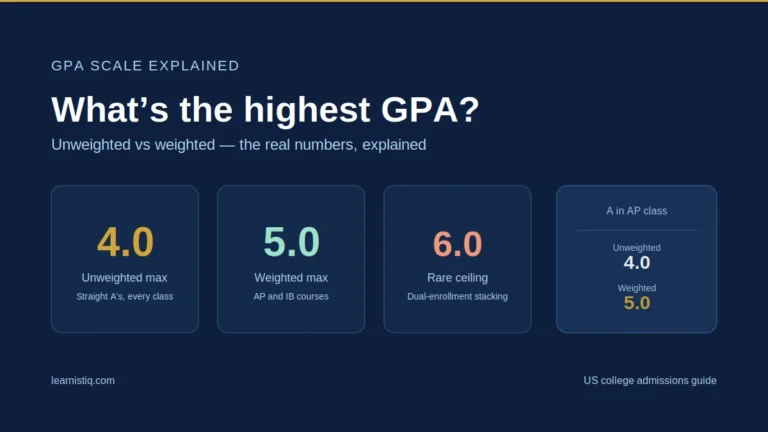
What is the Highest GPA? The Real Numbers Behind 4.0, 5.0, and Beyond
Ask a school counselor what the highest GPA is, and she’ll answer with a question of her own: weighted or unweighted? That’s not her dodging the question. That’s the whole answer. 4.0 caps the unweighted scale, full stop. A weighted scale blows past it, usually landing at 5.0. Sometimes higher than that. Most students run … Read more
-
Yale University: The Complete Guide (2025–2026)
There are universities, and then there is Yale. Sitting in the heart of New Haven, Connecticut, this private research university does not just educate — it shapes the world. As a member of the Ivy League, Yale carries a weight that few institutions can match. Founded in 1701 by Congregationalist clergy of the Connecticut Colony, … Read more
-
The University That Almost Never Existed — And Changed the World Anyway
There is a small detail about Princeton University that most people never think about. When the four founding ministers sat down in 1746 to petition for a college charter, the first governor they approached said no. A flat rejection. If a different man had been in charge that day — if history had turned slightly … Read more


Every article on Learnistiq is written by Shahzaib Khan — an education
researcher who has spent years studying university admissions,
scholarship systems, and online education across Pakistan, the USA,
the UK, and Germany.
Shahzaib started Learnistiq because he saw students making expensive
mistakes — choosing the wrong university, missing scholarship deadlines,
or believing myths about online degrees. This platform exists to fix that.
No AI-generated filler. No copy-paste from official university websites.
Every guide is researched, fact-checked, and written to actually help
you make a better decision.