
There is a small detail about Princeton University that most people never think about.
When the four founding ministers sat down in 1746 to petition for a college charter, the first governor they approached said no. A flat rejection. If a different man had been in charge that day — if history had turned slightly differently — there would be no Princeton. No Woodrow Wilson presidency. No Richard Feynman unraveling quantum mechanics. No Jeff Bezos building the company that would reshape global commerce. No Alan Turing laying the theoretical foundation for every computer you have ever used.
It almost did not happen.
That tension — between what Princeton is and what it so nearly was not — runs through every chapter of this institution’s story. Princeton University did not become one of the world’s greatest universities by following a plan. It became great through a series of accidents, arguments, wars, riots, and the occasional visionary who arrived at exactly the right moment.
This is that story. And along the way, it answers every serious question you might have about what Princeton actually is, what it takes to get in, what happens when you are there, and why — nearly 280 years after that first charter was signed — it still matters.
Quick Facts
| Detail | Information |
| Founded | October 22, 1746 |
| Location | Princeton, New Jersey, USA |
| Type | Private Ivy League Research University |
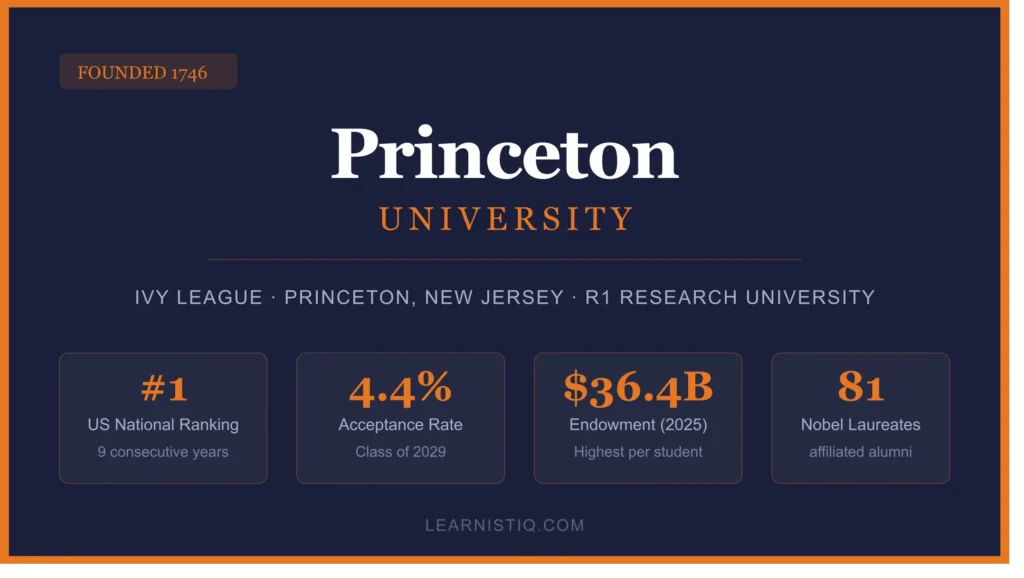
| Endowment | $36.4 billion (2025) |
| Undergraduate Enrollment | 5,813 (Fall 2024) |
| Graduate Enrollment | 3,324 (Fall 2024) |
| Acceptance Rate | 4.4% (Class of 2029) |
| US News Ranking | #1 National University (2024) |
| Student-to-Faculty Ratio | 5:1 |
| Campus Size | 600 acres |
Table of Contents
The Accidental University: How Princeton Was Born from a Church Fight
Most great universities have a founding myth. Princeton’s founding is stranger than most because it is essentially true.
In the early 1740s, the Presbyterian church in colonial America was tearing itself apart. A religious revival movement called the Great Awakening was spreading through the colonies, and it was deeply controversial. The New Light Presbyterians — those who embraced the revival — were expelled from the Synod of Philadelphia in 1741. Rather than accept this defeat, they decided to build something that could not be taken from them: a college.
The founding ministers were dissatisfied on multiple fronts. Harvard and Yale had both opposed the Great Awakening. A small seminary in Pennsylvania called the Log College, founded by a minister named William Tennent, had produced inspired graduates but was too informal and too limited to train the next generation of leaders. And there was a simple geographic reality: in 1746, no college existed between Yale in Connecticut and the College of William and Mary in Virginia. The entire middle stretch of colonial America had nowhere to send its students.
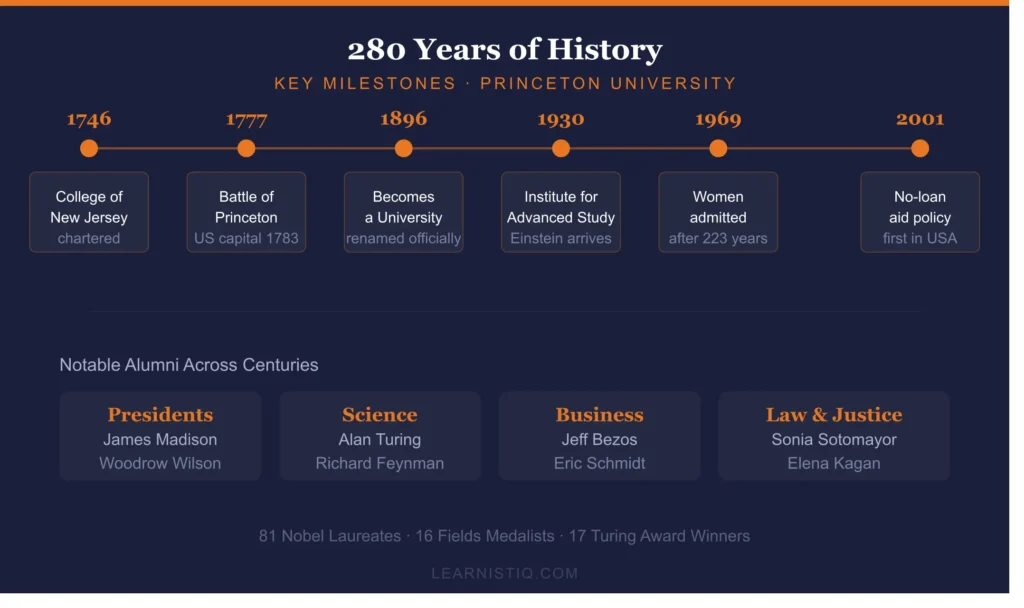
New Jersey became the answer. On October 22, 1746 — after the Anglican governor rejected the initial petition and the acting governor John Hamilton signed it instead — the College of New Jersey was chartered. Classes began the following year in Elizabeth, New Jersey, held in the home of the college’s first president, Jonathan Dickinson. From the beginning, the institution was open to students of any religious denomination. That was not a small thing in 1746. It was a deliberate statement about what kind of place this would be.
Within a decade, the college had outgrown its first home. It moved to Newark after Dickinson’s death, then relocated in 1756 to its permanent home in Princeton, New Jersey — a location recommended by the college’s powerful patron, Governor Jonathan Belcher, who had become disenchanted with his own alma mater Harvard and effectively adopted this young institution as a replacement.
The building waiting for them in Princeton was Nassau Hall — named for King William III of England, a member of the House of Orange-Nassau. When it was completed in 1756, it was the largest building in the American colonies.
When Princeton Became the Capital of a Nation
Here is something that does not appear on most Princeton promotional materials: for four months in 1783, Princeton was the capital of the United States.
The Continental Congress convened in Nassau Hall during the summer and fall of that year, and it was there — in that same building where Princeton students had once attended classes — that Congress received official word of the peace treaty ending the Revolutionary War with Britain. The new republic had its first capital in a college town in New Jersey.
This was not the only time Princeton found itself at the intersection of American history and violent conflict. In January 1777, the Battle of Princeton was fought on and around the campus itself. British soldiers occupied Nassau Hall. George Washington drove them out. The battle was a turning point in a war that was, at that moment, going badly for the American side.
The man most responsible for Princeton’s early intellectual character was John Witherspoon, who became president in 1768 and stayed until his death in 1794. Witherspoon was Scottish, scholarly, and deeply serious about what a college should accomplish. He believed that a university existed to prepare people for leadership — not just in the church, but in civic life, law, business, and politics. He tightened academic standards, broadened the curriculum, and pushed students to think about the world beyond scripture.
He was also the only college president to sign the Declaration of Independence.
Under Witherspoon’s influence, Princeton graduates became disproportionately represented among the architects of American democracy. James Madison — who would become the fourth U.S. president and the primary author of the Constitution — was a Princeton man. The tradition of Princeton shaping American political life did not start with Woodrow Wilson. It started here, in the 18th century, when the college was still called the College of New Jersey.
Fire, Riots, and the Long Road to Becoming a University
The 19th century at Princeton was, by almost any measure, chaotic.
Nassau Hall burned twice — once in 1802 and again in 1855. There were student riots serious enough to bring in outside intervention. Enrollment collapsed at one point so severely that the president at the time, James Carnahan, reportedly considered simply closing the institution. Princeton’s alumni association — led by James Madison himself — was essentially created as an emergency fundraising measure to keep the college alive.
What saved Princeton, more than once, was the arrival of the right person at the right moment. The most consequential of these was James McCosh, who took over the presidency in 1868 and found an institution weakened by the Civil War. With one third of its pre-war students having come from the South, enrollment had collapsed when those students left in 1861. The campus declared for the Union — it even awarded an honorary degree to Abraham Lincoln — but the war left deep financial and psychological scars.
McCosh spent twenty years rebuilding. He overhauled the curriculum. He recruited distinguished faculty from Europe and across the United States. He oversaw a wave of construction in the High Victorian Gothic style that gave Princeton its first coherent architectural identity. He presided over the launch of extracurricular life as we now understand it — the Glee Club, the first intercollegiate football team, the earliest eating clubs. In 1879, he awarded Princeton’s first doctoral degrees.
In 1896, the institution officially became Princeton University. The Graduate School was formally established four years later. The transformation from colonial seminary to research university was complete.
The President Who Reinvented the Classroom (Then Ran the Country)
Woodrow Wilson arrived at Princeton’s presidency in 1902 with a specific problem to solve. The university had grown in prestige but the quality of undergraduate education had quietly deteriorated. Students were coasting. Faculty were lecturing into large, passive rooms. The connection between professor and student had broken down.
Wilson’s solution was radical for its time. In 1905, he introduced the preceptorial system — small weekly discussion groups in which eight to ten students met directly with an expert in their field. Not a teaching assistant. Not a graduate student running through problem sets. An actual faculty member, engaging directly with undergraduates about ideas. It was a genuinely new concept in American higher education at the time, and it transformed the quality of learning at Princeton overnight.
Wilson also restructured the undergraduate curriculum so that students built a broad intellectual foundation in their first two years before concentrating deeply in a single discipline in their junior and senior years. He pushed to make research central to what seniors did — independent work that would eventually become the Princeton senior thesis, one of the defining experiences of undergraduate education there today.
He failed at some things. He tried to eliminate the eating clubs and proposed replacing them with residential quadrangles. The eating clubs survived. He also kept Princeton closed to Black students — a decision that his successors eventually had to reckon with publicly, leading to a building previously named in his honor being stripped of that name in 2020.
Wilson left Princeton in 1910. Two years later, he was President of the United States.
Einstein’s Neighborhood: Princeton Between the Wars
As Nazi Germany tightened its grip on Europe in the 1930s, some of the most brilliant minds on the continent began looking for a way out. Many of them ended up in Princeton, New Jersey. In 1930, the Institute for Advanced Study had been founded specifically to provide a sanctuary for pure intellectual work, free from teaching duties and administrative obligations. Albert Einstein became one of its most famous residents, spending the last two decades of his life in the town of Princeton.
Princeton’s reputation in physics and mathematics grew significantly during this period, partly because of this influx of European talent. When the United States entered World War II, that reputation became directly relevant. Princeton scientists contributed to the Manhattan Project. The entire physics department was involved in war-related research. The university offered accelerated graduation programs so students could finish their degrees before entering military service.
President Harold Willis Dodds guided the university through the Depression, the Second World War, and the Korean conflict — a run of sustained crisis that would have broken a lesser institution. He maintained academic standards throughout and established programs to help veterans return to education after discharge.
The Year Women Walked Through the Gate
For 223 years, Princeton University did not admit women.
The arguments used to justify this exclusion are painful to read now. A 1961 editorial in the student newspaper, responding to news that Princeton had admitted its first female graduate student, concluded: “Princeton is unique as an undergraduate men’s college and must remain so.” The dean of the graduate school clarified, reassuringly, that this single admission was an exception.
Eight more women enrolled in the Graduate School the following year.
By January 1969, a faculty report came out in favor of admitting women as undergraduates. That same month, the trustees voted 24 to 8 in favor. In September 1969, 101 female freshmen and 70 female transfer students arrived on campus. They were housed in Pyne Hall, and a security system was installed. According to accounts that have passed into campus legend, the women deliberately broke it within their first day.
By 1971, women were serving as trustees. By 1974, gender quotas had been eliminated entirely. In 1991, the eating clubs were required to go coeducational following a lawsuit that went to the U.S. Supreme Court. In 2001, Princeton elected its first female president: Shirley M. Tilghman, a molecular biologist who served for eleven years and significantly expanded financial aid and global programs.
The transformation that took 223 years to begin took another 32 to complete.
What Princeton Actually Looks Like: Built in Stone and Argument
Walk onto the Princeton campus for the first time and the architecture does something to you. The Collegiate Gothic style — pointed arches, carved stonework, towers that seem to have been standing since before America existed — creates an immediate sense of weight and permanence.
The oldest building is Nassau Hall, completed in 1756, which has served at various points as a colonial legislative chamber, a wartime military barracks, the seat of the United States Congress, and — since 1911, flanked by two bronze tigers — the home of the university president’s office. A cannon buried in the courtyard in front of it has been there since 1840, when Princeton students rolled it onto campus under cover of night after it was captured during the Battle of Princeton in 1777.
The Princeton University Chapel, completed in 1928 and designed by Ralph Adams Cram, seats 2,000 people and was at the time of its construction the second-largest university chapel in the world. More recently, architects including Frank Gehry, I.M. Pei, and Rafael Viñoly have added contemporary buildings that sit in deliberate contrast to the Gothic surroundings.
At the southern edge of campus lies Lake Carnegie — an artificial lake financed by Andrew Carnegie in 1906, reportedly because he hoped rowing would give Princeton students a gentlemanly alternative to football. Football survived. So did rowing.
The Princeton University Art Museum holds over 112,000 objects ranging from Greek and Roman antiquities to works by Monet, Cézanne, Van Gogh, and Andy Warhol. It is free and open to the public.
Inside the Classroom: What Princeton Actually Teaches and How
Princeton offers two undergraduate degrees: the Bachelor of Arts and the Bachelor of Science in Engineering. Students choose from 37 majors or design their own, and can pursue more than 60 minors and certificate programs. The student-to-faculty ratio is 5 to 1, and most classes have fewer than 20 students.
The preceptorial system Woodrow Wilson introduced in 1905 remains central to how Princeton teaches. Most courses combine a larger lecture with weekly precept sessions — small groups of ten to fifteen students meeting directly with faculty to argue, challenge, and build understanding through conversation rather than passive absorption.
A.B. students must complete distribution requirements across eight areas including literature and the arts, science and engineering, social analysis, and ethical thought. They must demonstrate foreign language proficiency, write two junior papers in their third year, and complete a senior thesis — a full independent research project often running 80 to 100 pages — before graduating.
The senior thesis is, for many Princeton alumni, the thing they remember most. Michelle Obama wrote her undergraduate thesis at Princeton on the experiences of Black alumni. Jeff Bezos wrote his on parallel processing in computing.
In 2026, after 133 years, Princeton announced it was ending its honor code system and introducing examination supervisors — citing a significant increase in students using artificial intelligence to cheat. It was a small institutional surrender to a large technological reality.
Graduate Education
The Graduate School enrolls roughly 3,000 students across 42 academic departments. About 40 percent are women, 42 percent are international students. The average doctoral degree takes 5.7 years to complete.
Princeton does not have a law school, a medical school, or a traditional business school. This is a deliberate choice reflecting a clear priority: undergraduate education and doctoral research come first. The School of Public and International Affairs is among the most respected policy schools in the world.
The National Laboratories
Two national laboratories operate under Princeton’s management. The Princeton Plasma Physics Laboratory grew out of a classified Cold War fusion project launched in 1951 and is today a leading global center for fusion energy research. The NOAA Geophysical Fluid Dynamics Laboratory at Princeton’s Forrestal Campus conducts climate modeling research that informs policy decisions worldwide.
In a typical year, Princeton receives approximately $250 million in sponsored research funding on its main campus, with the Plasma Physics Lab contributing another $120 million.
Princeton University Admissions: Numbers, Process, and What They Actually Mean
Admissions at a Glance (Class of 2029)
| Metric | Data |
| Acceptance Rate | 4.4% |
| SAT Range (Middle 50%) | 1490 – 1560 |
| ACT Range (Middle 50%) | 34 – 35 |
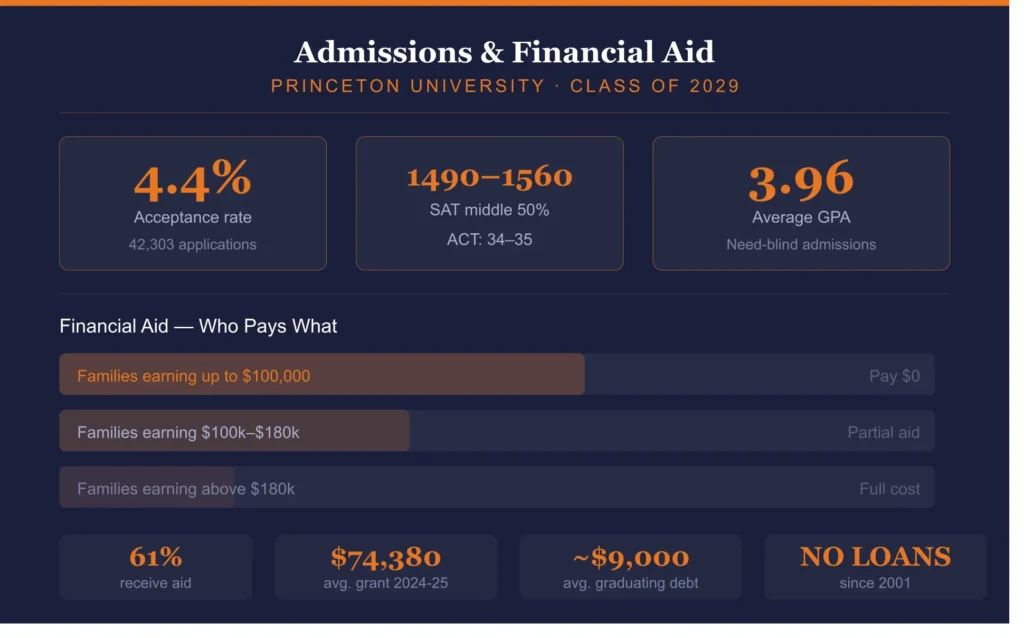
| Average High School GPA | 3.96 |
| Applications Received | ~40,000+ |
| Early Action Program | Single-choice Early Action |
| Application Platforms | Common App, Coalition App, QuestBridge |
Princeton is among the most selective universities in the world. A 4.4 percent acceptance rate means roughly 96 of every 100 students who apply — most of them extraordinarily accomplished — do not get in. But numbers alone do not tell the full story. Princeton evaluates candidates holistically. A perfect SAT score is not a guarantee of admission. What the admissions office is genuinely looking for is evidence of curiosity, independent thinking, and a sense that the applicant will contribute something real to the intellectual community.
The application requires written supplements and a graded paper submitted by the applicant — Princeton wants to see how you actually write when someone is watching.
Princeton uses single-choice early action. Students who apply early may not apply to other private universities in the same cycle. In 2018, Princeton reinstated its transfer program after a 30-year absence, with explicit priority given to students from low-income families, military veterans, and community college graduates.
Can International Students Apply to Princeton?
Yes — and this is one of the most under-discussed aspects of Princeton admissions.
Princeton actively recruits international students and is need-blind in its admissions for all U.S. citizens and permanent residents. For international students, Princeton’s admissions process is need-aware, meaning financial circumstances can factor into the decision. However, Princeton does meet 100 percent of demonstrated financial need for all admitted international students who qualify for aid. Roughly 12 percent of Princeton’s student body consists of international students from countries across the world.
International applicants follow the same application process — Common Application or Coalition Application — and must submit standardized test scores, transcripts, and English language proficiency where applicable. There is no separate international application form.
For students from countries where the SAT and ACT are not commonly administered, Princeton accepts results from these tests taken at international testing centers. The university’s financial aid office works directly with international applicants to assess needs using income documentation appropriate to their home country.
The Financial Aid Story Nobody Tells Loudly Enough
Princeton’s Cost and Aid Structure (2024–2025)
| Income Range | What Families Pay |
| Up to $65,000/year | $0 (full coverage) |
| Up to $100,000/year | $0 (full coverage) |
| Up to $180,000/year | Partial aid available |
| Above $180,000/year | Full cost of attendance |
| Average Financial Aid Grant | $57,251 |
| Students Receiving Aid | 61% of all undergraduates |
| Average Graduating Debt | ~$9,000 |
| Total Cost of Attendance | ~$82,000/year |
In 2001, Princeton became the first university in the United States to eliminate student loans from its financial aid packages entirely, replacing them with grants that never need to be repaid. That single decision changed the financial calculus of a Princeton education for thousands of students and their families.
All admissions are need-blind for domestic students. Princeton meets 100 percent of demonstrated financial need. There are no merit scholarships, no athletic scholarships. Every dollar of aid is based on financial need alone.
The average graduating debt of a Princeton student is approximately $9,000 — a figure that is frankly extraordinary for one of the most expensive institutions in the world to operate. This is the part of the Princeton story that gets significantly less attention than the acceptance rate. The university that seems most exclusive has, by certain measures, made itself more financially accessible than institutions that appear far less selective.
Living at Princeton: Traditions, Eating Clubs, and the Texture of Daily Life
Princeton guarantees housing for all four undergraduate years — an unusual commitment for a research university of its stature. More than 98 percent of undergraduates live on campus. First and second-year students are placed in one of seven residential colleges: Rockefeller, Mathey, Butler, Forbes, Whitman, Yeh, and New College West. Each college has its own dining hall, common spaces, and faculty leadership.
The Eating Clubs
Eleven private social organizations known as eating clubs line Prospect Avenue and one nearby street. They serve as dining and social centers for upperclassmen. Membership costs between $9,000 and $10,000 per year. Five clubs admit members on a first-come, first-served basis. Six use a selective process called bickering, in which prospective members are interviewed and evaluated. Princeton’s financial aid system accounts for these costs, and the clubs offer their own financial assistance. About 68 percent of upperclassmen join one.
Campus Traditions Worth Knowing
The ceremonial bonfire on Cannon Green is lit only when Princeton defeats both Harvard and Yale in football in the same season. The FitzRandolph Gates — the main ceremonial entrance to campus — are by tradition never used by undergraduates until graduation day. Annual Reunions bring tens of thousands of alumni back to campus in a gathering that has few equivalents elsewhere, culminating in the P-rade, in which alumni parade through campus organized by graduating class.
The American Whig-Cliosophic Society, founded around 1765, is the oldest collegiate political and debate society in the United States. Princeton’s WPRB at 103.3 FM is the oldest licensed college radio station in the country. The Princeton Triangle Club, founded in 1883, is the oldest touring musical-comedy theater group in America.
Princeton on the Field: A Sports Record Worth Knowing
The first intercollegiate football game in American history was played on November 6, 1869, between Princeton and Rutgers. Rutgers won. Princeton recovered — the university now claims 28 national football championships.
Dick Kazmaier won the Heisman Trophy in 1951, the last Heisman ever awarded to an Ivy League player. The Princeton offense, a patient ball-movement system developed by basketball coach Pete Carril during his tenure from 1967 to 1996, has been adopted by college and professional teams worldwide. His final game ended with an upset of defending national champion UCLA in the 1996 NCAA tournament.
The men’s lacrosse program won six national championships between 1992 and 2001. Princeton’s field hockey team won a national championship in 2012 — the first Ivy League program to do so in that sport. Princeton has won at least one Ivy League athletic championship every year since 1957 and was the first university in the conference to accumulate over 500 total Ivy League titles.
From 1896 to 2018, 113 Princeton athletes competed in the Olympic Games, winning 19 gold medals, 24 silver medals, and 23 bronze medals.
The People Princeton Made: Alumni Who Reshaped the World
Two U.S. presidents graduated from Princeton: James Madison, who wrote the Constitution, and Woodrow Wilson, who led the country through World War I. Current Supreme Court Associate Justices Samuel Alito, Elena Kagan, and Sonia Sotomayor are Princeton alumni. Michelle Obama earned her undergraduate degree there. Jerome Powell, Chair of the Federal Reserve, graduated from Princeton. Pete Hegseth, the 29th U.S. Secretary of Defense, is a 2003 graduate.
In technology: Jeff Bezos studied computer science and electrical engineering at Princeton before founding Amazon. Eric Schmidt, former chairman of Alphabet, graduated from Princeton. Pete Conrad, commander of the Apollo 12 lunar mission, studied there.
In science: Richard Feynman, one of the most important physicists of the 20th century, completed graduate work at Princeton. John Nash, whose work on game theory won the Nobel Prize and whose life inspired A Beautiful Mind, studied there. Alan Turing — who laid the theoretical foundations for modern computing and whose work helped break Nazi codes during World War II — completed his doctoral degree at Princeton in 1938.
In literature and media: F. Scott Fitzgerald attended Princeton. Nobel Peace Prize laureate and press freedom advocate Maria Ressa is a Princeton alumna. Pulitzer Prize-winning journalists Barton Gellman and Pam Belluck both hold Princeton degrees.
As of 2025, 81 Nobel laureates, 16 Fields Medalists, and 17 Turing Award recipients have been affiliated with Princeton as alumni, faculty, or researchers.
Princeton’s Unfinished History: Race, Exclusion, and Reckoning
Bruce Wright arrived at Princeton in 1936 as its first admitted Black student. He was told, upon arrival, that his admission had been a mistake. He was asked to leave. Three years later, he wrote to ask for an explanation. A Princeton dean replied that a member of his race might feel very much alone at the university.
Princeton did not meaningfully admit Black students until 1945, when the U.S. Navy’s V-12 program brought four Black naval cadets to campus. One of them, John L. Howard, graduated in 1947 and became the first Black student to receive a bachelor’s degree from Princeton.
In 2017, Princeton launched the Princeton and Slavery Project — a large-scale historical investigation into the university’s direct involvement with slavery, producing hundreds of primary sources and 80 scholarly essays. In 2018, the university named two campus spaces for James Collins Johnson and Betsey Stockton, enslaved people who had lived and worked on the Princeton campus. In 2020, Wilson College was renamed First College, acknowledging that Woodrow Wilson’s documented history of racial exclusion made his continued commemoration untenable.
These are not complete answers to an incomplete history. But they represent something genuine: an institution willing to examine its own record without the protective instinct to minimize or redirect.
Princeton and the Planet: Endowment, Finances, and Sustainability
Princeton’s endowment exceeds $36 billion — the fourth largest in the United States in absolute terms and the largest per student in the world, at over $4 million per enrolled student. The operating budget runs above $2 billion annually.
How Princeton’s operating budget is spent:
| Area | Percentage |
| Academic departments and programs | 50% |
| Administrative and student services | 33% |
| Financial aid | 10% |
| Princeton Plasma Physics Laboratory | 7% |
On sustainability, Princeton has set a target of net-zero greenhouse gas emissions by 2046. It has committed to divesting from thermal coal, tar sands, and companies involved in climate disinformation — commitments that came after sustained student and faculty pressure. Princeton is a member of the Ivy Plus Sustainability Consortium.
Frequently Asked Questions About Princeton University
What is Princeton University best known for?
Princeton is best known for being the fourth-oldest university in the United States, consistently ranking as the top national university, its need-blind admissions and no-loan financial aid policy, the preceptories teaching system, the senior thesis requirement, and producing an extraordinary number of Nobel laureates, U.S. presidents, and Supreme Court justices.
What GPA and SAT scores do you need for Princeton?
The average admitted student has a high school GPA of 3.96. The middle 50 percent of admitted students score between 1490 and 1560 on the SAT and 34 to 35 on the ACT. However, Princeton evaluates students holistically — there is no minimum cutoff score that guarantees admission or rejection.
Does Princeton University give full scholarships?
Princeton does not offer merit scholarships. All financial aid is based on demonstrated financial need. Families earning up to $100,000 per year receive full cost coverage through grants that do not need to be repaid. Princeton meets 100 percent of demonstrated financial need for all admitted students.
Can international students get financial aid at Princeton?
Yes. Princeton meets 100 percent of demonstrated financial need for all admitted international students who qualify for aid. The admissions process for international students is need-aware rather than need-blind, but admitted international students who need financial assistance will receive it in full.
What is the acceptance rate at Princeton University?
Princeton admitted 4.4 percent of applicants for the Class of 2029, making it one of the most selective universities in the world.
What is the Princeton preceptorial system?
Introduced by Woodrow Wilson in 1905, the preceptorial system supplements standard lectures with small weekly discussion groups of 10 to 15 students meeting directly with a faculty member. It remains a core feature of undergraduate education at Princeton today.
What is the senior thesis at Princeton?
The senior thesis is a full independent research project completed in the fourth year, typically 80 to 100 pages in length, conducted under faculty supervision. It is required for all undergraduate students and is widely considered the defining academic experience of a Princeton education.
Is Princeton University good for international students?
Princeton actively recruits international students, who make up approximately 12 percent of the student body. The university offers full financial aid to admitted international students who demonstrate need, maintains an active international student services office, and has partnerships and exchange programs with universities worldwide.
What are Princeton eating clubs?
Eating clubs are private social and dining organizations for upperclassmen, located primarily along Prospect Avenue. There are eleven clubs. Five admit members on a first-come, first-served basis; six use a selective process called bickering. Membership costs between $9,000 and $10,000 per year, and Princeton’s financial aid system accounts for these costs.
How does Princeton rank globally?
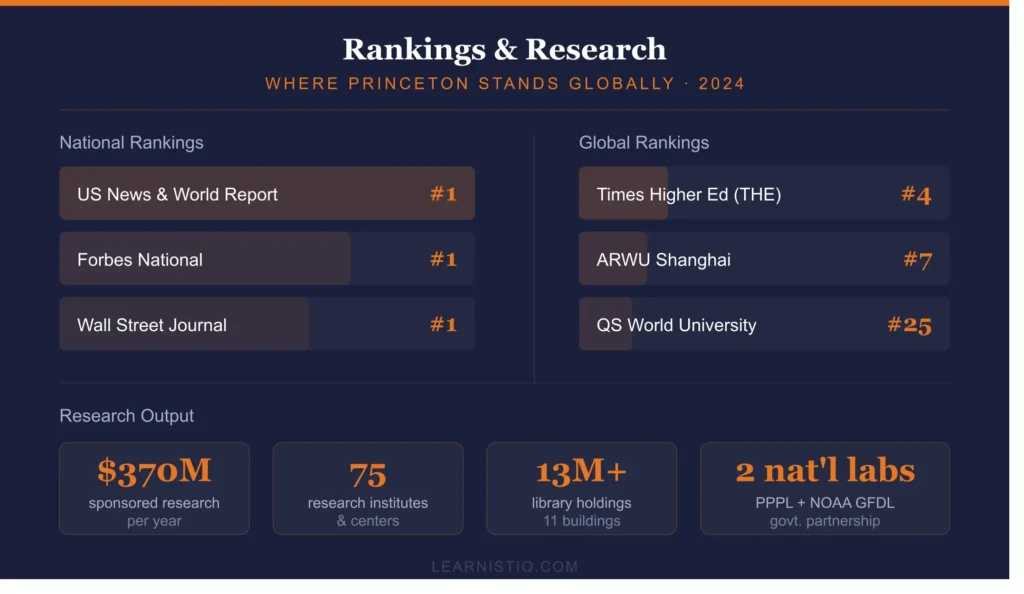
Princeton ranks first in U.S. News and World Report’s national university rankings for nine consecutive years through 2024. Globally, it ranks 7th in the ARWU, 4th in the Times Higher Education World Rankings, and 25th in the QS World University Rankings.
What Princeton Is, Honestly
Princeton ranks first in U.S. News and World Report’s national university rankings for nine consecutive years through 2024. It tops comparable lists by Forbes and The Wall Street Journal. Globally, it places among the top ten by most serious measures.
But rankings are a compressed and imperfect way to describe what a university is. Princeton is, more accurately, a specific bet about how education works: that small classes matter, that independent research matters, that the relationship between a student and a faculty member matters, and that financial circumstance should not determine who gets access to the best education available.
The median family income of Princeton undergraduates exceeds $186,000. Seventy-two percent of students come from the top 20 percent of earners. These numbers sit in uncomfortable tension with the financial aid policy and the stated commitment to access. Princeton is more accessible than it looks from the outside, and less accessible than it presents itself as being. Both things are true.
What is also true: the four ministers who decided in 1746 to build a college in New Jersey wanted to create an institution that would prepare people to lead. They could not have imagined what they were starting. But they started it. The acting governor signed the charter. And nearly 280 years later — through fires, wars, riots, exclusions, reckonings, and the occasional stroke of genuine genius — it is still going.
External Links:
https://admission.princeton.edu/cost-aid
https://admission.princeton.edu
-
Stanford University Free Online Courses 2026: Which Are Actually Worth Your Time?
Stanford university has hundreds of free online courses in 2026, and most people who start one never finish — not because the course is bad, but because nobody told them upfront what they were signing up for, which certificate actually matters, or whether they chose the right course for their goal in the first place. … Read more
-
Harvard University Is Free for Most Families — Here’s the Proof (2026)
Before You Start Reading — An Honest Warning Most articles about Harvard University are written to impress you, not to inform you. The letters start with autumn leaves in Harvard Yard they quote a Nobel laureate they list the acceptance rate. They close with something inspirational, about unleashing Harvard potential. Harvard letters are beautifully structured. … Read more
-
GCUF Admissions 2026: Fee, Closing Merit & Entry Test — Honest Guide
Every year, thousands of students from Faisalabad, Jhang, Chiniot, Toba Tek Singh, and Hafizabad ask the same question before applying to Government College University Faisalabad (GCUF): Is it actually worth it? This guide gives you the honest answer — not the official brochure version. We cover the complete GCUF admissions 2026 process, real fee structure, … Read more


Every article on Learnistiq is written by Shahzaib Khan — an education
researcher who has spent years studying university admissions,
scholarship systems, and online education across Pakistan, the USA,
the UK, and Germany.
Shahzaib started Learnistiq because he saw students making expensive
mistakes — choosing the wrong university, missing scholarship deadlines,
or believing myths about online degrees. This platform exists to fix that.
No AI-generated filler. No copy-paste from official university websites.
Every guide is researched, fact-checked, and written to actually help
you make a better decision.