
Fourteen years doing this job means I’ve sat with a lot of anxious families. Kitchen tables, living rooms, sometimes just a phone call at 11pm the night before a deadline. And the question that comes up more than almost any other? “What do you think about University of Central Punjab (UCP)?”
My answer has never been simple. Still isn’t.
The University of Central Punjab (UCP) is one of those institutions people either underestimate or overestimate, rarely neither. Parents who can’t afford LUMS sometimes treat UCP as the obvious fallback, which isn’t fair to it. And some students pick it without doing any real research, which isn’t fair to them either. This guide exists because most of what’s written about UCP online is either lifted from their own marketing material or written by someone who’s never set foot on campus.
How UCP Actually Got Started
Here’s something most people don’t know: UCP didn’t begin as a university. It started as Central Law College in 1990, operating under the Central Punjab Educational Trust. For its first twelve years, that’s all it was — a law institution with a decent reputation in Lahore, nothing more.
The HEC granted it full university status in 2002. That’s when the expansion began — new faculties, new buildings, new hiring. Engineering came online. Then Business. IT. Pharmacy. It grew quickly, maybe too quickly in some areas, but it grew.
I remember my first visit to the campus, around 2008 or 2009. The place felt unfinished in spots. Some departments were clearly further along than others. But there was something about it — you could tell the institution was building toward something rather than coasting. That instinct turned out to be right. The UCP I walk into today is a genuinely different place from what it was fifteen years ago. The infrastructure is there. The alumni base is real. The programs have proper accreditation. Whatever growing pains happened along the way, the institution came out the other side functional.
Campus and Location — What to Actually Expect
The Location Itself
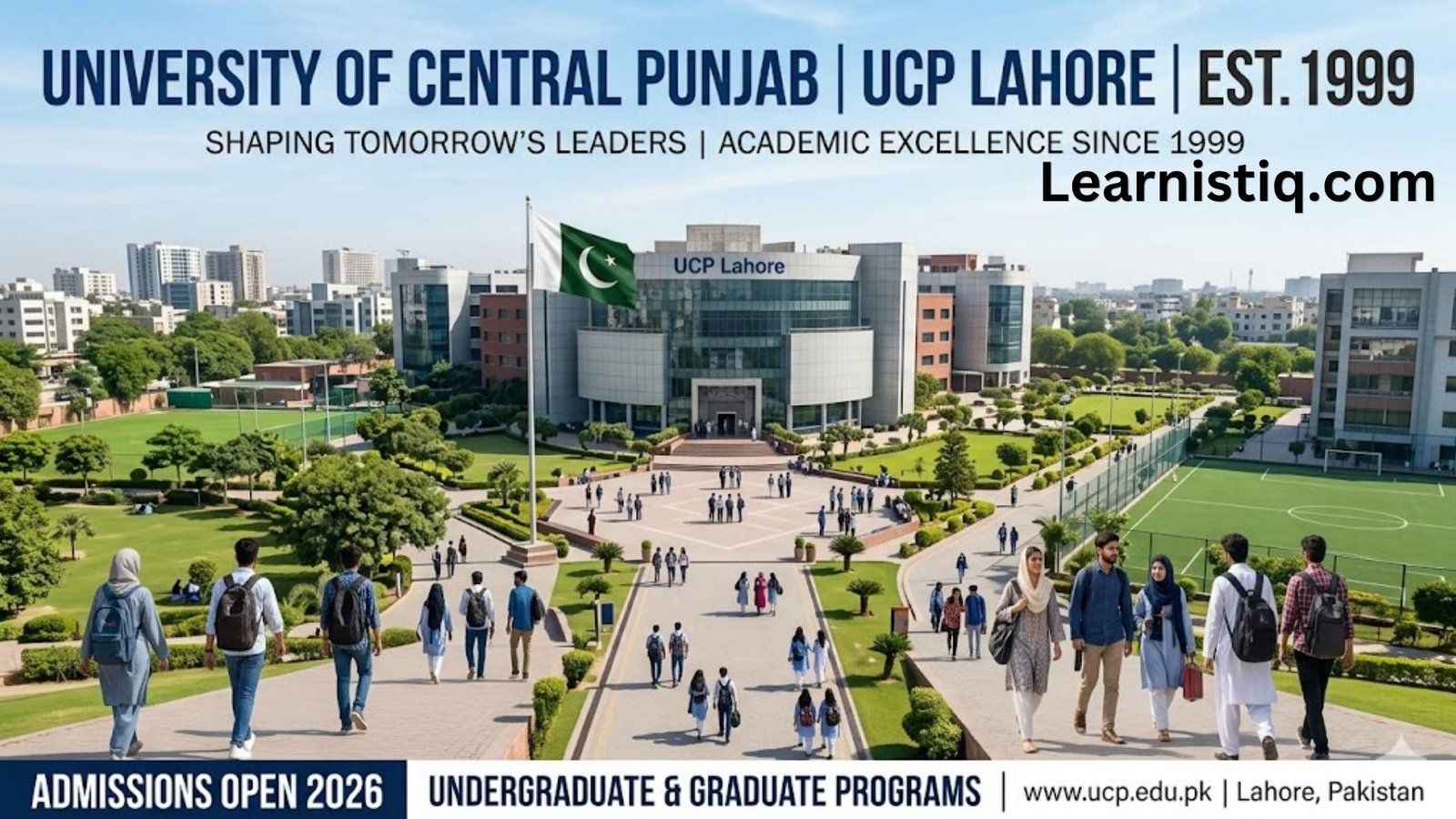
(UCP) main campus is at 1-Khayaban-e-Jinnah, Johar Town, Lahore. If you know Lahore well you know this is right, in the middle of the city. Canal Road is right there. Gulberg is minutes away. Students coming from Model Town, Garden Town, DHA — the commute is manageable for most of them.
I always bring up location when families are comparing options, because it matters more than people give it credit for. A student doing ninety minutes each way on bad roads every day is a tired student. That fatigue shows up in attendance, focus, grades. UCP’s Johar Town address is a quiet practical advantage that doesn’t make it into the rankings but absolutely affects the student experience.
There’s also a Gujranwala campus for students in that region, though the main conversation is always about Lahore.
Inside the Campus
Let me be direct about something: this is an urban campus. Don’t walk in expecting rolling green lawns and open courtyards. It’s compact, it’s in a city, and it looks like it. What it does have is well-organized, well-maintained, and clearly thought-through in terms of how the space is used.
The Business School building is genuinely impressive — purpose-built, not repurposed. It stands out even compared to some older private university campuses I’ve visited. The IT labs are regularly updated; I’ve seen them myself and the equipment is reasonable, not just decent-on-paper. Engineering workshops are functional — that’s the most honest word for them. They get the job done. The Pharmacy labs have proper analytical instruments, which matters a lot for Pharm-D students whose practical training depends directly on lab quality.
The library has a decent physical collection and digital database access including international research journals. The food court runs multiple options — cheap canteen-style food alongside a few branded stalls — and students spend a lot of time there between classes, which is honestly a good sign. A food court people actually use means students are staying on campus rather than rushing off, which means more campus life generally.
Security is solid. CCTV, controlled entry points, a visible security presence. Parents consistently mention this as a relief, especially those with daughters enrolling for the first time.
One thing I always mention that brochures never do: the parking is a problem. Peak hours in the morning, it gets congested and frustrating. If you’re driving yourself to campus, factor that in. It’s a small thing but it’s a daily thing, and daily friction adds up over four years.
Academic Programs — The Real Breakdown
Business School
This is where UCP has its strongest standing, and it’s earned. The Business School has NBEAC accreditation — that’s the National Business Education Accreditation Council — and not every business school in Pakistan has it. It’s a real quality marker, not just a certificate on a wall.
BBA runs for four years. MBA comes in 1.5 and 2.5-year variants depending on your academic background. BS Commerce, MS Management Sciences, PhD — all available.
Of all the programs I’ve sent students into at UCP, the Business School has the most consistent track record. I mean that in terms of actual jobs afterward. HBL, MCB, Engro, Packages Group, various FMCG multinationals — UCP Business School graduates turn up in these places. I know this because I’ve stayed in touch. It’s not a claim I’m making from their marketing material.
IT and Computer Science
Demand here has only grown. BSCS, BS Software Engineering, BS Information Technology — all three are offered, along with MS and PhD in Computer Science.
What’s interesting about UCP’s IT graduates specifically is how many of them ended up in remote work for international clients. I know an alumnus who graduated in 2015 and now leads a development team for a European fintech company, entirely remotely from Lahore. He’s not unusual. The CS and SE alumni who were proactive about building skills — not just collecting the degree — have done very well in the post-pandemic remote work market. Faculty industry connections are decent, placement in tech is one of UCP’s better stories.
Engineering
Two words matter here: PEC accreditation. Before you enroll in engineering at any Pakistani university, confirm it. A degree without Pakistan Engineering Council accreditation is professionally useless for licensed practice in Pakistan. UCP’s Electrical, Civil, and Mechanical Engineering programs have it.
Is UCP’s engineering faculty the strongest in Lahore? No, I wouldn’t say that. FAST and some others have stronger specialized engineering cultures. But UCP’s programs are accredited, they’re solid, and for a student who wants engineering within a full university environment — campus life, mixed social experience, extracurriculars — rather than a purely technical atmosphere, it works well. MS programs are available in Electrical and Civil Engineering too.
Law
Law is where UCP’s roots are, and it shows. The LLB program is five years long, integrated, and recognized by the Pakistan Bar Council. LLM is available for those continuing post-LLB. The faculty includes practicing lawyers alongside academics, which is actually important — you learn law differently from someone who was in court last week versus someone who only reads it.
Moot court culture here is active. Students participate in national competitions, they argue cases, they build the muscle memory of advocacy before they ever step into a real courtroom. For a private university law program in Lahore, this one has genuine depth that comes directly from its institutional history.
Pharm-D
Five-year program, recognized by the Pharmacy Council of Pakistan. For students who want to work in healthcare but aren’t going the MBBS route — or didn’t make the MDCAT cut — this is a credible option among Lahore’s private universities. Labs are properly equipped. Faculty has clinical connections. Worth knowing: this program has the highest fees in the university’s portfolio, so plan accordingly.
Psychology, Media, Arts and Social Sciences
These faculties don’t get much attention in the usual UCP conversation, which is unfair to them. Psychology enrollment has grown sharply over the past few years as mental health awareness has increased in Pakistan — the faculty has qualified clinical psychologists on staff, and graduates are finding their way into counseling, HR, and organizational behavior roles.
Mass Communication and Journalism has studio facilities, a practical curriculum, and genuine ties to Lahore’s media industry. BS English and Sociology round out the offerings.
Here’s something I’ve noticed with these smaller faculties: because they’re not the flagship programs, class sizes tend to be smaller, professors are more accessible, and individual students get more attention. Some of my students who were worried about getting lost in a large department specifically chose Psychology or English at UCP for this reason, and most of them don’t regret it.
Sciences
Mathematics, Statistics, Biotechnology at BS level, with some postgraduate options. These are niche programs at UCP. The students who come in knowing exactly why they want these fields tend to do fine here.
Getting into UCP in 2026 — Process, Requirements, Timing
For undergraduate programs — BBA, any BS, LLB — you need intermediate with a minimum 50% mark for most programs. Pharm-D requires FSc Pre-Medical. Engineering requires FSc Pre-Engineering. If you’re coming from A-Levels, get your IBCC equivalence certificate sorted before you apply, not after. That process takes time and students consistently underestimate it.
For postgraduate — MBA, MS, LLM — you need a 16-year bachelor’s degree in a relevant field and a CGPA of at least 2.0 to 2.5 depending on the program.
The process itself: apply online through UCP’s portal, upload clear scans of your documents (blurry uploads get rejected and cause delays — I’ve seen this hold students up), sit UCP’s entry test (some programs also accept NTS, confirm for your specific program rather than assuming), go through an interview if your program requires one, check the merit list when it’s announced, and submit your fee the moment you’re selected.
That last step — I can’t stress it enough. There is a deadline on fee submission after selection, and it’s tight. I’ve watched students lose their confirmed seats because they waited a week too long on the fee payment. Once you’re selected, get that payment done.
For Fall 2026, expect applications to open around June-July with entry tests in July-August. Dates shift a bit each cycle — confirm on ucp.edu.pk. And apply in the opening week of applications if you’re targeting BSCS, BBA, or Pharm-D. Those programs fill up fast and later applicants face a steeper climb.
Fees and Scholarships — Numbers Without the Marketing Spin
These are approximate figures based on recent trends. Always verify current numbers directly with UCP before making any financial decision.
| Program | Approximate Semester Fee (PKR) |
| BBA / BS Commerce | 90,000 – 130,000 |
| BS Computer Science / Software Engineering | 95,000 – 135,000 |
| BS Electrical / Civil / Mechanical Engineering | 100,000 – 145,000 |
| LLB | 80,000 – 110,000 |
| Pharm-D | 130,000 – 160,000 |
| BS Psychology / Mass Communication | 75,000 – 100,000 |
| MBA | 100,000 – 150,000 |
A BBA student is looking at roughly PKR 180,000 to 260,000 per year in tuition. That’s not LUMS money, but it’s not small money either. And fees have gone up every year for the past several years without exception. When you’re budgeting for a four-year degree, assume the number in year four will be higher than the number in year one.
Scholarships
They exist and they’re real. But they’re not automatic.
Students with 80% or above in both matric and intermediate are typically eligible for merit-based fee concessions. Top performers in UCP’s own entry test can also qualify for merit awards. Need-based financial aid is available with income documentation. HEC runs its own need-based scholarship program that UCP students can apply to — competitive but worth the effort. Sibling discounts exist for families with multiple UCP students. Faculty and staff children get institutional discounts. Hafiz-e-Quran concessions are available. Sports scholarships exist for athletes in cricket and football.
The issue isn’t whether these scholarships exist. The issue is that a lot of students never apply for them — because they didn’t know, because they assumed it was automatic, because they didn’t know who to call. Don’t let that be you. Call UCP’s financial aid office directly. Ask them specifically: what’s available for my program this intake, what do I need to submit, and what’s the deadline? Go in person if you can. The counter at admissions isn’t where this conversation happens — find the financial aid office specifically.
Rankings and Accreditations — The Unvarnished Version
UCP sits in HEC’s W4 category. It’s not in Pakistan’s top twenty universities by overall ranking. That’s the reality.
Some families hear that and immediately start reconsidering. I’d push back slightly on that reaction, because for most students, the more relevant question isn’t overall ranking — it’s whether the specific degree they’re getting is professionally recognized. And on that measure, UCP does well.
PEC accreditation for Engineering. Pharmacy Council recognition for Pharm-D. Pakistan Bar Council approval for LLB. NBEAC accreditation for the Business School. HEC recognition across all programs. These are the credentials that determine whether your degree opens professional doors in Pakistan, and UCP has them where they count.
The ranking matters more if you’re targeting highly competitive federal government positions that use institutional rank as a filter, or if you’re applying to selective foreign universities for a master’s degree that will scrutinize your undergraduate institution. If either of those is your path, factor the ranking into your thinking honestly. For everyone else, the program-level accreditations are what actually matter.
Why Students Pick UCP — The Real Reasons
Jobs After Graduation
Career fairs at UCP are genuine events. Companies actually show up — HBL, MCB Bank, Engro, NetSol Technologies, Systems Limited, Packages Group. The Business School and IT faculty have the most active industry connections, and placement outcomes in those two faculties are consistently the best on campus.
Is it LUMS-level placement? No. But the fee difference between UCP and LUMS is significant, and UCP’s placement outcomes are reasonable relative to what students are paying.
Faculty Quality
Business School: strong. Lots of PhD-qualified faculty, a good number with actual corporate backgrounds rather than pure academic experience. That combination matters — theory taught by someone who’s applied it lands differently.
Law: the practicing-lawyers-as-professors model works well here. Students learn from people who are active in the field.
IT: decent, with some inconsistency. Students I’ve spoken to have had great experiences in some semesters and frustrating ones in others depending on which professors they got. It’s not uniformly excellent.
Engineering and Sciences: this is where I’d apply the most caution. Faculty turnover has been a problem. Some semesters have been excellent, others have had students complaining about lack of continuity. Before committing to Engineering at UCP specifically, I’d strongly recommend talking to current students in that department rather than relying on general impressions.
Research
UCP is working on this. MS and PhD students have access to research support, publication assistance, and research centers that are gradually improving. For undergraduates, it’s essentially irrelevant to their day-to-day experience. For someone planning an academic career or needing a strong research environment for a thesis-based master’s, UCP is still behind LUMS and some public universities in this dimension. That’s not a permanent state — it’s improving — but it’s the current one.
What Student Life Actually Looks Like
Campus life at UCP is livelier than the institution’s ranking would suggest. The student society scene is genuinely active.
The Entrepreneurship Society runs real competitions — not just internal events, actual connections to Lahore’s startup ecosystem. The Debating Club participates at the inter-university level and takes it seriously. The CS Society runs hackathons and programming contests; if you’re going into CS, get involved there from semester one, not semester five. The Law Society’s moot court events are more than performative — they build actual advocacy skills. The Media Society does documentary and journalism projects with real outputs. The Literary Society runs both Urdu literary events and English ones.
These aren’t resume-stuffing clubs. The students who throw themselves into these societies come out with networks, skills, and experiences that the curriculum alone doesn’t give them. The students who skip all of it and just attend classes — they graduate with a degree and not much else, which is true at any university.
Annual events worth knowing about: the Sports Gala is taken seriously by students and genuinely competitive across faculties. Cultural Week changes the feel of campus completely — music, drama, art. The Career Fair is worth attending from third year onward; employer presence is real. Tech Fest is the IT and engineering showcase. Convocation is formal, well-organized, worth going to.
Sports facilities — cricket, basketball, football, indoor games — are functional. They’re not spectacular. Students who want to make sports a major part of their university life might find the facilities a bit limiting. For recreational use, they’re fine.
Where UCP Graduates Actually End Up
Law alumni from the early batches are now senior advocates practicing at Lahore High Court. A few have their own chambers. This is what you’d expect from a program with Law’s institutional depth at UCP, but it’s still reassuring to see it play out.
In IT, the remote-work alumni story is real and growing. I mentioned one example earlier — 2015 graduate now leading a fintech team from Lahore. He’s not the only one. The CS and SE graduates who built real skills during their degree, not just passed exams, have found international remote opportunities that simply didn’t exist ten years ago.
BBA and MBA graduates are in banking, FMCG, and consulting — middle and senior management levels for the older batches. If you search “University of Central Punjab” on LinkedIn and look at where alumni work, the picture is more respectable than the W4 ranking would imply.
The formal alumni network is still not as organized as it should be. There’s an alumni association, but it doesn’t function the way LUMS’s network does — the kind where a phone call from an alumnus actually opens doors. That’s a gap UCP hasn’t closed yet. Individual alumni are doing well; collective alumni leverage is still weak.
Honest Assessment — What’s Good, What’s Not
I can’t write this guide and only tell you the good parts. That’s not how this is useful to anyone.
UCP offers genuine program breadth — very few private universities in Lahore cover Business, Law, Engineering, Pharmacy, IT, Psychology, and Media all under one roof. The fees are mid-range — meaningfully cheaper than LUMS, broadly comparable with Bahria or UMT. The program-level accreditations are real and where they need to be. The Johar Town location is genuinely convenient. Career services are active. Campus life has energy if you engage with it.
On the other side: mid-tier HEC ranking is a real limitation for specific competitive scenarios. Faculty quality varies too much across departments — Engineering and Sciences specifically have had consistency problems. Research culture is behind where it needs to be. The campus is compact and urban with no green spaces to speak of. Parking is a daily annoyance. Fees have gone up every year and will continue to.
None of the negatives are dealbreakers on their own. But stacked together for the wrong student in the wrong program, they matter.
UCP vs Other Lahore Private Universities
| Factor | UCP | LUMS | FAST-NUCES | UMT | Bahria |
| HEC Ranking Tier | W4 | W1 | W2 | W3 | W3 |
| Fee Level | Mid | High | Mid-High | Mid | Mid |
| Business / Commerce | Strong | Excellent | Good | Good | Good |
| IT / CS | Strong | Strong | Excellent | Good | Good |
| Engineering (PEC) | Yes | Limited | Strong | Yes | Yes |
| Law | Deep heritage | Not offered | Not offered | Available | Not offered |
| Pharm-D | Yes | No | No | No | No |
| Campus Environment | Urban / compact | Spacious / premium | Urban | Spacious | Spacious |
| Industry Linkages | Good | Excellent | Strong | Good | Good |
| Research Culture | Developing | Strong | Good | Moderate | Moderate |
LUMS — if the fees are genuinely manageable for your family and your program of interest is offered there, LUMS’s brand and alumni network are real differentiators. The network specifically opens doors that other degrees don’t. This isn’t hype; it’s something I’ve watched play out repeatedly over fourteen years.
FAST-NUCES — if Computer Science or Software Engineering is your primary goal and you want a focused, technically intense environment, FAST is the stronger specialized choice. The CS culture there is different in a way that matters for certain career paths.
UCP — if you need broad program options, want solid professional accreditations across multiple fields, and need a fee structure that’s actually sustainable, UCP is a strong choice particularly for Business, Law, Pharmacy, or a well-rounded BS program. It’s not a consolation prize. It’s a legitimate first choice for the right student.
UMT — if you prefer a larger, more open campus environment and their specific programs align with your goals.
I’ve seen students thrive at all four. I’ve also seen students struggle at all four. The fit between student, program, and institution matters more than any ranking.
My Final Recommendation
After fourteen years, what I actually believe about UCP is this: it’s a solid mid-tier private university that tends to be underestimated in casual conversation and overanalyzed by families who’ve read too many ranking tables.
It’s not secretly elite. It’s not going to put the same doors in front of you that LUMS does. But for a family that can’t write that kind of tuition check — and most families in Lahore can’t — UCP offers a real, properly accredited, industry-connected degree that has sent thousands of graduates into meaningful careers. That’s not nothing. That’s actually a lot.
The students I sent to UCP who did well had some things in common. They knew why they were there. They didn’t just attend classes, they also got involved in campus life. They looked for internships on their own while waiting for the university to help them. They saw their four years as a way to prepare for a career not to get a degree.
The ones who struggled had an approach. They saw UCP as a plan they didn’t really want. They put in effort and coasted through semesters. They were surprised when just having a degree wasn’t enough to get them a job. That’s how it works everywhere.
Before you make a decision here’s my advice: visit the campus on a day not during an open house. Sit in the canteen for an hour. Get a feel for the place.
Find a student in your target department and ask them directly — how are the teachers in your department actually, are the labs functional or just present, did the career fair lead to anything real? Their answers will tell you more than any guide can.
FAQs — Straight Answers
Is the UCP degree recognized by HEC?
Yes, fully. Every program is HEC-recognized. That’s the foundational requirement and UCP meets it.
What merit do I realistically need for Fall 2026 admission?
The official floor for most programs is 50% in intermediate. The real competitive bar for BSCS, BBA, and Pharm-D is higher — because hundreds of students apply for limited seats, the effective merit ends up higher than the minimum. Entry test performance is a major factor and can compensate for a weaker intermediate score. I’ve seen students with 65% intermediate get into BSCS because their entry test was strong.
Do they accept A-Levels?
Yes, but get your IBCC equivalence certificate done early. It takes time. Students leave this too late every year.
Is the engineering degree really PEC accredited?
Yes — Electrical, Civil, and Mechanical Engineering. Verify this yourself at the time of application; accreditations are renewed periodically.
Are the scholarships real or just marketing?
They’re real. You have to apply actively. Call the financial aid office, ask what’s available for your specific program this semester, ask for the deadline, ask what documents you need. Don’t assume your grades automatically trigger anything.
Is there a hostel on campus?
The main Johar Town campus doesn’t have extensive hostel facilities. Out-of-city students typically find private accommodation nearby. Ask admissions about the current situation when you apply — it can change.
-
🎓 Student Loan for Education
A Complete Guide for Students in 2025 Meta Description:Learn everything about student loans for education . what they are, how they work, and how to apply. Discover the best options for funding your studies in 2025. Introduction: A student loan helps students cover tuition fees, books, housing, and other study-related expenses. It allows you to … Read more
-
Best Online Jobs for Students
in the time of competition learnistiq.com give you some different and unique method to earn online in 2025. Guidance for new in passion. In today’s fast paced digital age, online jobs are offering the way students work and earn. With just a laptop, an internet connection, and the right skills. Whether you’re saving for tuition, … Read more
-
EDUCATION AND TECHNOLOGY
Learn how technology is revolutionizing education in 2025. Explore trends like AI, VR, hybrid learning, and digital transformation. In today’s fast-evolving world, education and technology are no longer separate entities, they are deeply intertwined forces shaping the way we learn teach, and grow. At Learnistiq.com, we believe that technology in education is not merely a … Read more


Shahzaib Khan is the founder of Learnistiq.com
and an independent education researcher based in
Rawalpindi, Pakistan. With over 8 years of
experience in student counseling and educational
guidance, he has personally helped hundreds of
Pakistani students choose the right universities
and career paths.
His research focuses on Pakistani university
admissions, online degree outcomes, and practical
career guidance for students who cannot afford
expensive counseling services. Every article on
Learnistiq is written from real experience and
verified information — not copied or AI-generated
content.
Shahzaib has been featured in student communities
across Pakistan and is committed to providing
honest, pressure-free guidance to students from
Rawalpindi, Lahore, Karachi, and beyond.