
Let me be straight with you from the very first line.
Every year, hundreds of students ask me the same question: “Should I join FAST-NUCES or not?” My answer is never simple because FAST is not the right choice for everyone in 2026. It can be an excellent university for the right student, but a very expensive mistake for the wrong one.
After personally guiding more than 13,000 students over the past 13 years, I have seen FAST at its best and at its worst. This is not another promotional review you will find on their official website. This is the real, honest, and detailed picture based on actual student outcomes, industry feedback, and ground reality.
FAST National University of Computer and Emerging Sciences (FAST-NUCES), established in 2000, has built a strong reputation over the years — especially in Computer Science, Software Engineering, Artificial Intelligence, and Cyber Security. When recruiters in Karachi, Lahore, and Islamabad see “FAST-NUCES” on a resume, they still take notice.
However, the university faces much stronger competition in 2026. Universities like NUST SEECS, ITU Lahore, COMSATS, and LUMS have significantly improved their standards. The golden era when FAST was the only top choice for tech programs is now over.
Table of Contents
2. All 6 Campuses: Which One Is Best for You?
One major correction from most guides you will read online: FAST does not have 5 campuses. It has 6 campuses. FAST-NUCES has six campuses in Pakistan: Islamabad (H-11/4, the founding campus), Lahore (Block-B, Faisal Town), Karachi (Shah Latif Town), Peshawar (Hayatabad Industrial Estate), Chiniot-Faisalabad, and Multan. Many articles online still say five campuses and leave out Multan. That is factually wrong. QuizWing
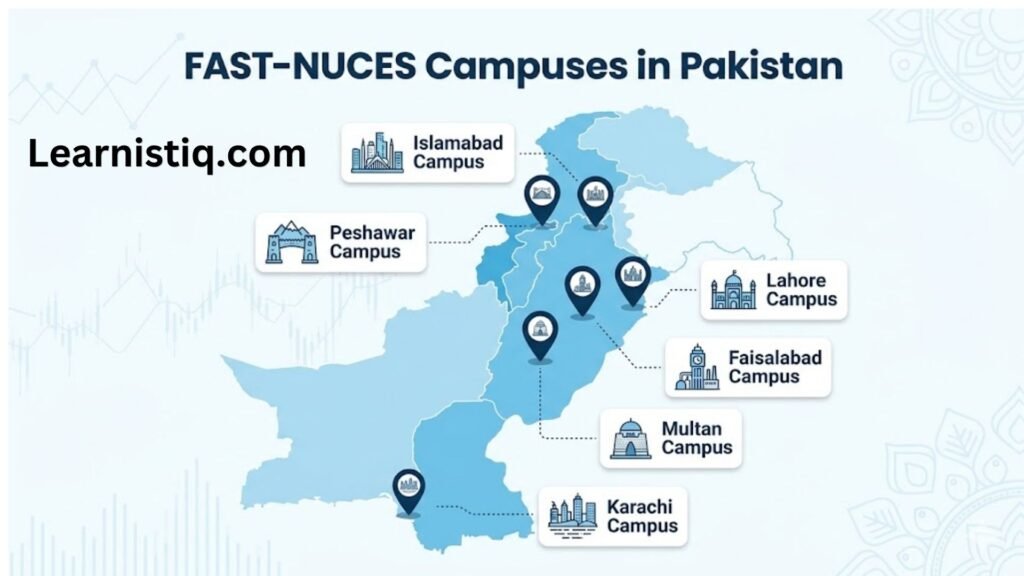
Here is the honest comparison:
Islamabad Campus — Top Tier This is the founding campus and still the strongest. The faculty quality is the highest across all campuses. Islamabad gives you proximity to government tech institutions like NADRA, NTC, and NCEG, which are major recruiters. Research output is the best here. Students targeting MS abroad, government tech jobs, or research careers should strongly prefer this campus. Merit is the most competitive.
Lahore Campus — Top Tier Pakistan’s largest private tech sector is in Lahore. This campus has the best industry connections to IT export companies, software houses, and the growing startup scene. Companies like Arbisoft, Systems Limited, Confiz, and Devsinc hire heavily from FAST Lahore. If your goal is to enter Pakistan’s software industry as quickly and smoothly as possible, this campus is arguably the best choice. Campus life and society culture are also the most vibrant here.
Karachi Campus — Strong Pakistan’s commercial capital gives Karachi students strong access to multinational companies, banks, and fintech firms. The FAST Karachi alumni network in corporate Karachi is solid. Good choice for students from Karachi who want to eventually work in that city’s corporate sector.
Peshawar Campus — Developing The KPK tech sector is growing but is not at the level of Lahore or Islamabad. FAST’s brand carries weight here but industry connections are limited. Faculty quality is decent but not at the level of the main campuses. A reasonable choice for students from KPK who cannot relocate, but if you can access Islamabad, that is a better option.
Chiniot-Faisalabad Campus — Developing The youngest of the established campuses. Faisalabad has an industrial base but limited IT sector. The campus is still building its identity. If you are from the region, it is not a bad option, but Lahore is close enough that commuting or relocating is worth considering.
Multan Campus — Newest The newest addition. Still in early stages. Alumni network is minimal. For students in South Punjab, it provides access to FAST’s degree and brand, which is valuable. But for career outcomes, it will take years to build the placement infrastructure that older campuses have.
Campus Comparison Table
| Campus | Industry Access | Faculty Quality | Research | Merit Level | Best For |
| Islamabad | Excellent | Excellent | High | Most Competitive | Research, Govt Tech, MS Abroad |
| Lahore | Excellent | Very Good | Moderate | Very Competitive | Software Industry, Startups |
| Karachi | Very Good | Good | Moderate | Competitive | Multinationals, Fintech |
| Peshawar | Growing | Adequate-Good | Low | More Accessible | KPK Regional Careers |
| Chiniot-Faisalabad | Limited | Adequate | Low | Most Accessible | Regional Industry |
| Multan | Very Limited | Building | Very Low | Accessible | South Punjab Students |
3. Programs: Honest Review with Scope
BS Computer Science — FAST’s Best Program
This is what FAST was built for. The curriculum is one of the most demanding in Pakistan. Data Structures, Algorithms, Operating Systems, Compiler Construction, Computer Networks — these are taught seriously. The workload is heavy, but the output is strong. FAST CS graduates compete confidently in the market. Starting salaries locally range from Rs. 90,000 to Rs. 180,000. Top performers increasingly land remote positions. Rating: 9/10.
BS Software Engineering
Very similar to CS in terms of job outcomes. The curriculum has slightly more focus on software processes, team development, and project management. Industry employers generally treat FAST CS and SE graduates equally. If you prefer practical project work over theory, SE might suit you better. Rating: 8.5/10.
BS Artificial Intelligence
FAST launched dedicated AI programs and they are developing well. The foundation courses are solid. The limitation is that truly advanced AI research faculty in Pakistan are few. For industry-focused AI careers, this is a good program. For cutting-edge research, NUST or ITU have a slight edge. Rating: 7.5/10.
BS Cyber Security
A newer and genuinely exciting program. Demand for cyber security professionals from Pakistani banks, PEMRA, NADRA, and government agencies is growing fast. FAST’s Cyber Security curriculum is competitive. Rating: 8/10.
BS Data Science
Growing program with strong market demand. Similar observations to AI — solid foundation, industry demand is high, research depth is still developing. Good career prospects. Rating: 7.5/10.
BBA
I will be honest here because most guides are not. FAST’s BBA is a decent degree but the FAST brand does not carry the same weight in business circles as it does in tech. If business is your goal, IBA Karachi, LUMS, or even some other business schools are stronger choices. FAST BBA makes more sense if you are combining it with technology management or planning to work in IT companies’ business functions. Standalone as a business degree, it is average. Rating: 6/10.
BS Electrical Engineering
FAST offers EE but this is not their heritage. NUST, UET, GIK — these names mean far more in the EE world. I have seen FAST EE graduates struggle to shake the perception that their university is “a CS place.” Unless EE at FAST is your only viable option, I would think carefully. Rating: 5.5/10.
4. Admission Process, Entry Test Pattern & Expected Merit 2026
Eligibility for BS Programs
Minimum 60% marks in FSc Pre-Engineering, ICS with Mathematics, or equivalent (A-Levels with Mathematics). Mathematics is mandatory for CS, SE, AI, EE, and Data Science programs.
The NU Entry Test — Official 2026 Pattern
FAST conducts its own centralized entry test. There is negative marking — you lose 0.25 marks for each wrong answer. Calculators are not allowed. The test pattern for BS CS and Engineering programs is: Advanced Mathematics 50%, Analytical Skills and IQ 20%, and English 10%. The remaining 20% is not listed in the public breakdown — based on past papers and student reports, this section tests basic CS knowledge and logical reasoning for CS-specific programs. nu
You can also apply using SAT-I scores as an alternative to the NU Test, subject to FAST’s minimum cut-off thresholds.
Merit Formula
The FAST-NUCES aggregate is calculated using three components with fixed weightages: 10% from Matriculation (SSC) marks, 40% from Intermediate (FSc/HSSC) marks, and 50% from the entry test score. Maqsad
Entry Test Registration Fee: Rs. 3,000
Expected Merit Aggregates 2026 (Based on Historical Trends)
These are estimates based on patterns from 2023–2025. Final merit lists are set by FAST after test results.
| Program | Islamabad | Lahore | Karachi | Peshawar | CFD/Multan |
| BS Computer Science | 78–83% | 75–80% | 70–76% | 64–70% | 60–67% |
| BS Software Engineering | 76–81% | 73–78% | 68–74% | 62–68% | 58–65% |
| BS Artificial Intelligence | 77–82% | 74–79% | 69–75% | 63–69% | 59–66% |
| BS Cyber Security | 72–77% | 70–75% | 66–72% | 61–67% | 57–63% |
| BBA | 68–74% | 65–71% | 61–67% | 57–63% | 53–59% |
Note: Top CS programs at Islamabad and Lahore regularly close above 75–80% aggregate. Always verify with the official FAST admissions portal at nu.edu.pk/admissions.
Test Preparation Advice
For the Advanced Mathematics section (50% weight), revise FSc Part 1 and Part 2 thoroughly — Calculus, Algebra, Trigonometry, Permutations and Combinations. For Analytical/IQ (20%), practice IQ-style aptitude tests. For English (10%), vocabulary is more important than grammar on this test. Total recommended preparation time: 45 to 60 focused days. FAST past papers from platforms like FASTVault and Maqsad are reliable practice resources.
5. Complete Fee Structure 2026 — Official and Verified
This section uses data directly from FAST’s official website at nu.edu.pk, accessed May 2026. The previous version of this article had incorrect fee figures. Here is the accurate information:
One-Time Fees at Admission
Admission Fee of Rs. 30,000 is payable once at the time of admission. A refundable security deposit of Rs. 20,000 is also payable at the time of admission. FAST National University
Tuition Fee Per Credit Hour — Academic Year 2026-27
For the academic year 2026-27, the tuition fee per credit hour applicable to all batches is Rs. 12,000 for BBA/BS, MBA/MS, and PhD programs. FAST National University
Semester Fee Calculation
A typical BS semester at FAST carries 16 to 17 credit hours. Using 17 credit hours as a standard:
- Tuition per semester: 17 × Rs. 12,000 = Rs. 204,000
- Student Activities Fund per semester: Rs. 2,500 per semester (effective Fall 2024) FAST National University
- Approximate total per semester: Rs. 206,500
First Semester Total (including admission and security)
Approximately Rs. 256,500 (tuition + Rs. 2,500 activities fund + Rs. 30,000 admission fee + Rs. 20,000 security deposit)
Full Degree Cost
A standard BS degree requires approximately 130 credit hours spread over 8 semesters. At Rs. 12,000 per credit hour:
- Total tuition for 130 credit hours: Rs. 1,560,000
- Add activities fund (8 semesters × Rs. 2,500): Rs. 20,000
- Add one-time admission fee: Rs. 30,000
- Add security deposit (refundable at graduation): Rs. 20,000
- Total approximate 4-year cost: Rs. 1,630,000 (approximately Rs. 16–17 lakh)
This is significantly higher than what many older guides quote. The fee was revised upward for 2026-27.
Hostel and Living Costs (Approximate)
These vary by city and type of accommodation:
| Living Arrangement | Monthly Cost | Annual Cost |
| On-campus hostel (shared, where available) | Rs. 12,000–18,000 | Rs. 144,000–216,000 |
| Private hostel near campus | Rs. 10,000–20,000 | Rs. 120,000–240,000 |
| Shared apartment (2–3 students) | Rs. 8,000–15,000 per person | Rs. 96,000–180,000 |
| Food and daily living | Rs. 15,000–25,000 | Rs. 180,000–300,000 |
For an out-of-city student, total annual expenses including tuition and living can reach Rs. 500,000 to Rs. 700,000 per year.
Financial Aid
FAST offers need-based financial aid (partial to full tuition waiver based on family income) and merit-based scholarships for top-ranked students in the merit list. HEC’s need-based scholarship program is also applicable. Students should apply for financial aid at the time of admission — it becomes much harder to obtain later. The university’s aid is genuinely helpful but not as comprehensive as NUST’s scholarship system.
6. Campus Life, Faculty Quality, Societies and Environment
The Academic Atmosphere
FAST is academically intense. This is not an exaggeration — it is the most consistent piece of feedback from students across all campuses and all years. The grading system uses relative grading (a bell curve approach), which means your grade depends partly on how your entire class performs. Students regularly work through nights before assignment deadlines.
This environment produces technically strong graduates. But it also produces burnout. Mental health struggles among FAST students are real and the university’s support systems, while improving, are still not adequate for the level of stress the curriculum creates. If you are someone who has struggled with anxiety or depression, factor this into your decision honestly.
Faculty Quality
Mixed, to be frank. FAST has some excellent faculty — PhD holders with international research experience who genuinely challenge and inspire students. But contract and adjunct faculty whose quality varies significantly are also present, particularly at newer campuses. Islamabad consistently has the strongest faculty pool. The practical advice: in your first week of every semester, identify the strong faculty early. Choose electives accordingly when you have a choice.
Student Societies and Activities
FAST has a surprisingly active society culture given the academic pressure. The Computing Society (ComSoc) runs hackathons, ICPC competitive programming events, and regular tech talks from industry professionals. The Entrepreneurship Society has grown significantly since Pakistan’s startup wave. There are debate, drama, and arts societies too. FAST Lahore typically has the most vibrant society scene. FAST Islamabad has the strongest competitive programming culture, with regular ICPC participation.
Hostels and Facilities
On-campus hostel availability is limited at most campuses. Seats fill quickly and early application is essential. The on-campus hostels are functional and clean — not luxurious, but adequate. WiFi quality varies. Most out-of-city students end up in nearby private hostels or shared apartments.
Computing labs and library resources have improved significantly since 2022. For a computing-focused university, the hardware and software resources are adequate for undergraduate education. Islamabad and Lahore campuses have the best facilities.
7. Placements and Alumni — The Numbers That Actually Matter
Pakistan Local Market — Fresh Graduate Salaries 2025–2026
| Level | Role | Salary Range |
| Fresh graduate | Junior Software Engineer | Rs. 90,000–160,000/month |
| 1–2 years experience | Software Engineer | Rs. 160,000–280,000/month |
| 3–5 years experience | Senior/Lead Engineer | Rs. 300,000–600,000/month |
| Fresh graduate (remote) | Junior Developer | USD 800–2,000/month |
| 3+ years (remote) | Senior Engineer | USD 2,500–5,000/month |
Top Recruiters from FAST Campuses
Consistent major recruiters include: Systems Limited, Arbisoft, 10Pearls, Techlogix, NetSol Technologies, Confiz, Tintash, Devsinc, Folio3, and Contour Software. Government-sector employers who recruit from FAST Islamabad include NADRA, NTC, and various federal IT bodies. International companies with Pakistan-based teams, including Motive (formerly KeepTruckin) and Careem, also recruit from FAST.
The Alumni Network Advantage
This is genuinely one of FAST’s most valuable hidden assets. The FAST alumni in Pakistan’s tech industry are now mid-to-senior level professionals — team leads, engineering managers, CTOs — who actively refer and hire fresh FAST graduates. This informal network is real and it works. Students who build relationships with seniors during university years are significantly better positioned for their first job.
Honest Placement Caveat
The best outcomes go to students who: maintain a CGPA above 3.0, complete at least one strong internship during Semester 5 or 6, and actively participate in technical events like hackathons. Students who only attend classes and do nothing else often have average outcomes despite the FAST degree. The degree opens the door — you still have to walk through it.
8. FAST vs NUST vs COMSATS vs GIKI vs LUMS — Full Comparison
| Criteria | FAST-NUCES | NUST SEECS | COMSATS | GIKI | LUMS |
| CS/SE Reputation | Excellent | Excellent | Good | Good | Good |
| Annual Tuition Fee | ~Rs. 400,000+ | ~Rs. 80,000–130,000 | ~Rs. 100,000–150,000 | ~Rs. 200,000–240,000 | ~Rs. 700,000–900,000 |
| Entry Test Difficulty | Very Hard | Very Hard | Moderate | Very Hard | Very Hard |
| Research Quality | Moderate-Good | Excellent | Moderate | Good | Excellent |
| Industry Placement | Excellent | Excellent | Good | Good | Excellent |
| Campus Life | Good (stressful) | Excellent | Average-Good | Good (isolated) | Excellent |
| Alumni Network | Very Strong (CS) | Very Strong | Moderate | Growing | Very Strong |
| Hostel Availability | Limited | Good | Good | Full Residential | Good |
| Scholarship System | Decent | Strong | Decent | Good | Strong |
| Best For | CS/SE industry careers | Best overall value | Budget-conscious students | Engineering discipline | Elite multidisciplinary |
My honest read on this comparison:
If you get NUST SEECS for CS or SE, choose it over FAST at any campus other than Islamabad or Lahore — the quality is comparable and the cost is a fraction. FAST Islamabad or Lahore CS/SE versus NUST SEECS is a genuine close call, and either is a strong choice. LUMS is worth the cost only if you have financial access and are pursuing the CS/business overlap or aiming for academic careers. COMSATS is underrated — it is a solid choice for cost-conscious students who want a recognized degree.
9. Real Pros and Cons — No Sugar Coating
Genuine Advantages
FAST has the strongest brand name in Pakistan specifically for CS and SE in industry circles. The alumni network is real, active, and genuinely helps with job referrals. The curriculum rigor produces technically strong graduates. Active tech societies run hackathons and ICPC events. Islamabad and Lahore campuses have excellent industry access. A CGPA of 3.5 or above from FAST carries real weight with employers. FAST graduates have a strong track record for MS admissions abroad, particularly from the Islamabad campus.
Genuine Weaknesses
The fees are expensive — approximately Rs. 16–17 lakh for the full degree, which is steep for what is classified as a private-sector chartered university. Grading is harsh and relative — even students who understand material well can end up with a low CGPA because of how the bell curve works. Mental health pressure is real and is inadequately addressed by the university. Faculty quality is inconsistent across campuses and departments. Non-CS programs carry a fraction of the brand value. On-campus hostel seats are limited. Faisalabad and Peshawar campuses lag well behind Islamabad and Lahore. Work-life balance as a student is genuinely poor, and burnout cases are common.
10. Common Student Questions
Does CGPA from FAST matter in the industry?
More than you expect. Above 3.0 is the minimum most good companies require. Above 3.5 opens premium doors. However, a 2.8 CGPA from FAST with one strong internship often beats a 3.8 from a weaker university — skills and experience matter at interview stage, but the CGPA gets you the interview in the first place.
Can FAST graduates get into MS programs abroad?
Yes, and it happens regularly. FAST graduates successfully get into master’s programs in Germany, UK, Canada, and the US. You need a strong CGPA (3.5 or above), some research contribution or strong projects, a good GRE or IELTS score, and strong letters of recommendation. FAST Islamabad has the best track record for this path because of stronger faculty references available.
Is FAST’s workload heavier than NUST’s?
Based on consistent feedback from students and transfer cases I have seen over the years: yes, FAST’s assignment and assessment load is generally heavier. NUST is also rigorous but the relative grading system and assignment culture at FAST creates a particularly high-pressure environment. This is a pattern, not an exception.
CS or SE — which should I choose at FAST?
Both programs have nearly identical industry outcomes from FAST. CS gives more theoretical depth and is better preparation for graduate school or research. SE is more project-based and process-oriented. If you are strong in Mathematics and considering MS or research, go CS. If you are industry-focused and enjoy team projects, SE is fine. The distinction matters very little to most employers for fresh graduates.
Is FAST suitable for female students?
FAST is co-education and the environment is generally professional. Female enrollment in CS/SE programs has been growing and is currently around 25–30% at most campuses. The campus is safe during university hours. Late evening lab work can create logistical issues for female students who commute. Female hostel availability varies by campus — check with the specific campus admissions office.
What if I only get Peshawar or Faisalabad campus?
Do not automatically accept. First compare with COMSATS in your region, UET, or other strong local options. If FAST Peshawar or CFD is genuinely your best option after comparison, then it is still a reasonable choice because the FAST brand has national recognition. But do not assume it is automatically better than every other alternative just because of the FAST name.
11. Who Should Apply to FAST and Who Should Not
Apply to FAST if:
You are serious about CS, SE, AI, Data Science, or Cyber Security as a career. You can handle academic pressure and competitive grading without your mental health suffering badly. You have the financial capacity to manage Rs. 16–17 lakh over four years, or you qualify for significant financial aid. You are targeting Islamabad or Lahore campus where the value is strongest. You are self-motivated and do not need constant hand-holding from faculty. You want an active tech society culture with hackathons and industry networking.
Think twice or look at alternatives if:
You are applying for BBA, Electrical Engineering, or other non-CS programs where FAST’s brand advantage largely disappears. You have significant financial constraints and NUST or COMSATS are accessible to you — the cost difference is substantial. You have only gotten admission at Multan or Chiniot-Faisalabad and better regional alternatives exist. You have serious mental health vulnerabilities — the environment can make these worse. You are hoping for a relaxed university experience with time to explore yourself socially and academically. You want strong research mentorship, unless you are at the Islamabad campus specifically.
12. Final Verdict: Is FAST Worth It in 2026?
Rating Summary
- CS/SE Program Quality: 8.5/10
- Industry Placement: 8.2/10
- Value for Money: 6/10 (fees have gone up significantly)
- Campus Life: 7/10
- Faculty Quality: 7/10
- Overall for CS/SE Students: 7.8/10
After 13 years and thousands of students, my honest verdict is this: FAST is worth it, but only under the right conditions.
If you are a motivated student pursuing CS or SE, with financial capacity for Rs. 16–17 lakh over four years, and you are going to Islamabad or Lahore campus — FAST is an excellent choice. The brand, the alumni network, and the technical rigour are real advantages that will serve you for decades.
But FAST is not a university you attend passively. It demands commitment, mental resilience, and financial investment. It is not automatically better than NUST SEECS, which costs a fraction of the price for comparable CS output. And for any program outside CS, SE, AI, and Cyber Security, the value proposition weakens considerably.
My practical recommendation: Apply to FAST as your top private university option, but also appear for the NUST-NET. If you get NUST SEECS, take it. If you get FAST Islamabad or Lahore CS/SE without NUST, take FAST without hesitation. If you get FAST Peshawar, Faisalabad, or Multan only, compare carefully with local alternatives before deciding.
Go to FAST because you want to become technically strong and build a serious career in tech. Go because you are ready to work hard. Not just because people around you say the brand is good.
If that describes you, FAST will reward your effort genuinely well.
- PIEAS University 2026 Honest Guide

- FAST-NUCES Review 2026: Complete Guide

- Aga Khan University Complete Guide 2026


Shahzaib Khan is the founder of Learnistiq.com
and an independent education researcher based in
Rawalpindi, Pakistan. With over 8 years of
experience in student counseling and educational
guidance, he has personally helped hundreds of
Pakistani students choose the right universities
and career paths.
His research focuses on Pakistani university
admissions, online degree outcomes, and practical
career guidance for students who cannot afford
expensive counseling services. Every article on
Learnistiq is written from real experience and
verified information — not copied or AI-generated
content.
Shahzaib has been featured in student communities
across Pakistan and is committed to providing
honest, pressure-free guidance to students from
Rawalpindi, Lahore, Karachi, and beyond.