
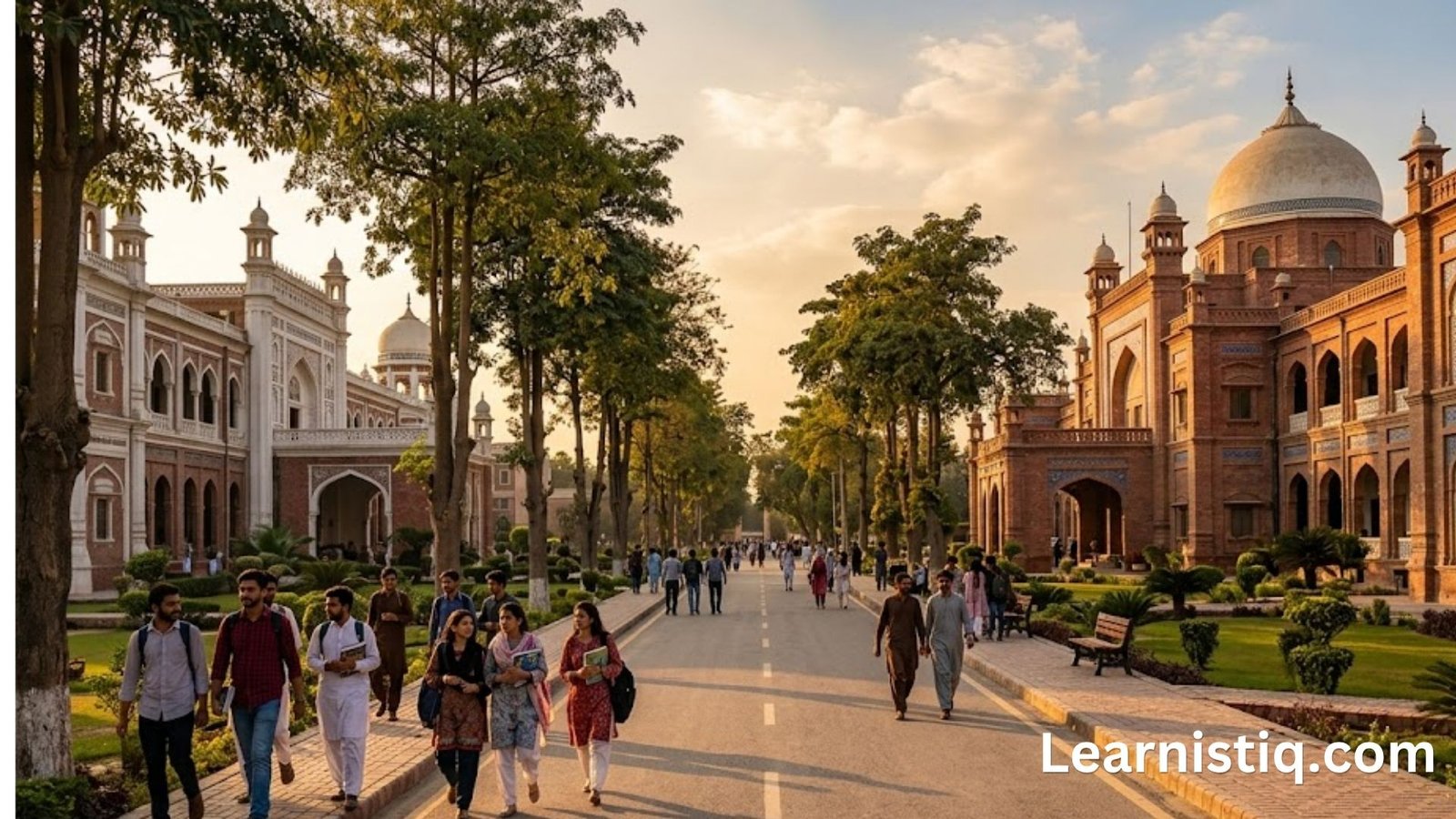
Bahauddin Zakariya University, also known as BZU university in Multan. It is located in South Punjab. I think BZU is a place for people who want to study Engineering, Pharmacy, Agriculture or Mathematics. BZU has more than 20,000 students. It has faculties, around 10 and many departments, around 81. People from South Punjab like to go to BZU because it’s a good option that does not cost too much money. BZU is a choice for students in South Punjab.
BZU is not a backup option. For the right student, in the right department, with the right approach, it is the best decision available in South Punjab.
This guide tells you whether you are that student — and if you are, exactly how to get in, what to expect, and what to do with four years there.
What BZU Actually Is
Bahauddin Zakariya University is a public university in South Punjab. It was started in 1975. This university offers a lot of programs. In fact it offers the range of programs in the region. Bahauddin Zakariya University is like the place for higher education between Lahore and Sindh.
The university was renamed to honor Hazrat Baha-ud-din Zakariya, a respected Sufi scholar. He was part of the Suhrawardiyya order. There is a shrine for Hazrat Baha-ud-din Zakariya in Multan. A lot of people visit this shrine. It is one of the most visited sites in Pakistan. Bahauddin Zakariya University takes its name seriously. The university is in a city that has a history of intellectual and spiritual things. This city has centuries of history. At its best Bahauddin Zakariya University shows this history. It really reflects the weight of all these years.
Today, BZU has over 20,000 enrolled students on its main campus in Multan and sub-campuses in Vehari and Lodhran. It runs 10 faculties and 81 departments. Out of 643 faculty members, around 495 hold PhD degrees, a ratio that compares favorably with most public universities in Punjab.
Rankings that matter:
- QS World University Rankings: 1201–1400
- THE World University Rankings: 601–800
- QS Subject Ranking (Agriculture & Forestry): 251–300 globally
These rankings show that BZU really does really well in the field of Agriculture.
The rankings will let you know how one university is doing compared to universities. They will not tell you if the degree you get from BZU will help you get the job you want. That is what we will talk about in the rest of this guide, about BZU and its Agriculture fields.
Table of Contents
What Every Competing Article Fails to Tell You
Many websites only copy basic information from BZU’s official page — such as program lists, fee structures, and admission dates. While this information is useful, it often fails to answer the real questions students have:
- Which departments at BZU are actually strong?
- What is real student life and hostel experience like?
- Will this degree actually help me get a job?
- Should I really join BZU or consider other options?
BZU’s Ten Faculties: The Complete Structure
BZU is organized into ten faculties. Each faculty contains multiple departments. Each department runs its own merit list, its own seat quota, and its own admission process. When applying to BZU, a student applies to a specific department — not to the university generally and not to a faculty broadly.
Arts and Social Sciences
* Engineering and Technology
* Commerce, Banking and Business Administration
* Islamic Studies and Languages
* Pharmacy
* Science
* Agriculture. Technology
* Veterinary Sciences
* Food Science and Nutrition
* Law
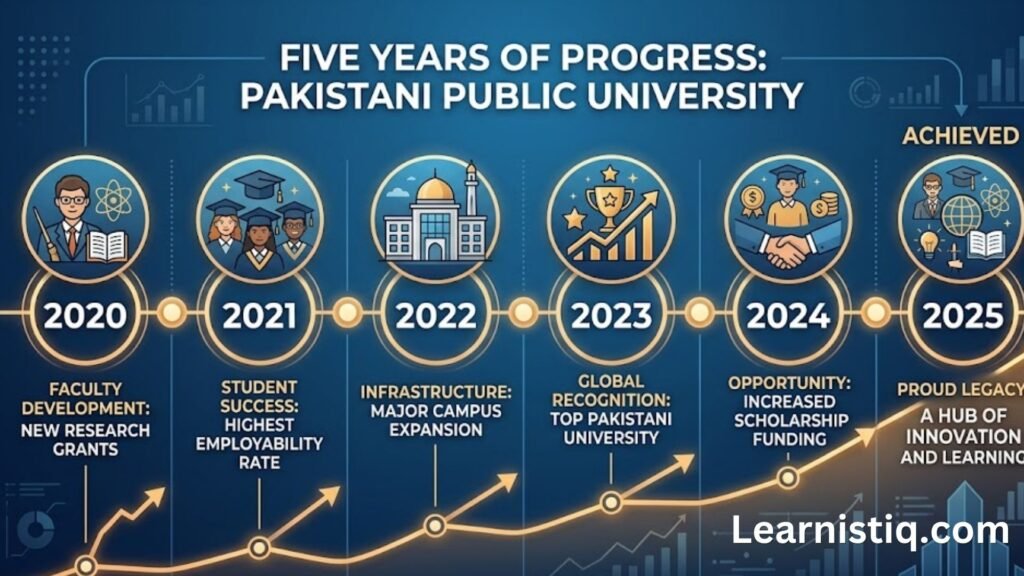
Computer Science sits under the Faculty of Science, not Engineering. This matters for merit calculation. The Engineering Faculty runs ECAT-eligible admission processes for its programs. Science Faculty programs including Computer Science follow a different merit track. Applying to the wrong faculty track is an error that costs applicants time and sometimes their admission window.
Department by Department: An Honest Assessment
Not every part of BZU performs at the same level. You really need to know which departments at the school are actually good, which departments are getting better and which departments are not so great and need the student to do a lot of work on their own. This makes a difference between having four years that are really productive and four years that are really frustrating. Knowing about the departments can help you have a time at school. The departments that are strong can give you a lot of support. Help you learn a lot. The departments that are growing can be exciting to be a part of.. The departments that are not so good can be really tough if you have to do everything by yourself.
CASPAM — Centre for Advanced Studies in Pure and Applied Mathematics
One of the strongest departments at BZU. Excellent for students serious about Mathematics, Statistics, or research.
The Department of Mathematics opened with the university in 1975 and was upgraded to a specialized research centre in 1985 — one of the earliest dedicated mathematics research centres in any public Pakistani university.
Its graduate placement record is specific and verifiable. CASPAM graduates hold positions in the Pakistan Atomic Energy Commission, the Armed Forces, provincial government departments, banking and financial institutions, and universities both inside Pakistan and internationally. The centre completed a documented collaboration with the Department of Mathematics at Bradford University in the UK, which produced faculty exchanges and laboratory upgrades including a Sun Computer System installation.
CASPAM runs BS, MSc, MPhil, and PhD programs in Mathematics. The Computer Centre at this place is really helpful for students who want to do math work, use computers for science and look at data for their research projects.
For a student who’s really into math, statistics or using computers to learn new things the Computer Centre gives them a great place to learn and grow which is not common at other public universities, in South Punjab.
The Computer Centre earns its reputation every year.
Faculty of Engineering and Technology
The Faculty of Engineering and Technology became a faculty in 2019. It was previously a college. Prof. Engr. Dr. Tahir Sultan is the Dean.
The faculty offers four-year engineering degrees in these areas:
* Civil Engineering
* Electrical Engineering
* Building and Architectural Engineering
* Computer Engineering
* Mechanical Engineering
* Metallurgy and Materials Engineering
* Textile Engineering
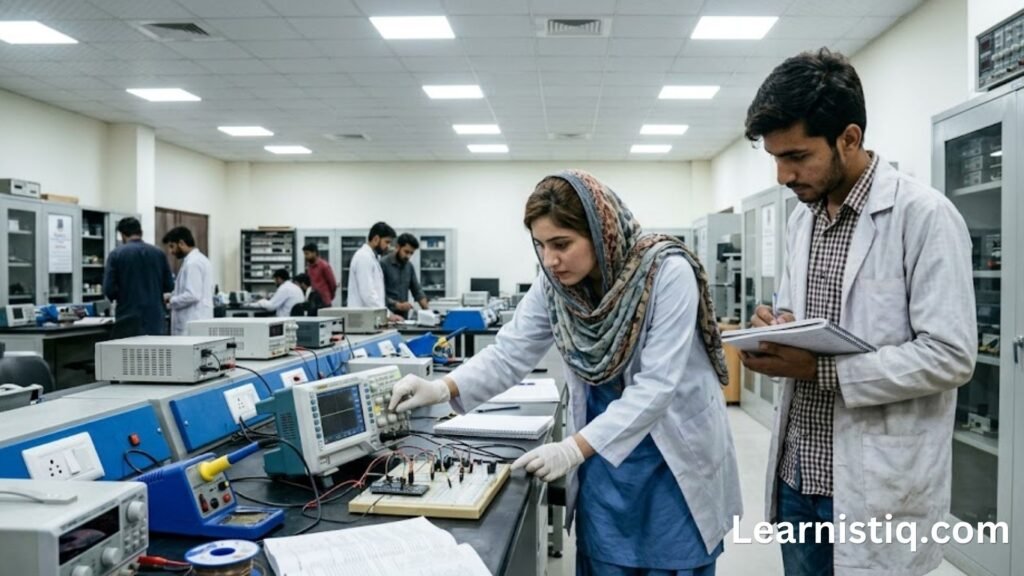
Let me tell you the history of each area is important to understanding the faculty.
Civil Engineering started in 1994. It is the area in the faculty. It has been around for over 30 years. Has produced many graduates. The Faculty of Engineering and Technology has Civil Engineering as its mature discipline. It offers engineering degrees and has a rich history. Electrical Engineering followed in 1997. Computer Engineering, Mechanical Engineering, and Building and Architectural Engineering launched in 2004. The Computer Engineering and Building and Architecture department buildings were completed in November 2015. Metallurgy and Materials Engineering came through the Institute of Advanced Materials established in 2006. The Textile Engineering College operates from a separate campus on Khanewal Road.
The Textile Engineering program deserves specific attention beyond its placement in a list. Multan sits at the geographic centre of Pakistan’s cotton-producing belt. Textile engineering students at BZU are not studying an abstract industry in a classroom far removed from it. They are studying the economy of the city and region they are physically inside. The cotton fields, spinning operations, and weaving units of South Punjab are not case studies. They are the employment context the student will enter within a year of graduation. No textile engineering program in Lahore or Islamabad can replicate that structural proximity.
For BS Engineering admission, the minimum eligibility is 60% marks in FSc Pre-Engineering with Physics, Chemistry, and Mathematics. BZU accepts results from its own departmental entry test or from the ECAT conducted by University of Engineering and Technology Lahore, where applicable. Competitive programs regularly see first merit list cutoffs above 75%.
Faculty of Pharmacy
The Pharmacy program at BZU is a five year Pharm-D program. It has requirements to get in and Pharmacy graduates usually get jobs. Many Pharmacy graduates work for companies that make medicines in cities like Karachi, Lahore and Multan. Some Pharmacy graduates go abroad to get education. For years the Pharmacy sector in Pakistan has needed more pharmacists than it can find so the demand for Pharmacy graduates remains high.
For a student in South Punjab targeting pharmaceutical science, BZU is a first-choice public option — not a compromise.
Faculty of Agricultural Sciences and Technology
The Bahauddin Zakariya University ranking of 251–300 globally in Agriculture and Forestry is really good because of some things that no other university in Pakistan can do in the way. Bahauddin Zakariya University is located in one of the areas of Pakistan for growing crops. This area produces a lot of cotton, mangoes, citrus fruits and dates, for the whole country. Agriculture students here have access to real crop systems, real soil conditions, and real agricultural extension networks. A College of Agriculture was started at BZU in 1989 because the College of Agriculture people knew that agriculture is a part of the economy in that area. The College of Agriculture at BZU has been around for more than thirty years now.
Students who study agriculture at BZU are not just reading books about farming. They are actually learning about the land that’s right around them. This way the College of Agriculture students at BZU are ready to get a job when they finish their studies and that is something that students who only study in a classroom cannot do.
Faculty of Veterinary Sciences
Veterinary Sciences benefits from the same regional context. Students work with farm animals and diseases that are common in Punjab’s farms. They do not use examples from places. The teachers regularly post job openings for part-time teachers. This shows that the program is always happening and getting bigger and it is still growing as of Spring 2026.
Faculty of Science — Computer Science
BS Computer Science at BZU sits under the Faculty of Science. It is the most heavily enrolled technology program at the university and carries real name recognition in Pakistan’s technology employment market.
The honest assessment separates two things: the degree and the outcome.
The degree from BZU CS is good. People know about it all over the country. It teaches students the skills they need.. What really matters is what the student does with it. If a BZU CS student works on their projects while studying, makes a portfolio that people can see, gets certifications like AWS or Google Cloud and works on open-source projects they can get a good job in Pakistan’s technology field. BZU CS graduates who do these things are competitors in the job market. On the other hand BZU CS graduates who only have the degree and do not do any extra work will find it hard to stand out from others because many people have a BZU CS degree.
This is not a criticism unique to BZU. It is true of CS programs at most public Pakistani universities. It matters more to state clearly here because BZU’s large CS enrollment means employers have extensive experience with BZU CS graduates of varying quality. A written plan to build practical skills from the first semester is not optional. It is the strategy that determines whether the degree translates into a career.
Faculty of Law
The University Gilani Law College offers LLB programs including a private candidate route that is regionally significant. BZU Law is one of the few institutions in southern Punjab that provides accessible LLB pathways for working professionals who cannot enroll full-time. For students in South Punjab targeting legal careers, this structural access advantage is worth weighing carefully against alternatives.
Faculty of Commerce, Banking and Business Administration and Institute of Management Sciences
BZU’s commerce faculty and the Institute of Management Sciences together offer BBA, MBA, and management science programs. The IMS has built a consistent presence in South Punjab’s business education landscape over decades. Graduates enter banking, microfinance, corporate finance, and the FMCG sector. Multan’s banking and commercial infrastructure provides immediate regional employment absorption for many of these graduates without requiring relocation to Lahore or Karachi.
Faculty of Arts and Social Sciences
Arts and social science departments serve a large student population across English, Urdu, History, Political Science, Sociology, Psychology, and Mass Communication. Library resources in some older departments vary in currency and depth. The honest observation is this: students in these programs who actively use the HEC Digital Library — available to every enrolled BZU student at no additional cost through bzu.edu.pk/hec-digitallibrary.php — access thousands of international academic journals that raise the quality of their academic work significantly above textbook-only output. The majority of students in arts departments discover this resource in their third year, by which point two years of research opportunity have already passed. Finding and activating it in the first week of the first semester is one of the most high-value actions an arts student at BZU can take.
BZU Admissions 2026: The Complete Step-by-Step Process
Two Admission Cycles
BZU runs a Fall admission cycle and a Spring admission cycle every year.
Fall is the primary intake. The Fall 2026 cycle has been announced. The last date to apply for undergraduate programs is August 18, 2026. Applications are submitted through bzu.edu.pk. Fall carries more seats, more program availability, and higher competition. Any student targeting a competitive program — Engineering, Pharmacy, Computer Science — must attempt Fall. Spring offers limited seats and not all programs are available in that cycle.
How Merit Is Calculated
For most BS programs the merit formula is:
70% weight — Intermediate marks (FSc, FA, ICS, ICom, or equivalent) 30% weight — Entry Test score
Programs without an entry test calculate merit on Intermediate marks alone. Some faculties include an interview component. Hifz-e-Quran marks are added for merit determination where applicable. The exact formula for a specific program is confirmed in the official BZU admission prospectus — always verify from that source, not from third-party portals.
The practical implication of the 30% entry test weight is direct and important: a student with 85% FSc marks and strong entry test preparation will outperform a student with 90% FSc marks and no preparation in the competitive cutoff range. In some programs the first and second merit list cutoffs are not that different. They can be apart by 2 to 4 percentage points. So what makes the difference between getting in and getting rejected? It is often the entry test score of the programs. The entry test score of the programs is what decides if you get admission to the programs or not.
Minimum Eligibility Requirements
Most Bachelor of Science programs need at least 45% to 50% marks in Intermediate.
Engineering programs need at least 60% marks in FSc Pre-Engineering.
The FSc Pre-Engineering must include Physics, Chemistry and Mathematics subjects.
Medical programs: MDCAT qualification required. Where no specific minimum is stated for a program, 50% is the practical floor based on historical merit patterns.
The Six-Step Application Process
Step 1 — Get the prospectus. The BZU admission prospectus costs Rs. 600 from the Admission Office on campus. Candidates from other cities can receive it by courier for Rs. 700. It is also downloadable from bzu.edu.pk during the open admission window. Read it for your specific program before doing anything else.
Step 2 — Apply online. Complete the application at bzu.edu.pk. The portal opens and closes according to the announced schedule. Late applications are not accepted.
Step 3 — Prepare documents. You need to attach some papers to your application. These are:
* Matric certificates
* Intermediate academic certificates
* Detailed marks certificate
* Character certificate from the school or college you went to last
* Domicile certificate if that applies to you
* Hifz-eQuran certificate if that is relevant to you.
Make sure these’re attested photocopies of Matric and Intermediate academic certificates and other documents. Attach attested photocopies of detailed marks certificate and character certificate from the institution you attended. Also attach photocopies of domicile certificates where that is applicable to you and Hifz-e-Quran certificate if that is relevant, to your application.
Step 4 — Appear in the entry test. For programs requiring it, appear in BZU’s departmental test or ECAT where applicable. Prepare specifically for the test format of your target program. The 30% weight means this step cannot be treated casually.
Step 5 — Monitor merit lists. Multiple rounds are released on the official BZU website. First merit list. Second merit list. Subsequent rounds as unconfirmed seats open. Check bzu.edu.pk directly on the day each list is published — not through third-party portals, which are routinely delayed or inaccurate.
Step 6 — Pay dues immediately. When a name appears on a merit list, pay fees at the designated bank within the stated deadline. A seat that is not confirmed by payment passes to the next candidate. In competitive departments, the window between list publication and seat expiry is measured in hours, not days.
The rule that costs students money every year: Once fees are paid for a department at BZU, that payment is non-refundable and non-transferable — even if the student later gains admission to a preferred program elsewhere. BZU’s official policy states this explicitly. Choose the target department carefully and pay only when the choice is confirmed and final.
In self-finance seats, a minimum of 10 seats is allocated per undergraduate program — an additional pathway for students who fall just below open merit cutoffs.
How Merit Lists Work in Practice
The gap between first merit list cutoff and final round cutoff typically ranges from 3 to 8 percentage points depending on the department and year. Students who fall below the first list but above the final round sometimes receive admission in later rounds as confirmed candidates do not take their seats. The critical behavior is checking the official website immediately on publication day and responding within the same day.
Fee Structure and Scholarships: What BZU Actually Costs
BZU is a public, chartered university. The fee structure published applies to local students. Separate structures apply for overseas Pakistanis, Pakistanis holding foreign nationality, and international students — those details are obtained directly from the Admission Office or from bzu.edu.pk.
For local students, annual tuition fees across most BS programs are substantially lower than any private university equivalent in Pakistan. Engineering and Pharmacy programs sit at the higher end of BZU’s fee range. Arts and social sciences programs sit at the lower end. The official fee structure for Fall 2024 is at bzu.edu.pk/fee-structure-fall2024.php. Students applying for Fall 2026 should check the updated structure on the official website when announced, as fees are revised periodically.
Scholarships Available at BZU
Ehsaas Scholarship — Federal government program covering eligible students from lower-income households. Based on NSER database eligibility. Applications processed through the national Ehsaas portal.
Honhaar Scholarship — Targets high-merit students from government schools. Phase III was active in early 2026 with the document submission deadline extended to February 23, 2026. Phase I document submission notices were active as of May 2026. Current phase status is at bzu.edu.pk.
BZU Merit Scholarships and Fee Concessions — Awarded through BZU’s internal Scholarship Cell based on academic performance. Applications submitted directly through the Scholarship Cell at bzu.edu.pk/scholarship-cell.php.
Interest-Free Loans — Available to financially constrained students through a prescribed application process at the Scholarship Cell.
Students who qualify for any of these programs and do not apply are giving up money they have earned. The Scholarship Cell is the starting point for all of them.
Campus Life: What an Ordinary Week at BZU Looks Like
The BZU main campus on Bosan Road is large and spread out. Students arriving from smaller towns and districts — Muzaffargarh, Layyah, Rajanpur, Dera Ghazi Khan — frequently describe the first two weeks as disorienting. Not because the campus is hostile. Because its scale requires active orientation to understand. The layout does not have the compact walkability of a small private campus. Learning where things are takes time. That time is worth spending deliberately in the first week rather than stumbling through it across the first month.
What the Physical Campus Contains
The main university library, department-level libraries, computer labs, auditoriums, sports grounds with cricket and football facilities, cafeterias at multiple price points, a medical centre, research centres including CASPAM’s dedicated computational facility, and the BZU Transport System operating buses and coasters on scheduled routes.
CASPAM’s computer centre is equipped for scientific computing and advanced mathematical modeling. Engineering department buildings were constructed across different periods — Civil Engineering in 1998, Electrical Engineering in 2000, Mechanical Engineering in 2007, and Computer Engineering and Building and Architecture in 2015. Infrastructure quality reflects building age. Newer buildings are better equipped. Older ones have been maintained but not always modernized. Knowing this before arrival sets realistic expectations.
A university-wide four-day work week and work-from-home policy was announced by BZU in early 2026, reflecting institutional adaptation to evolving operational models.
The HEC Digital Library: The Most Underused Resource at BZU
Every enrolled BZU student has access to thousands of international peer-reviewed academic journals through the HEC Digital Library. The access point is at bzu.edu.pk/hec-digitallibrary.php. This resource costs nothing beyond enrollment. It connects a student in Multan to the same research literature used at universities in London, Toronto, and Singapore.
The majority of BZU students do not discover this resource until their third year. By that point they have already written two years of assignments and research papers using textbook content alone — content that is often years behind current academic understanding in their field.
Students who activate HEC Digital Library access in their first week and use it consistently produce academic work of measurably higher quality from the start. This is not a minor point. It is one of the highest-return actions available to any BZU student at any level.
Hostel Life
BZU operates boys’ and girls’ hostels on the main campus. Allotment for new students is handled through departmental channels, the Hall Council Office, or designated hostel staff assigned to each faculty. Students arriving at the start of semester with luggage are allocated rooms through the hostel management system.
What hostel life at BZU is like in practice: the facilities are functional, not luxurious. Rooms are shared. Mess food is consistent and adequate — not memorable. Shared spaces are used by large numbers of students and can feel crowded during peak semester periods. Students who arrive comparing the experience to private university dormitories will be disappointed. Students who arrive with realistic expectations and an understanding of what the hostel actually provides — affordable, independent living alongside peers from across South Punjab — tend to find it genuinely valuable.
For students from districts like Muzaffargarh, Dera Ghazi Khan, Rajanpur, and Layyah — many of them the first person in their family to attend university — the hostel is where the real work of building a professional identity begins. Living alongside students from fifteen different districts, navigating a major institution together, building friendships and professional connections across different regional backgrounds — none of this happens in the classroom. It happens in the shared spaces of the hostel from Sunday evening through Friday afternoon. That social infrastructure is part of what BZU produces in its graduates that have no transcript records.
Hostel rooms fill quickly at the start of each semester. Students who need on-campus accommodation must contact the Hall Council Office or their faculty’s designated hostel staff immediately when admission is confirmed — not after orientation, not after the first week of class. Waiting creates a genuine and avoidable risk of not getting a room.
Transport System
The BZU Transport System runs buses and coasters on scheduled routes for students commuting from within Multan city. The schedule was updated on April 7, 2026 and is posted at bzu.edu.pk. Students finalizing off-campus accommodation should check the current transport routes before committing to a location.
Career Events and Student Organizations
BZU runs student societies and councils across its faculties. CASPAM specifically operates student councils focused on leadership and soft skills development. The annual BZU Job Fair and Industrial Expo — held in February 2026 — connects enrolled students directly with employers from industry, government departments, and the corporate sector. This event is where many BZU students make their first real employer contact for internships and entry-level roles. Students who attend with a targeted list of employers they want to reach take away substantially more than those who arrive without preparation.
After Graduation: Where BZU Students Actually End Up
The Career Development Centre (CDC) is BZU’s institutional bridge between the university and the employment market. It is led by Director Dr. Furrukh Bashir and Deputy Director Engr. Amir Riaz. The CDC operates a placement cell, arranges recruitment drives on campus, negotiates MOUs with companies for internship placements, manages the alumni database, and organizes annual alumni gatherings in collaboration with the Directorate of Student Affairs. The alumni portal operates at alumni.bzu.edu.pk. The CDC page is at bzu.edu.pk/cdc-bzu.php.
Post-graduation outcomes follow the pattern seen at every serious university: they are field-specific, not uniform. Here is the field-by-field picture.
Agriculture and Veterinary Sciences graduates enter government agricultural extension services, provincial research institutes, and agri-technology businesses operating in Punjab. Demand for trained agriculture and veterinary professionals in South Punjab’s farming economy is structural and ongoing. Graduates with practical field exposure during their degree years have strong employment prospects in a sector where regional demand consistently exceeds the trained supply.
CASPAM mathematics and statistics graduates have an established pipeline into PAEC, defense sector technical roles, banking and financial analysis, insurance operations, and academic positions. A portion pursue doctoral programs internationally, particularly in mathematics, computational science, and applied statistics.
Pharmacy graduates enter pharmaceutical manufacturing companies concentrated in Karachi, Lahore, and Multan. Pakistan’s pharmaceutical sector production scale has kept demand for qualified Pharm-D graduates above domestic supply across multiple consecutive years.
Engineering graduates go into public sector infrastructure projects, private construction and manufacturing firms, the energy sector, and industrial operations. Civil Engineering graduates absorb into infrastructure projects across Punjab and nationally. Textile engineering graduates have the most immediate regional employment pathway of any engineering discipline at BZU — the South Punjab textile industry is the largest employer of textile engineers in Pakistan, and it is directly accessible without relocation.
Computer Science graduates — outcomes diverge more sharply here than in any other BZU program. Graduates who built freelancing income, visible project portfolios, and industry certifications during their degree enter a competitive but accessible market. Graduates who relied on the credential alone face a crowded field where a BZU CS degree is an insufficient standalone signal. The degree is a foundation. What is built on that foundation during four years determines the outcome more than the degree itself.
Law graduates enter the legal profession across South Punjab. A number pursue government legal roles, corporate counsel positions, and judicial service examinations. The private LLB candidate route at BZU’s Law College produces working professionals who complete their legal qualification while maintaining employment.
Commerce and Business Administration graduates enter banking, microfinance, corporate finance, and the FMCG sector. Multan’s banking and commercial base provides immediate regional employment for many — a significant advantage for students who want to build a career in South Punjab rather than relocating to Lahore.
Should You Go to BZU? A Direct Assessment for Six Types of Student
You are from South Punjab and want quality public university education within the region. BZU is the strongest public option available. The program range, research infrastructure, faculty depth in key departments, and cost structure make it the rational first choice for most fields. Moving to Lahore or Islamabad makes sense only when a specific program is unavailable at BZU, or when the employment outcome in a particular field is demonstrably and verifiably better — not just presumed to be.
Your target is Engineering. BZU should be the first-choice public university in South Punjab. All seven engineering disciplines are established. The faculty has three decades of operational history. Employment absorption in Civil, Electrical, and Textile Engineering is documented and ongoing.
Your target is Pharmacy. BZU is a first-choice option. The five-year Pharm-D program has consistent placement and competitive entry that ensures capable peers throughout the degree.
Your target is Mathematics or research-focused science. CASPAM is one of the better environments for this work in public Pakistani academia. The faculty depth, research culture, documented international collaboration, and graduate pipeline make it worth pursuing as a genuine first choice rather than a public sector fallback.
Your target is Computer Science. BZU is viable with real name recognition. Arrive with a specific, written plan to build practical skills alongside the curriculum starting from week one of semester one. The degree is a credential. The career comes from what is built using the time the degree provides.
You are a first-generation university student from a rural district. BZU is built for access at scale. Low fees, multiple active scholarship programs, hostel infrastructure, transport routes, and a student body that includes thousands of students from exactly your background make it more navigable than any private alternative at equivalent or greater cost. The transition from a small district to a 40,000-student campus is real and requires adjustment. But BZU has produced working graduates from Muzaffargarh, Layyah, Rajanpur, and Dera Ghazi Khan for decades. The institution has the scale and the systems to support you through it. You will not be navigating it alone.
You are comparing BZU to a private university. The honest comparison is field-specific cost against field-specific outcome. In most fields, BZU delivers comparable or sufficient outcomes at a fraction of the cost of mid-tier private institutions. Where a private university has demonstrably stronger industry partnerships, international accreditation advantages, or career linkages directly relevant to a specific goal, the cost difference may be justified. That is a field-by-field calculation requiring real research — not a general verdict based on brand name or perceived prestige.
Five Things Every New BZU Student Must Know Before Day One
The official website is the only source that matters. Admission dates, merit lists, fee voucher deadlines, scholarship windows, transport schedules, and examination date sheets posted on third-party portals are routinely delayed, outdated, or wrong. bzu.edu.pk is the only authoritative source. Bookmark it. Check it directly and regularly throughout the admission period. learnistiq.com in every condition can give you honest review.
The department payment is final. BZU’s stated policy is that fees paid for a department are non-refundable and non-transferable. A student who pays for a backup department choice and later gains admission to a preferred program elsewhere loses those fees entirely. Apply to the department that is genuinely wanted. Pay only when the choice is confirmed.
Activate the HEC Digital Library in week one. Every enrolled BZU student has free access to thousands of international academic journals at bzu.edu.pk/hec-digitallibrary.php. Students who use this from the first semester produce work of higher quality throughout their degree. Most students find out this exists in their third year. Do not be one of them.
Use the Career Development Centre from year two, not year four. Students who attend the Job Fair from second year, register for recruitment drives, and build CDC relationships over multiple years transition into employment with significantly less difficulty than those who walk in during their final semester. The CDC page is at bzu.edu.pk/cdc-bzu.php.
Act the same day a merit list is published. In competitive departments, seats pass to the next candidate within hours of a confirmed student failing to respond. Check the official website on the day of publication and initiate the payment process without delay.
BZU University: Key Facts Reference Table
| Detail | Information |
| Full Name | Bahauddin Zakariya University |
| Established | 1975 (originally Multan University) |
| Location | Bosan Road, Multan, Punjab, Pakistan |
| Sub-Campuses | Vehari, Lodhran |
| Total Enrolled Students | Approximately 40,000 |
| Faculties | 10 |
| Departments | 81 |
| Total Faculty Members | 643 |
| PhD-Qualified Faculty | 495 out of 643 |
| Undergraduate Programs | 99 |
| MS/MPhil Programs | 70 |
| PhD Programs | 47 |
| Associate Degree Programs | 5 |
| Diploma Programs | 13 |
| Short Courses | 13 |
| QS World Ranking 2026 | 1201–1400 |
| QS Agriculture and Forestry | 251–300 globally |
| CWUR Ranking 2024 | 1697 globally (top 8–9%) |
| HEC Status | Recognized, Chartered |
| Engineering Faculty Dean | Prof. Engr. Dr. Tahir Sultan |
| CDC Director | Dr. Furrukh Bashir |
| CDC Deputy Director | Engr. Amir Riaz |
| Fall 2026 Last Date (UG) | August 18, 2026 |
| Official Website | bzu.edu.pk |
| Phone | +92-61-9210071 / +92-61-9210069 |
| registrar@bzu.edu.pk | |
| Alumni Portal | alumni.bzu.edu.pk |
Closing Assessment
BZU is not a perfect institution. No public university serving 40,000 students on a government budget delivers uniform quality across every department and every program. That is not a criticism specific to BZU. It is the reality of scale in public higher education.
What BZU consistently is — and this is the point that matters most for any student making this decision — is the most accessible, most substantive pathway to real higher education available across South Punjab. The students who extract the most from it are not passive. They choose their department with research rather than convenience. They activate the HEC Digital Library in week one. They engage the CDC before their final year. They attend the Job Fair with preparation. They build skills the curriculum does not teach and that the market actually requires.
BZU gives you the tools to succeed. They provide infrastructure, credentials and a strong teaching staff, in some departments. They also offer scholarships, a hostel system and a network of students. What you get out of it really depends on what you choose to do with these resources.
For students in South Punjab making this decision in 2026, that is the complete and honest picture.
-
PIEAS University 2026 Honest Guide
Pakistan has one PIEAS university that built the country’s nuclear capability, charges Rs. 62,500 per semester, and sends graduates into positions that are never publicly advertised. Most students have heard the name. Almost none of them understand what studying there actually means for the next forty years of their life. That gap is what this … Read more
-
FAST-NUCES Review 2026: Complete Guide
Let me be straight with you from the very first line. Every year, hundreds of students ask me the same question: “Should I join FAST-NUCES or not?” My answer is never simple because FAST is not the right choice for everyone in 2026. It can be an excellent university for the right student, but a … Read more
-
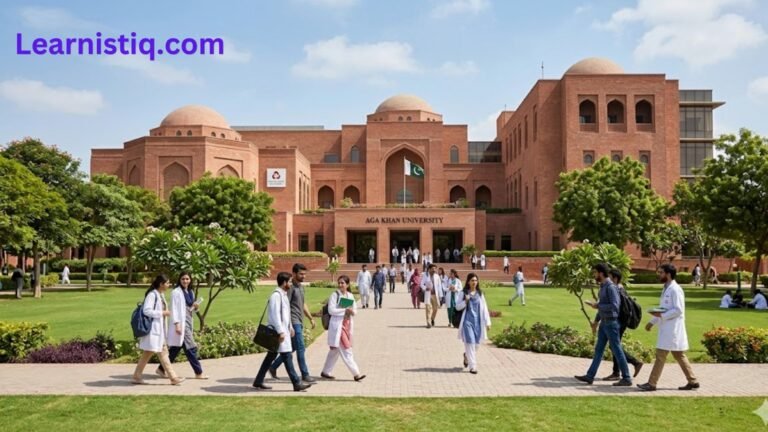
Aga Khan University Complete Guide 2026
Every year a lot of students from Pakistan want to go to Aga Khan University. It is their choice.. Many of these students do not have the right information about getting in. They also do not know what the entry test is like. This guide is here to help with that. If you are a … Read more


Shahzaib Khan is the founder of Learnistiq.com
and an independent education researcher based in
Rawalpindi, Pakistan. With over 8 years of
experience in student counseling and educational
guidance, he has personally helped hundreds of
Pakistani students choose the right universities
and career paths.
His research focuses on Pakistani university
admissions, online degree outcomes, and practical
career guidance for students who cannot afford
expensive counseling services. Every article on
Learnistiq is written from real experience and
verified information — not copied or AI-generated
content.
Shahzaib has been featured in student communities
across Pakistan and is committed to providing
honest, pressure-free guidance to students from
Rawalpindi, Lahore, Karachi, and beyond.