
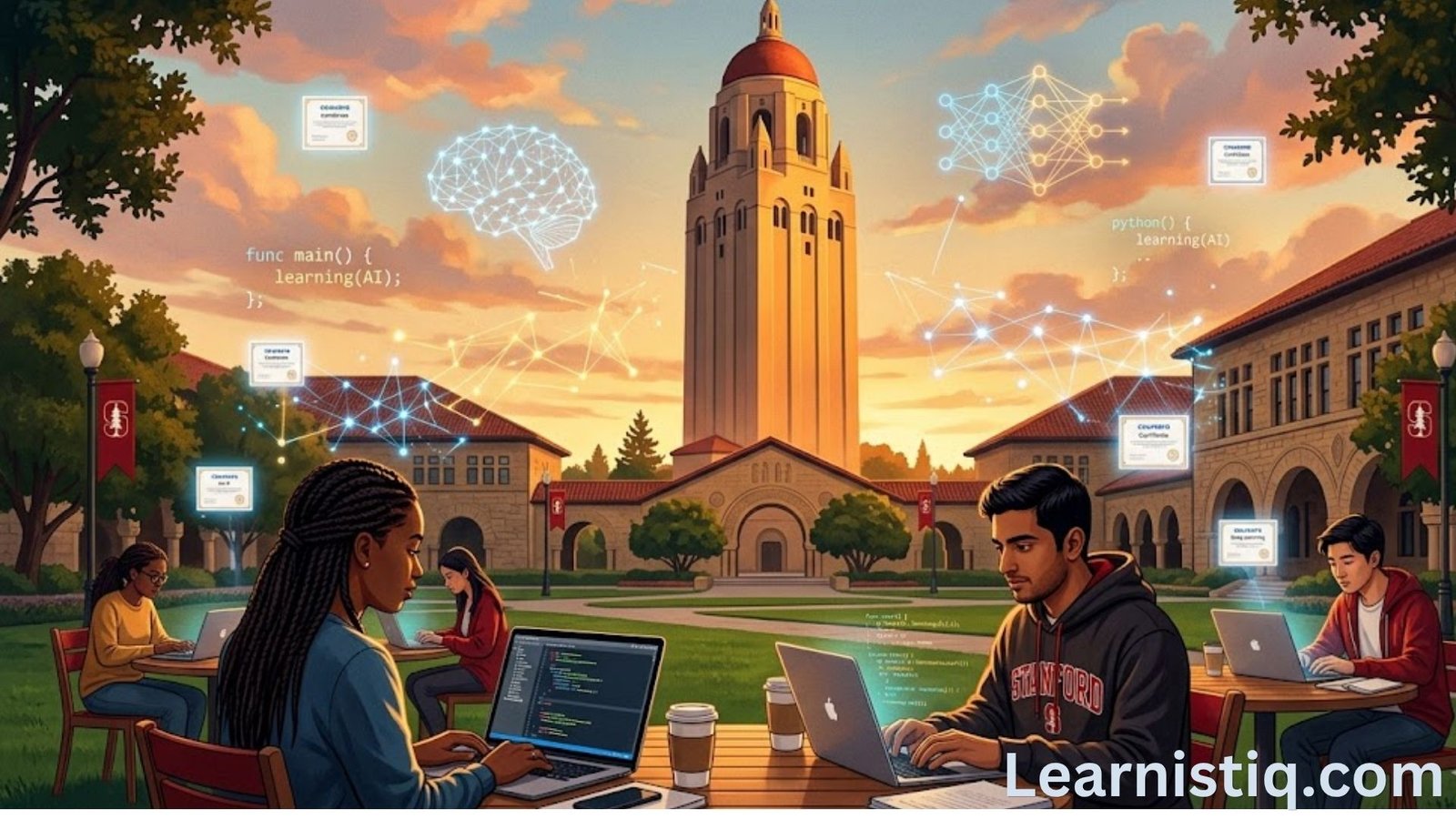
Stanford university has hundreds of free online courses in 2026, and most people who start one never finish — not because the course is bad, but because nobody told them upfront what they were signing up for, which certificate actually matters, or whether they chose the right course for their goal in the first place.
This guide fixes that. We cover Stanford’s free courses by category, tell you exactly how long each one takes, which certificates US employers recognize, how to get them free or near-free, and what everything else about Stanford — rankings, scholarships, location, admissions — looks like in June 2026.
Stanford University: Quick Facts for 2026
| Detail | 2026 Data |
| Official Name | Leland Stanford Junior University |
| Location / Address | Serra Mall, Stanford, CA 94305, USA |
| Founded | 1885 (opened 1891) |
| Type | Private Research University |
| Campus Size | 8,180 acres — Silicon Valley, near Palo Alto |
| Total Students | ~18,625 (undergrad ~7,900 / grad ~10,700+) |
| Acceptance Rate | ~3.6% |
| QS World Ranking 2026 | #3 |
| Times Higher Education 2026 | #5 |
| US News National Ranking | #4 |
| Tuition & Fees 2025–26 | ~$67,000–$68,500/year |
| Student-to-Faculty Ratio | 6:1 |
| Graduation Rate | 92% |
| Free Courses Available Via | online.stanford.edu, Coursera, edX |
| Nobel Laureates Affiliated | 83+ |
Table of Contents
Stanford University Location: Where It Sits and Why It Matters
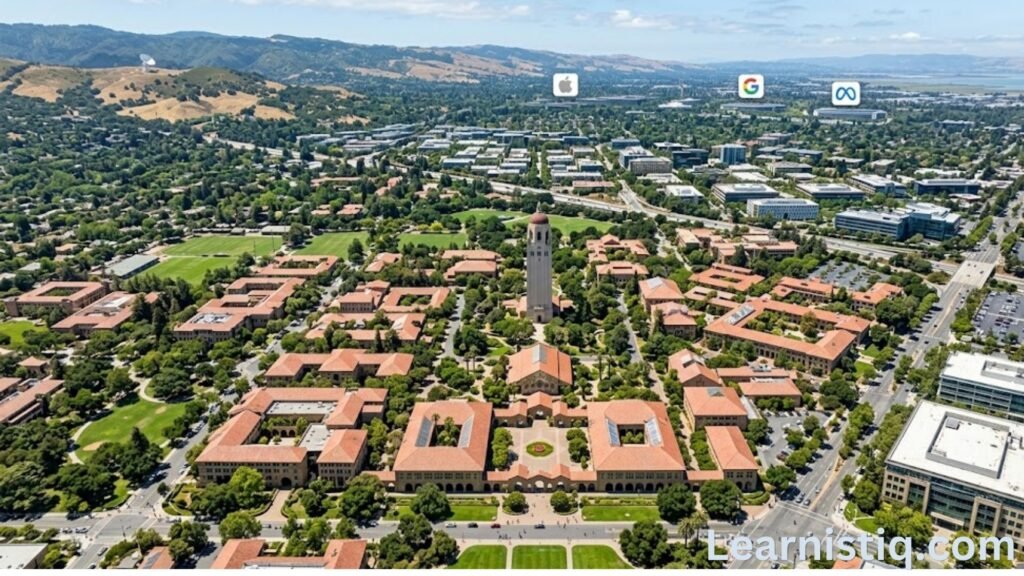
Stanford’s official postal address is Serra Mall, Stanford, California 94305. The campus sits on its own land bordering Palo Alto, right in the heart of Silicon Valley. San Francisco is 35 miles north; San Jose is about 20 miles south.
The location shapes everything about Stanford’s identity. Google’s Mountain View campus is 8 miles away. Apple Park in Cupertino is 12 miles away. Meta’s Menlo Park office is under 5 miles away. This isn’t trivia — it means Stanford students don’t wait until after graduation to enter the tech industry. They intern there, meet investors at on-campus events, and sometimes leave mid-degree to launch companies. The distance between Stanford’s gates and the world’s most powerful technology companies is small enough to walk.
For online course students, location is irrelevant — you can take Stanford’s courses from anywhere. But for anyone considering applying for admission, the Bay Area’s cost of living (~$2,500–$3,500/month for housing near campus) is a real factor that financial aid may not fully cover, especially at the graduate level.
Stanford University Rankings 2026
| Ranking System | Stanford’s Position (2026) |
| QS World University Rankings 2026 | #3 |
| Times Higher Education (THE) 2026 | #5 |
| US News Best National Universities | #4 |
| US News Best Global Universities | #3 |
| Graduation Rate (vs. all US universities) | Top 4% |
| Freshman Retention Rate | 98% |
One practical note: the 2–3 position difference between Stanford, MIT, and Harvard across ranking systems is meaningless for most decisions. All three consistently place in the global top five, all three are recognized identically by employers and graduate programs worldwide. What matters more is fit — program strength in your specific field, research opportunities, and financial aid — not whether a school is ranked #3 or #5 this year.
Stanford University Free Online Courses 2026: What Actually Exists
Stanford delivers free and low-cost online learning through three channels. Understanding how each works saves a lot of confusion.
Stanford Online (online.stanford.edu) is Stanford’s own platform. It hosts professional certificate programs, some credit-bearing courses, and a catalog of free open courses. This is the most “official” Stanford online presence, but most of the genuinely free content lives on partner platforms.
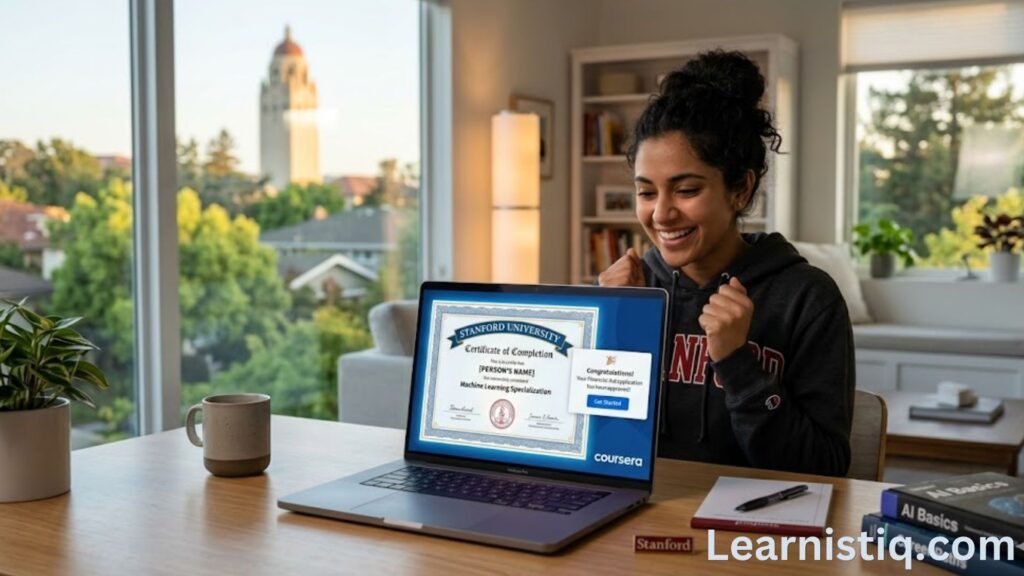
Coursera is where Stanford’s biggest, most employer-recognized courses live — Andrew Ng’s Machine Learning Specialization, the Deep Learning Specialization, AI in Healthcare, and others. Course content is free to audit. Certificates cost money, but Coursera’s financial aid program can bring that to nearly nothing if you apply properly.
edX hosts Stanford’s older catalog, including Statistical Learning and the database courses Stanford professors originally put online in 2011 — among the first MOOCs ever created. Same model: audit free, pay for the certificate.
One thing worth being clear about before going further: none of these platforms give you a Stanford degree or a Stanford academic transcript. A Coursera certificate says “Stanford University” and is issued by Coursera on Stanford’s behalf. It is a professional development credential. For most people reading this, that’s exactly what they need — but it’s worth knowing before you spend 60 hours on a course expecting something it was never designed to give.
Stanford University Free Online AI Courses 2026 — And Which One to Start With
This is the most searched category, and also the one where most people pick the wrong course first. Here’s the full picture.
Machine Learning Specialization
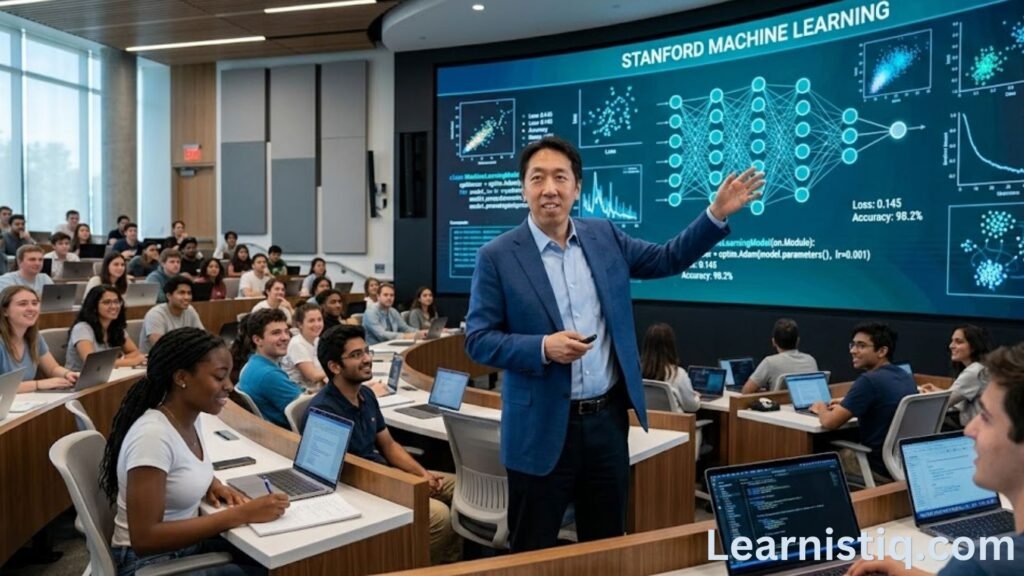
This course is taught by Andrew Ng, a Stanford professor and former head of Google Brain. The original version launched on Coursera with over 6 million enrollments. The updated 2022 version is still growing, and in 2026 it remains the most widely recognized free AI credential that tech employers actually know by name.
One honest thing most guides skip: completion rates for online courses are consistently between 5% and 15% across all platforms. That’s not because the courses are bad — it’s because the majority of people who enroll are browsing, not committed. If you’re reading this with a specific job or career move in mind, you’re already ahead of most people who sign up. Finishing one of these courses genuinely means something, precisely because so few people do.
What it covers: Supervised learning, unsupervised learning, recommender systems, and reinforcement learning basics.
Time commitment: ~60 hours total. At 8–10 hours per week, expect 6–8 weeks.
Cost: Free to audit. Certificate ~$79 on Coursera; financial aid available.
Prerequisites: Comfort with high school math. Linear algebra helps but isn’t required for the first two weeks.
Honest word of caution: This course has a high dropout rate not because it’s too hard, but because people start it without a clear reason to finish. If you’re trying to move into a data or ML role, this certificate on your LinkedIn genuinely moves things at tech companies. If you’re just curious about AI, auditing the first two weeks for free is perfectly reasonable — you’ll get solid conceptual grounding without committing to the full course.
Introduction to Statistics
Most guides skip this one. They shouldn’t. If you haven’t worked with data before, jumping straight into the ML Specialization means you’ll be lost by Week 3. This course covers the probability, distributions, and hypothesis testing that make the ML Specialization actually click. It’s shorter (~15 hours), free to audit, and sets you up for everything that comes after.
Deep Learning Specialization
Also taught by Andrew Ng. Five courses covering neural networks, CNNs, sequence models, and structuring ML projects. This is the course that takes you from “I understand machine learning” to “I can build and deploy a neural network.” Free to audit. More demanding than the ML Specialization — budget 90–100 hours.
AI in Healthcare
Developed by Stanford Medicine and co-created with practicing physicians, not just CS professors. Covers AI applications in diagnostics, clinical data management, medical imaging, and responsible AI in clinical settings. Free to audit. Particularly useful for US healthcare professionals, pre-med students, or anyone working at the health-technology intersection.
Stanford University Free Cybersecurity Courses Online 2026
Stanford’s cybersecurity content is more structured than most people realize, but it’s also scattered across platforms in a way that creates confusion. Here’s what actually exists.
Computer and Network Security (Stanford Online)
Covers cryptographic protocols, authentication, network security architecture, and threat modeling. Part of Stanford’s Advanced Cybersecurity Program. Worth being clear here: most of these courses are paid professional programs, not free open courses. A small number of modules have free preview access, but if you’re planning to go deep into Stanford’s security curriculum, check current availability at online.stanford.edu before assuming free access. The content quality justifies the cost if you’re serious about a security career.
Web Security (Stanford Online / Class Central)
Covers browser security models, SQL injection, cross-site scripting, CSRF, and modern web attack vectors. Free to audit through Class Central. One of the more practically useful security courses available online — the content is specific enough to apply immediately if you’re working in web development.
AI Security — XACS134 (Stanford Online)
Part of the Advanced Cybersecurity Program. Covers adversarial machine learning, AI-driven threat detection, and the specific security risks created by AI systems. This is a paid professional course (~$545 for ~10 hours), not a free course — but it’s included here because it’s one of the only courses in the world that sits specifically at the AI-cybersecurity intersection, taught at Stanford’s level of rigor.
A note for US-based learners: If you work at a company with a learning and development (L&D) budget, Stanford’s cybersecurity professional programs are often reimbursable. The $545 that looks steep out of pocket frequently gets covered by employer education benefits — worth asking before you pay personally.
Stanford Medicine Free Online Courses With Certificates 2026
Stanford Medicine runs a continuing education (CME) platform separate from Stanford Online. The key distinction: these certificates carry CME credits recognized by licensing boards for practicing healthcare professionals in the US — not just participation certificates.
COVID-19 Training for Healthcare Workers: Still listed on the Stanford Medicine CME portal, with over 6 million completions at its peak. In 2026, its direct clinical relevance has dropped as the acute pandemic phase ended — but the course remains on the platform and the free certificate is still valid for CME credit hours. Worth taking if you need the hours; less relevant as a career-building credential compared to 2020–2022.
Introduction to Food and Health (Coursera): Taught by Maya Adam, MD at the Stanford School of Medicine. Covers nutrition science, child health, and practical cooking fundamentals. One of the more accessible Stanford courses — no technical background needed. Free to audit, ~15 hours to complete.
AI in Medicine series: Covers clinical decision support, predictive modeling, and radiomics. Some modules are free; full CME credit access requires payment. Most relevant for licensed US healthcare providers seeking continuing education hours
Other Stanford Free Courses Worth Knowing About
Algorithms Specialization — For CS Students
Four-course series by Stanford CS professor Tim Roughgarden. Covers divide and conquer, graph search, greedy algorithms, and NP-completeness. Free to audit. The go-to recommendation in the CS community for anyone preparing for technical interviews or building a rigorous theoretical foundation. Budget ~80–100 hours for the full specialization.
Statistical Learning (edX / Stanford Online)
Based on the textbook Introduction to Statistical Learning, co-authored by Stanford professors. One of the most referenced data science courses in both academia and industry. More mathematically demanding than Andrew Ng’s ML courses. Free to audit. Best for people who want to understand what’s actually happening inside machine learning models — not just how to use them.
Introduction to Mathematical Thinking
Taught by Keith Devlin at Stanford. Covers formal logic, proof writing, and mathematical reasoning from the ground up. Genuinely useful for anyone who struggled with “why does math work this way” in school. Free to audit, ~35 hours.
Coursera vs edX for Stanford Courses: Which Platform Is Better?
| Factor | Coursera | edX |
| Stanford’s Best Courses | Machine Learning, Deep Learning, AI in Healthcare, Statistics, Algorithms | Statistical Learning, CS101, Database courses |
| Free Audit | Yes (most courses) | Yes (most courses) |
| Certificate Cost | $49–$99 per course | $99–$300 per course |
| Financial Aid | Up to 90% discount — apply through course page | Financial assistance available — apply per course |
| Certificate Name | “Stanford University” via Coursera | “Stanford University” via edX |
| Employer Recognition (USA) | Higher — more commonly seen on US resumes | Moderate — equally credible, less common |
| Best For | AI, ML, modern tech courses, career switching | Older Stanford catalog, statistics, CS fundamentals |
Practical recommendation for US-based learners: If your goal is a credential that shows up well on a LinkedIn profile in 2026, use Coursera for Stanford courses. The certificates are more widely recognized in the US job market, and the financial aid application is straightforward to complete.
How to Get a Stanford Certificate for Free in 2026
Most articles on this topic say “apply for financial aid on Coursera” and move on. Nobody explains what actually happens when you apply, what Coursera is looking for, or why some applications get approved and others sit in review for weeks before getting rejected. This section covers all of that.
Step 1: Start with the audit track — not paid enrollment
Go to coursera.org and search for your Stanford course. When you land on the course page, click “Enroll for Free.” Coursera will ask whether you want the full certificate track or the free audit. Choose audit first.
Why audit first? Because you don’t know yet whether this course fits how you actually learn. The ML Specialization is excellent — but it assumes comfort with basic algebra and probability. If you jump straight to the paid track and realize in Week 2 that you need to brush up on math, you’ve wasted money or a financial aid application. Two weeks of auditing costs nothing and tells you everything you need to know about whether to commit.
Step 2: Apply for financial aid — and take it seriously
When you’re ready for the certificate, go back to the course page. Below the enrollment button, look for the small link that says “Financial Aid Available.”
The application asks for your income, employment status, and two written responses — minimum 150 words each. One asks how the course connects to your career. The other asks why you need financial assistance.
Here’s what most people get wrong: they write two or three sentences and hit submit. Coursera reviews these manually. A response that says “I want to learn ML because it will help my career” gives a reviewer nothing to work with. A response that says “I’m currently working as a marketing analyst at a mid-size company and trying to move into a data analytics role — this course covers the statistical foundation I’m specifically missing” gives them a complete picture in under 150 words. Write the second kind.
Approval typically comes within 15 business days. When it does, you get full access to graded assignments and the verified certificate at no cost. The certificate looks identical to what paid learners receive — there’s no note on it saying financial aid was used. It says Stanford University. That’s what employers see.
Step 3: If you’re a US university student, check this first
Hundreds of American universities have a Coursera for Campus agreement, meaning your institution pays for Coursera access on your behalf. Before you spend time on a financial aid application, email your university library or check the IT services page for “Coursera” or “online learning partnerships.” If your school has it, you’re done in five minutes.
For edX courses
The process follows the same structure. Audit the course for free, then apply for financial assistance through the course page. edX typically processes applications within 10 business days and offers up to 90% off the certificate fee. The written responses matter here too — same advice applies.
One last thing worth saying plainly: the financial aid on these platforms is not charity or a loophole. It’s the business model working as intended. Coursera earns revenue from employers and institutions. Free certificates for individuals who genuinely need them cost Coursera very little relative to that revenue — and having millions of learners complete Stanford courses benefits everyone involved. You’re not gaming the system by applying. You’re using it the way it was built.
Are Stanford Online Certificates Worth It for US Jobs? Honest Answer
The Machine Learning Specialization certificate from Coursera/Stanford is the most valuable free AI credential available right now. Andrew Ng designed it, 6+ million people have taken it, and hiring managers at tech companies know exactly what it covers. If you’re applying to data science, ML engineering, or AI product roles at US companies, it signals that you’ve done the foundational work. It won’t get you the job alone, but it removes a question mark that would otherwise exist on your resume.
The cybersecurity courses carry less consistent name recognition in hiring, but they work well as evidence of self-directed learning — particularly if you’re transitioning from a non-security background and want to show structured study time.
What these certificates don’t do: they don’t substitute for a portfolio of projects. In tech hiring in 2026, a Stanford certificate plus a GitHub with actual ML projects will outperform a Stanford certificate alone every time. The certificate proves you did the coursework. The portfolio proves you can apply it.
Stanford University Courses: Full Degree Programs in 2026
Stanford’s on-campus programs span seven schools.
Key 2026 updates:
Stanford has reinstated standardized testing requirements. All first-year undergraduate applicants entering Fall 2026 must submit SAT or ACT scores — the test-optional policy is no longer in effect.
For international applicants, Stanford now accepts IELTS Academic scores (minimum 7.0) in addition to TOEFL. This expands options for applicants who previously could only submit TOEFL scores.
At the undergraduate level, the most popular majors are Engineering, Economics, Human Biology, and Political Science. At the graduate level, the Stanford GSB MBA, MS in Computer Science, MD/PhD, and JD are the flagship programs — the MBA and CS master’s are both considered among the two or three best in the world in their respective fields.
Stanford University Scholarships 2026
Knight-Hennessy Scholars — Fully Funded, Graduate Level
Up to 100 students receive this scholarship each year. It covers full tuition, provides a living stipend, and includes one round-trip travel allowance annually. Any student pursuing a graduate degree at Stanford is eligible — MBA, MS, PhD, MD, JD, or MFA. International students are eligible on the same terms as US students.
Application deadline is typically early October each year; you apply simultaneously to Knight-Hennessy and your Stanford graduate program. Selection criteria emphasize leadership, civic orientation, and cross-disciplinary thinking — not just academic performance.
Undergraduate Need-Based Aid — Better Than Most Scholarships
Stanford doesn’t call this a scholarship. For families who qualify, it functions like one:
- Family income under $100,000/year → $0 for tuition, housing, and meals
- Family income under $150,000/year → $0 tuition
- All admitted students → 100% of demonstrated financial need met
- International students → same aid policy as US students
- 88% of recent undergraduates graduated with zero debt
Apply via FAFSA and CSS Profile. Stanford is need-blind for US citizens — your ability to pay is not a factor in the admissions decision. Run the Stanford Net Price Calculator at financialaid.stanford.edu before assuming you can’t afford it. The sticker price and the actual price for many families are very different numbers.
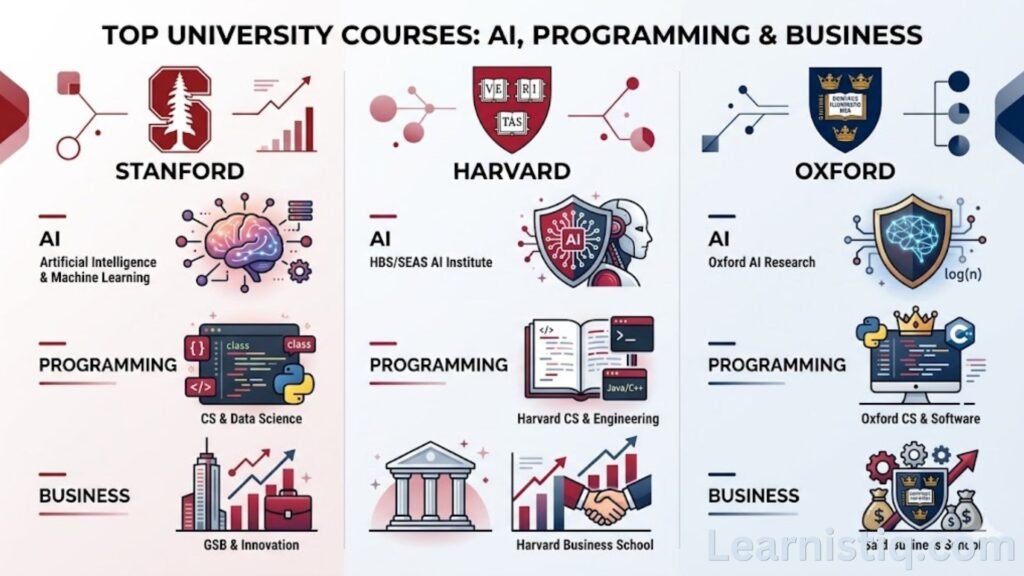
Stanford vs Harvard vs Oxford: Free Online Courses — Which Is Best for You?
| University | Best Free Courses | Certificate Cost | Best For | Weakness |
| Stanford | Machine Learning, Deep Learning, Statistics, Web Security, AI in Healthcare | $0–$99 (with aid) | AI/ML careers, data science, cybersecurity, medicine | Most courses assume some math or technical background |
| Harvard | CS50 (Python, Web Dev, AI, Cybersecurity), Data Science | Free on edX (some paid) | Absolute beginners, programming foundations, CS overview | Less depth in specialized ML/AI topics |
| Oxford | Business strategy, digital marketing, fintech, data science | $500–$3,000 | Working professionals, executive education, business skills | Very few genuinely free options |
Practical recommendations:
If you’re starting from zero in tech, do Harvard’s CS50 Python first — it’s the best beginner programming course on the internet, completely free, and takes about 10 weeks. Then move to Stanford’s ML Specialization once you have the foundation.
If you already have a technical background and want an AI/ML credential that US employers recognize, go straight to Stanford on Coursera.
If you’re a business professional looking to upskill in strategy or digital topics without heavy technical content, Oxford’s GetSmarter programs are strong — but budget for the cost, because free options from Oxford are limited.
Stanford University Admissions 2026: What It Takes
Stanford’s acceptance rate is 3.6%. Out of approximately 57,326 applications in the most recent cycle, around 2,067 students were admitted — the largest incoming class in Stanford’s 141-year history.
Key 2026 changes:
Stanford now requires standardized test scores again. The test-optional period is over — SAT or ACT scores are required for all first-year applicants. IELTS Academic (minimum 7.0) is now accepted alongside TOEFL for international students.
Stanford offers Restrictive Early Action: if you apply early to Stanford, you cannot simultaneously apply early to other private universities. However, it’s non-binding — being admitted early does not obligate you to attend.
Admitted students typically carry GPAs of 3.9–4.0, SAT scores of 1500–1570, or ACT scores of 34–36. Stanford does not make decisions based on numbers alone. Admissions officers are looking for self-awareness, intellectual curiosity, and a clear sense of what a student wants and why — not just a record of achievements. Essays that are honest and specific tend to do better than essays that are polished and vague.
Things Other Guides Won’t Tell You About Stanford Free Courses
AI and Cybersecurity Courses Age Fast
The Machine Learning Specialization was substantially updated in 2022, which is why it still holds up in 2026. But the AI field moves faster than any single course can match. By the time you finish a course, some of the tools it covers — specific frameworks, APIs, deployment methods — may already have newer versions that practitioners have moved to. That doesn’t make the course less valuable. The foundational concepts in machine learning — gradient descent, regularization, backpropagation — don’t become outdated. The ML Specialization is still worth doing precisely because it teaches those ideas well. But treat it as a foundation, and expect to stay current through newsletters, GitHub, and industry blogs after you finish.
Cybersecurity courses face a sharper version of this problem. Threats evolve constantly, new vulnerabilities emerge every month, and a course discussing specific attacks from 2022 may feel dated when applied to today’s threat landscape. The underlying principles remain sound. The specific examples may not. Keep that in mind when evaluating cybersecurity content.
Not All of Stanford’s “Hundreds of Courses” Are Equal
Stanford Online lists 2,100+ courses across all platforms according to Class Central. Most people read that number and assume they have 2,100 equally excellent options. They don’t. The Andrew Ng ML courses, the Algorithms Specialization, Statistical Learning, and Introduction to Statistics are genuinely world-class. A large portion of the remaining catalog consists of older content, niche modules with low enrollment, or specialized professional programs that aren’t actively maintained. Check enrollment numbers and ratings on Coursera and Class Central before committing to a course. A course with 100,000+ learners and consistent ratings is a reliable signal. A course with minimal reviews and no visible community activity is not.
Accessibility and Mobile Experience
Coursera and edX both support mobile apps with offline download on paid plans. For free auditors on mobile, the experience is functional but not seamless — some quiz formats don’t render well on small screens, and discussion forums are easier to use on a desktop. For pure video-lecture studying, the Coursera mobile app handles Stanford courses reasonably well. Stanford Online’s own platform is better suited to a desktop browser.
Subtitles are available on all major Stanford courses. Some courses also offer subtitles in Spanish, French, Portuguese, and Arabic — check before you start if that matters for your workflow.
Frequently Asked Questions
Does Stanford offer free online courses with certificates in 2026?
Yes. Through Coursera and edX, Stanford’s courses are free to audit. Verified certificates run $49–$99, but Coursera’s financial aid program can reduce that to near-zero. No application fee, no age limit, open to learners in all countries.
Which Stanford free course should I take first?
For AI: take Introduction to Statistics before the Machine Learning Specialization — the math foundation makes the ML course significantly clearer. For cybersecurity: Stanford’s Advanced Cybersecurity Program is the right path, but note most of it is paid professional content. For absolute beginners: Harvard’s CS50 Python before any Stanford course.
Is a Stanford Coursera certificate worth it for US job applications?
Yes, with context. The Machine Learning Specialization is recognized by tech hiring managers at Google, Meta, Amazon, and similar companies. It won’t replace a degree, but it removes doubt and signals structured learning. Pair it with actual projects on GitHub for maximum impact.
How long does the Stanford Machine Learning Specialization take?
Approximately 60 hours of content. At 8–10 hours per week, most learners finish in 6–8 weeks. It’s self-paced — you can pause and resume anytime.
What is Stanford’s QS ranking in 2026?
Stanford ranks #3 in QS World University Rankings 2026, #5 by Times Higher Education, and #4 among US national universities by US News.
Where exactly is Stanford University?
Serra Mall, Stanford, CA 94305 — bordering Palo Alto in Silicon Valley, approximately 35 miles south of San Francisco.
What are Stanford’s scholarships for 2026?
Knight-Hennessy Scholars is fully funded for graduate students (up to 100 per year). For undergraduates, families earning under $100,000 pay nothing — tuition, housing, and meals all covered. 88% of recent undergraduates graduated debt-free.
Bottom Line: What to Do After Reading This
If you came for the free courses: The fastest path is to go to coursera.org right now, search “Stanford Introduction to Statistics,” audit it for free, and give it two weeks. If it holds your attention, you have your answer about whether the full ML Specialization is worth committing to. If it doesn’t, you haven’t lost anything except a few hours.
If you’re thinking about applying to Stanford: Go to financialaid.stanford.edu and use the net price calculator before making any decisions based on sticker price. The $95,000/year figure sounds unreachable. The actual price for a family earning $80,000/year is $0. Those are very different situations, and the calculator takes five minutes.
If you came to research Stanford as a university: It’s genuinely one of the best institutions on the planet — not primarily because of its ranking, but because of what a 6:1 faculty ratio, $1.69 billion in annual research funding, and a campus inside Silicon Valley actually produce in terms of student outcomes and intellectual environment. Whether it’s the right place for you depends entirely on what you’re trying to build.
-
The University That Almost Never Existed — And Changed the World Anyway
There is a small detail about Princeton University that most people never think about. When the four founding ministers sat down in 1746 to petition for a college charter, the first governor they approached said no. A flat rejection. If a different man had been in charge that day — if history had turned slightly … Read more
-
Stanford University: Is It Free for Most Families? (2026)
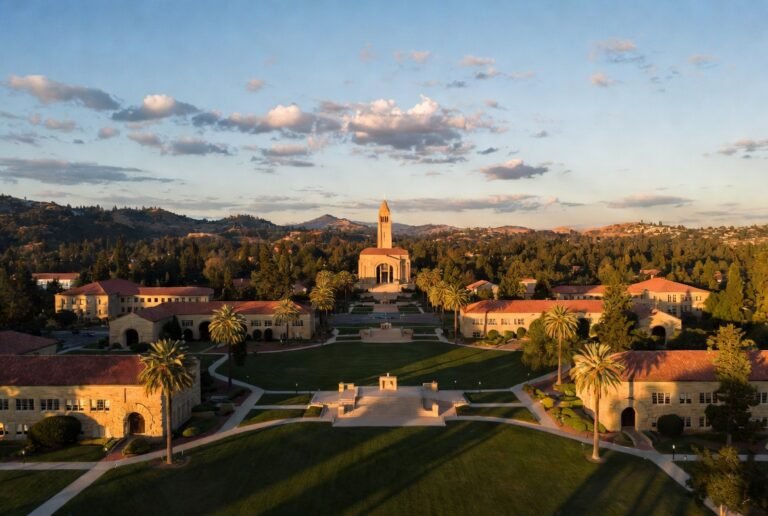
There is a moment in Stanford’s founding story that most university guides skip entirely. It is June 1893. Leland Stanford — railroad baron, former Governor of California, United States Senator — dies at his estate. He is 68 years old. He leaves behind a university that is only two years old, an estate buried under … Read more
-
Harvard University Is Free for Most Families — Here’s the Proof (2026)
Before You Start Reading — An Honest Warning Most articles about Harvard University are written to impress you, not to inform you. The letters start with autumn leaves in Harvard Yard they quote a Nobel laureate they list the acceptance rate. They close with something inspirational, about unleashing Harvard potential. Harvard letters are beautifully structured. … Read more

Every article on Learnistiq is written by Shahzaib Khan — an education
researcher who has spent years studying university admissions,
scholarship systems, and online education across Pakistan, the USA,
the UK, and Germany.
Shahzaib started Learnistiq because he saw students making expensive
mistakes — choosing the wrong university, missing scholarship deadlines,
or believing myths about online degrees. This platform exists to fix that.
No AI-generated filler. No copy-paste from official university websites.
Every guide is researched, fact-checked, and written to actually help
you make a better decision.