
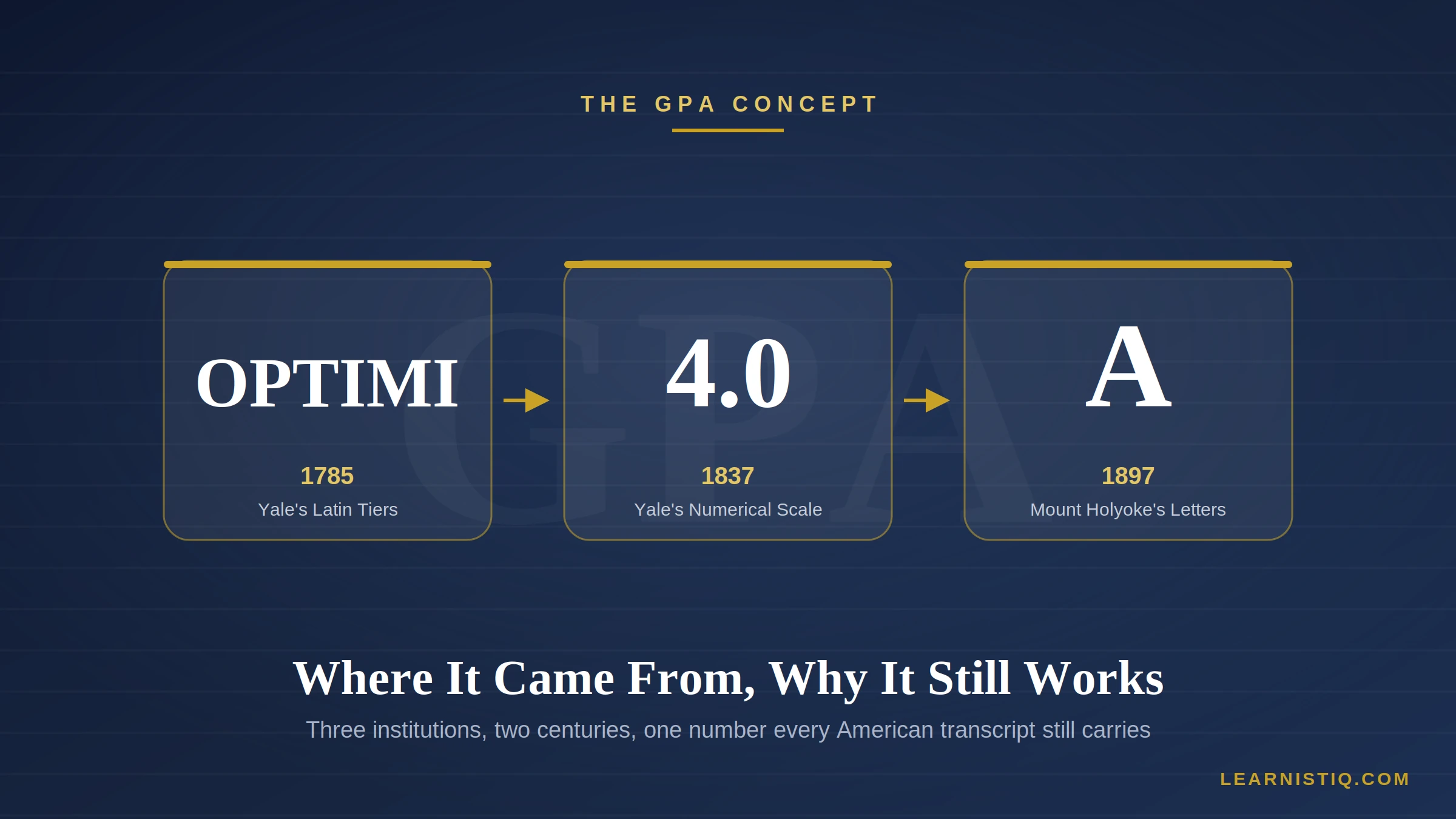
A high school senior named Marcus once asked his guidance counselor a question that stopped her mid-sentence: “Who actually invented the GPA?” She had answered thousands of questions about scholarship cutoffs and weighted scales over eighteen years on the job. Nobody had ever asked her where the number came from in the first place. She didn’t have an answer that day. Most counselors still don’t, because most GPA guides skip straight to the formula and never touch the origin.
That gap is worth closing, because the GPA concept did not arrive as a finished system. It was built in pieces, across more than two centuries, by people solving a much narrower problem than the one GPA solves today. Understanding where the concept came from changes how a student reads the number sitting at the top of a transcript. It stops looking like an arbitrary scoreboard and starts looking like what it actually is: a 19th-century compromise that the entire American education system never fully replaced.
Table of Contents
What the GPA Concept Actually Is
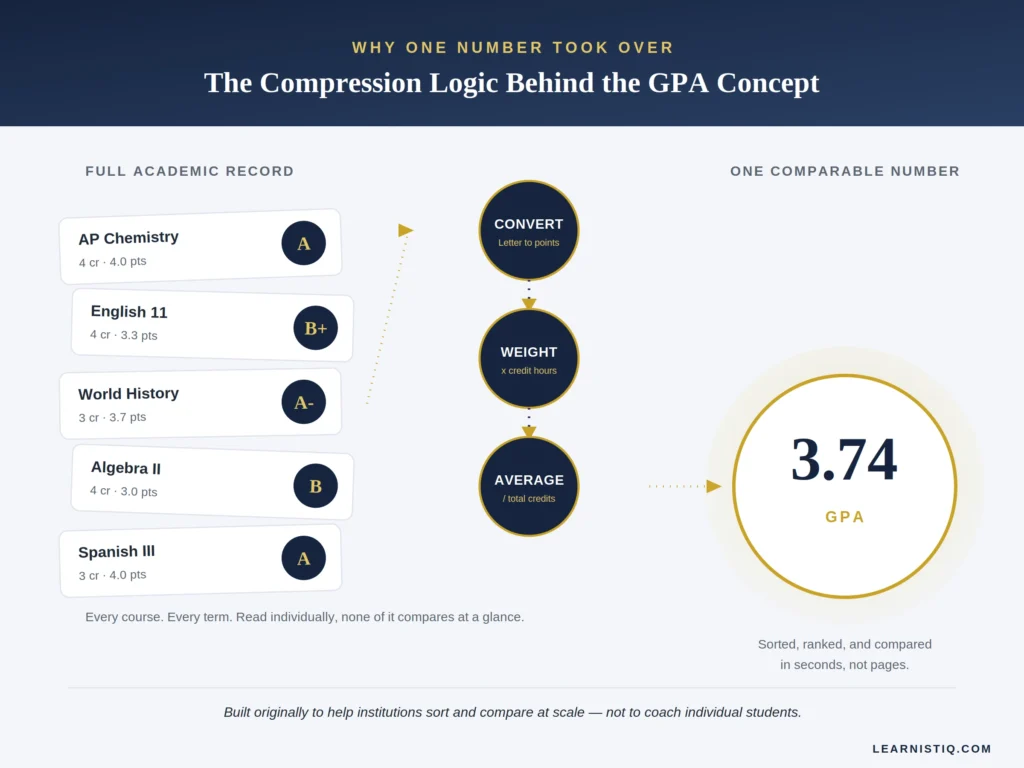
Strip away every calculator, every weighted scale, and every scholarship policy built on top of it, and the GPA concept reduces to one idea: a single number that compresses a student’s entire academic record into something that can be compared at a glance. That’s it. That’s the whole concept. Everything else — the 4.0 ceiling, the weighting for AP and Honors classes, the credit-hour math — is an addition layered onto that original idea over time.
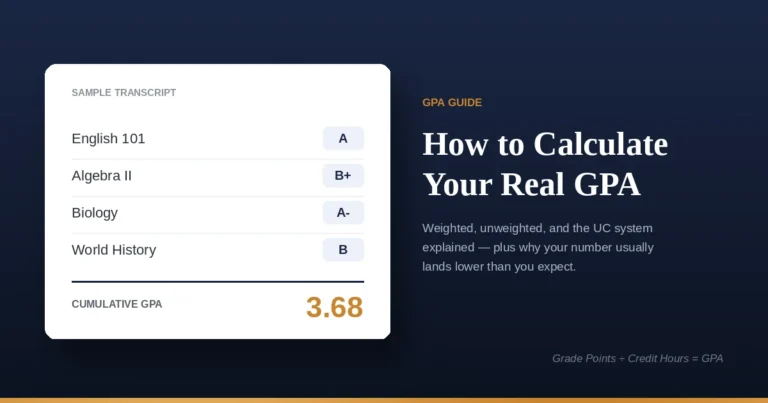
The term itself stands for grade point average, and the core mechanic has never really changed since its modern form took shape. A letter grade converts into a number. The numbers get averaged. The result becomes shorthand for performance. What has changed, repeatedly and sometimes contentiously, is how each generation of educators decided to build that conversion.
Most students encounter the GPA concept for the first time without anyone explaining why it exists at all. They learn the mechanics of how to calculate GPA long before they learn why a 4-point scale exists instead of a 10-point scale, or why an A became worth exactly 4 points instead of 100. Those choices were not random. They were decisions made by specific institutions, at specific moments, often for reasons that had nothing to do with the students who would eventually carry that number on a transcript.
Before Numbers: How American Colleges Graded Students for 150 Years
The instinct to formally evaluate students is old. Education researchers trace structured assessment back roughly 2,500 years, long before any university existed in the form recognized today. But evaluation and grading are not the same thing, and that distinction matters more than it sounds.
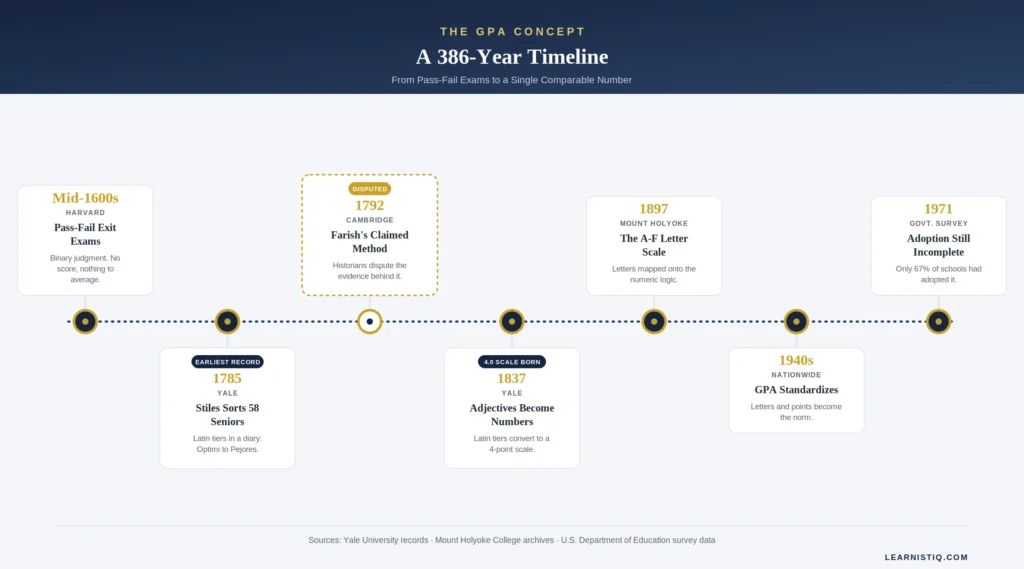
Harvard University required exit examinations starting in the mid-1600s, making it one of the earliest American institutions to formally test what a student had learned before allowing them to graduate. Those exams produced judgments — pass or fail, in practice — but they did not produce scores. There was no number attached to a student’s performance, no scale, nothing that could be averaged or compared across students. A student either satisfied the examiners or didn’t. For roughly 150 years after Harvard’s founding, American higher education evaluated students without ever assigning them anything resembling a grade.
That absence is easy to miss today, because every transcript a modern student sees is built entirely around numbers. But the GPA concept could not exist until someone decided that academic performance should be expressed as a measurable quantity rather than a binary judgment. That shift took another century to arrive, and it happened first at a university most American students associate today with prestige rather than grading history.
Yale, 1785: The First Documented Grading Record in America
What makes the earliest known American grading record interesting isn’t the system itself — it’s how unrecognizable that system would look to a modern student. There were no numbers in it. There were no letters. A university president sat down after personally examining an entire graduating class and sorted them into four tiers using Latin words, a method that has more in common with how a judge might rank competitors than with anything resembling today’s transcript.
That record traces back to Yale, where President Ezra Stiles personally examined 58 graduating seniors in 1785 and recorded his judgments in a personal diary rather than any official school document. Education historian George Wilson Pierson later uncovered that diary entry, which split the class into four Latin-derived tiers: Optimi at the top, second Optimi just below, then Inferiores, and finally Pejores at the bottom. Roughly translated, the labels move from “best” through “second best” down to “inferior” and “worse” — a blunt four-way sort rather than a fine-grained score.
Calling this the birth of GPA stretches the comparison further than the evidence supports. Stiles wasn’t building a transferable scale, a number anyone could average, or anything meant to outlive his own tenure as president. He was solving a one-time problem: how to summarize his impressions of 58 students he’d just spent days examining. What matters historically isn’t the sophistication of his method. It’s that an American university, for the first known time, chose to formally record a graded distinction between students rather than simply pass or fail the entire class as a group. That same practical impulse — sort students efficiently, communicate standing at a glance — is still the engine behind every GPA policy a registrar’s office writes today.
The Leap From Adjectives to Numbers
There’s a reason “Optimi” never became a lasting academic standard while a four-point scale did: words resist arithmetic. A label can describe where a student stands, but it can’t be added to another label, divided by a semester count, or tracked as a trend across four years the way a number can. Yale’s Latin categories worked fine for one president summarizing one graduating class, but they had no mechanism for comparing students who never sat in the same examination room together.
By 1837, that limitation pushed Yale toward a different format entirely: the same four-tier judgment, now expressed as a numerical scale rather than a set of Latin adjectives. Several education historians treat this specific conversion as the direct ancestor of the modern American GPA scale, and the reasoning holds up. The conceptual distance between an adjective and a number is bigger than it looks on the surface. A word describes a quality. A number invites a calculation. The instant Yale assigned numerical values to academic standing, averaging a student’s performance across multiple courses or multiple years became mathematically possible for the first time — which is the exact function a GPA still performs nearly two centuries later.
It’s worth being precise about the size of that 1837 shift. Yale wasn’t introducing letter grades; those still didn’t exist anywhere in the country. It was converting an existing ranking system into a number system — a narrower change than it sounds, but a foundational one. The four-point ceiling that came out of that conversion isn’t a coincidence shared with today’s 4.0 scale. It’s the identical structural choice, made nearly two hundred years earlier, that the overwhelming majority of American schools still default to without ever questioning why four became the number rather than five, or ten, or a hundred.
Cambridge, 1792: The Disputed Origin Story
History gets messier the moment a second country enters the picture, and GPA’s history has a second country. Yale’s American timeline isn’t the only origin story in circulation, and the rival account doesn’t even agree with itself among historians.
Some accounts trace quantitative grading back further still, and further afield: to a Cambridge University tutor named William Farish, credited in popular retellings with developing the idea of scoring academic work numerically and implementing it in 1792. That claim shows up often enough in casual histories of grading that it sounds settled. It isn’t. Historian Christopher Stray examined the evidence behind Farish’s supposed breakthrough and came away unpersuaded, arguing the historical record simply doesn’t support crediting him as the inventor of the numerical mark. Stray’s analysis pushes further than a simple rebuttal, too, tracing how the format of an examination — spoken aloud versus written down — shaped entirely different grading philosophies on opposite sides of the Atlantic, which undercuts any version of the story that tries to pin the whole concept on one person.
That disagreement is worth sitting with rather than smoothing over, because most casual explanations of GPA history flatten it into a single tidy narrative: one inventor, one date, one country. The documented record won’t support that simplicity. An American thread runs through Yale’s evolving rankings. A separate, contested British thread runs through Cambridge and a tutor whose role historians still argue about. Neither thread, on its own, produced the system used across the United States today. Both fed, unevenly and without coordination, into a broader idea that academic performance could be scored numerically — an idea no single institution or country can cleanly claim as its own invention.
Mount Holyoke, 1897: The Birth of the Modern Letter Scale
A number on its own doesn’t communicate the way a letter does, and that gap is exactly what kept the GPA concept incomplete for six decades after Yale’s 1837 breakthrough. Anyone glancing at a transcript today expects to see A’s and B’s, not raw decimal averages. That expectation has a surprisingly late birthday.
Mount Holyoke College, a women’s institution in Massachusetts, is credited with the first documented version of the A-through-F letter system, introduced in 1897. The timing tends to surprise people who assume letter grades are baked into American education from its earliest days. They’re a late-Victorian invention, arriving more than a century after Harvard’s pass-fail exams and sixty years after Yale had already moved to numbers. Once Mount Holyoke paired letters to the existing numerical logic — a letter mapped to a number, multiple numbers averaged together — the basic architecture of the modern GPA was finally complete in form, even if almost nobody outside that one campus was using it yet.
That last detail matters more than the invention itself. A new system existing somewhere is very different from a new system being adopted everywhere, and the gap between those two things turned out to be enormous.
Why the Concept Took 50 More Years to Spread
Adoption speed is where most accounts of GPA history go quiet, probably because the real answer is unflattering to the idea of grading as some carefully engineered national system. It wasn’t one. The letter-grade format Mount Holyoke introduced in 1897 did not become the standard across American schools until the 1940s, and even that figure undersells how slow the rollout actually was: government surveys found only 67 percent of American primary and secondary schools had adopted letter grading by 1971 — nearly three quarters of a century after Mount Holyoke’s original version.
Part of that delay is structural. Nineteenth and early-twentieth-century American education had no central authority dictating grading policy, no department issuing a national standard the way a modern Department of Education might. A rural schoolhouse in one state had no real obligation to follow whatever a Massachusetts women’s college had decided, and for decades, plenty simply didn’t. Part of the delay is also philosophical rather than administrative. Standardizing a four-letter or five-letter scale is the easy part. Getting every teacher, in every district, to agree on what separates an A from a B is a much harder problem — one that arguably still isn’t fully solved given how differently two schools can grade comparable student work even now.
By the time letter grades and numerical averaging finally converged into something resembling the modern GPA system, the concept had absorbed roughly 150 years of incremental decisions — Harvard’s pass-fail exams, Yale’s Latin rankings, Yale’s 1837 numbers, the disputed Cambridge claim, and Mount Holyoke’s letters — none of which were designed with each other in mind. The GPA a student receives today is less an engineered system and more a historical accumulation, several separate solutions stacked on top of each other and eventually treated as one.
From a Single Number to a System: How the GPA Concept Expanded
Once American schools settled on letter grades mapped to a four-point numerical scale, the concept stopped being static. It kept expanding to answer new questions that the original 1837 Yale scale was never built to handle.
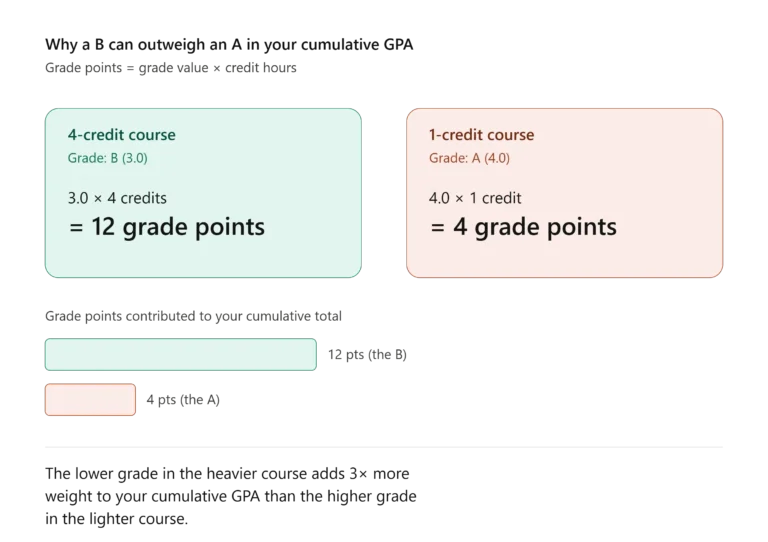
The most immediate expansion was averaging across more than one term. A single letter grade in a single class tells almost nothing about a student’s overall academic trajectory, which is exactly the problem cumulative tracking was built to solve. Cumulative GPA extends the original concept across every term a student has completed, weighting each grade by the credit hours behind it rather than treating every class as equally significant. That weighting detail — a 4-credit course pulling more mathematical weight than a 1-credit one — is a refinement the original Yale or Mount Holyoke systems never had to consider, because credit-hour structures themselves didn’t exist yet in any standardized form.
The mechanics of actually performing that averaging — multiplying grade points by credit hours, totaling them, dividing by total credits attempted — is where most students first encounter the practical side of the concept, and how to calculate GPA step by step is exactly where the abstract 19th-century idea turns into the concrete arithmetic a registrar’s office runs every semester. The concept and the calculation are not the same thing. The concept is the idea that performance should be quantified and averaged. The calculation is the specific arithmetic a particular school chooses to implement that idea with, and those specifics vary meaningfully from one institution to the next.
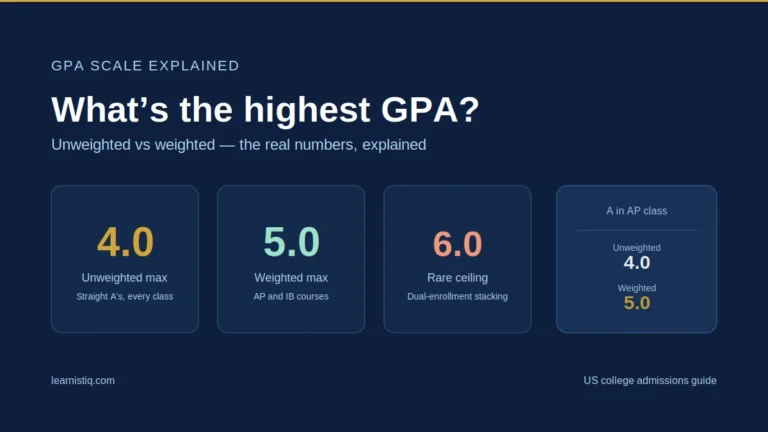
A second major expansion came from a problem the original four-point ceiling created almost by accident: it couldn’t distinguish between a student who took the easiest available classes and one who took the hardest. An A in a beginner elective and an A in an advanced placement course registered identically under the unweighted system inherited from Yale’s 1837 scale. Weighted GPA emerged specifically to solve that flattening problem, adding bonus points for course difficulty and pushing the practical ceiling above 4.0 for the first time in the concept’s history. That single addition is also why a meaningful share of selective colleges recalculate every applicant’s GPA using their own internal formula instead of trusting whatever number a transcript reports, since weighting scales vary so dramatically between schools that a 4.5 at one institution and a 4.5 at another can represent genuinely different levels of rigor. The full mechanics behind that ceiling, and exactly what the highest GPA looks like once weighting enters the picture, trace directly back to this gap in the original concept.
The Psychology Behind Why a Single Number Took Over
There’s a question worth asking honestly: why did American education converge on a single compressed number at all, rather than some richer description of student performance? The answer has less to do with pedagogy and more to do with scale.
By the early 20th century, American colleges were processing far more applicants and far more course records than any single admissions officer could read individually. A single number solved a logistical problem before it solved an educational one. It let an institution sort, rank, and compare students without requiring anyone to read a full transcript narrative for every applicant. That practical convenience — not some deliberate pedagogical theory about how learning should be measured — is the real engine behind why the GPA concept spread and survived where competing systems didn’t.
That origin explains a tension that still exists in education today. Critics have long argued grades function as short-term snapshots that only partially reflect genuine learning, and that the pressure to optimize for a single number can push students toward prioritizing grades over the deeper understanding the number was originally meant to represent. Those criticisms aren’t new. They trace back nearly as far as the system itself, because a concept built primarily to solve an administrative sorting problem was always going to sit awkwardly alongside the broader goals of actual education.
Common Misunderstandings About the GPA Concept
A handful of assumptions about GPA persist precisely because almost nobody explains where the concept came from, and they’re worth correcting directly.
The first misunderstanding is that the 4.0 scale is some kind of natural or inevitable standard. It isn’t. It’s a specific historical artifact, traceable to Yale’s 1837 conversion from Latin rankings to numbers, and other scales — a 5-point system, a 10-point system, a straight percentage — would have worked just as well mathematically. Four became the standard largely because Yale happened to set it that way nearly two centuries ago, and enough institutions copied the format afterward that it calcified into the default.
The second misunderstanding is that letter grades and numerical GPA arrived together as a single package. They didn’t. Numbers came first, in 1837. Letters came sixty years later, in 1897. For more than half a century, American grading existed in a numerical-only form that would look unfamiliar to any current student raised entirely on A’s, B’s, and C’s.
The third misunderstanding is that GPA was designed primarily to help students. It wasn’t, at least not originally. Every documented step in its development — Stiles sorting 58 seniors in 1785, Yale converting to numbers for easier comparison in 1837, Mount Holyoke standardizing letters in 1897 — solved an institutional problem first: how a school organizes, ranks, and compares its own students efficiently. The benefits students draw from GPA today — a clear personal benchmark, a tool for tracking improvement — exist downstream of a system built for administrative clarity rather than individual feedback.
Why the Concept Still Matters in 2026
None of this history is purely academic trivia. Understanding the GPA concept’s origin changes how a student should actually treat the number once they have one.
The arbitrary, historically contingent nature of the 4.0 scale is exactly why so many colleges recalculate applicant GPAs using their own internal formula rather than trusting the number a transcript reports. If 4.0 were some objectively correct measurement standard, that recalculation wouldn’t be necessary. It happens precisely because the scale is, and always has been, a convention rather than a law of nature — one that different institutions have implemented with enough variation that the raw number alone can’t be trusted across schools.
The slow, uneven spread of the system — taking more than a century to standardize — also explains why GPA policies still vary so widely between states, districts, and even individual scholarship programs today. There was never a single moment where the United States adopted one unified GPA standard from a central authority. The concept grew the way it was built: unevenly, institution by institution, decision by decision, and that fragmented origin is the direct reason a 3.5 GPA can mean something different depending entirely on which school issued it.
The Bottom Line
Marcus, the student whose question opened this piece, eventually got his answer, though not from a single source. No one person invented the GPA. Ezra Stiles sorted Yale seniors into Latin categories in 1785 because he needed a practical way to summarize an examination. Yale turned those categories into numbers in 1837 because numbers could be averaged in ways adjectives couldn’t. A disputed claim places quantitative grading at Cambridge in 1792, a thread historians still argue about today. Mount Holyoke introduced letter grades in 1897, sixty years after the numbers that letters would eventually be mapped onto. None of it spread quickly. None of it was planned as a unified system from the start.
What survived is a concept built from fragments, each one solving a narrow, practical problem for a specific institution at a specific moment. The number sitting at the top of a transcript today carries all of that history, whether a student knows it or not. Understanding where it came from doesn’t change how it’s calculated, but it changes how seriously a student should treat any single school’s version of the scale as the only correct one.
External Links :
Yale, 1785: The First Documented Grading Record in America
Link: https://advising.yalecollege.yale.edu/sites/default/files/files/Yale%20Firsts.pdf
Yale’s own historical record
Mount Holyoke, 1897: The Birth of the Modern Letter Scale
Link: https://lits.mtholyoke.edu/news/2023-03-30/know-our-history-grading-mhc
Mount Holyoke’s archived grading history
From a Single Number to a System: How the GPA Concept Expanded
Link: https://bigfuture.collegeboard.org/plan-for-college/get-started/how-to-calculate-gpa-4.0-scale
College Board’s GPA scale guide
Frequently Asked Questions
Who invented the GPA?
No single person invented it. The earliest documented American grading record comes from Yale University in 1785, when President Ezra Stiles ranked 58 seniors into Latin-derived categories. Yale converted that ranking into a numerical four-point scale by 1837, which several historians consider the direct ancestor of the modern GPA. A separate, disputed claim credits William Farish with developing quantitative grading at the University of Cambridge in 1792, though historian Christopher Stray has challenged the evidence behind that claim. Letter grades — the A through F system used alongside the numerical scale today — didn’t appear until Mount Holyoke College introduced them in 1897.
When did GPA start being used in the United States?
The concept developed in stages rather than starting on a single date. Harvard required pass-fail exit exams as early as the mid-1600s, but without any numerical scoring. The first documented numerical ranking appears at Yale in 1785, with a four-point numerical scale following by 1837. Letter grades arrived later still, introduced at Mount Holyoke in 1897, and the combined letter-and-number GPA system most American students recognize today didn’t become the national standard until the 1940s.
Why is the GPA scale based on 4.0?
The four-point ceiling traces back to Yale’s 1837 conversion of its Latin-based student rankings into a numerical scale. There’s no inherent mathematical reason a 4-point scale is superior to a 5-point or 10-point alternative; it became the standard largely because Yale set that precedent and other American institutions gradually adopted the same format. That historical origin is also why weighted GPA scales, which push past 4.0 for advanced coursework, feel like a departure from the “real” ceiling, even though the original 4.0 itself was just one institution’s arbitrary choice.
Is the GPA concept the same in every country?
No. The 4.0 letter-grade system traces a specifically American institutional history, running from Yale’s 18th-century rankings through Mount Holyoke’s 1897 letter grades to nationwide adoption by the 1940s. Other countries built entirely separate grading traditions, some based on direct percentage scores, others on different numerical scales entirely, which is why international students often need conversion charts to translate their academic record into the American GPA format.
Does understanding GPA history actually help students today?
It helps contextualize the number rather than calculate it. Knowing that the 4.0 scale is a 19th-century convention, not a universal standard, explains why so many colleges recalculate applicant GPAs internally instead of trusting the transcript figure directly. It also explains why GPA policy still varies so widely between schools today: the system never had a single unifying authority standardizing it from the start, which is exactly why a cumulative GPA at one school and the same number at another can carry different weight in front of an admissions committee.
-
Cumulative GPA: The Quiet Number That Decides Scholarships, Probation, and Admissions
Sarah found out she’d lost her scholarship in an email that took four lines to say it. Not a phone call. Not a meeting with her advisor. Four lines, sent on a Tuesday afternoon in March, informing her that her cumulative GPA had landed at 2.94 — six hundredths of a point under the 3.0 … Read more
-
How to Calculate Your GPA (And Why It’s Lower Than You Think It Should Be)
I’ve looked at more transcripts than I can count, and the same conversation happens almost every time. A student does quick mental math and lands on a number that doesn’t match their report card, then asks the question nobody says out loud at first: “Why is my GPA lower than I thought it’d be?” That … Read more
-
What is the Highest GPA? The Real Numbers Behind 4.0, 5.0, and Beyond
Ask a school counselor what the highest GPA is, and she’ll answer with a question of her own: weighted or unweighted? That’s not her dodging the question. That’s the whole answer. 4.0 caps the unweighted scale, full stop. A weighted scale blows past it, usually landing at 5.0. Sometimes higher than that. Most students run … Read more

Every article on Learnistiq is written by Shahzaib Khan — an education
researcher who has spent years studying university admissions,
scholarship systems, and online education across Pakistan, the USA,
the UK, and Germany.
Shahzaib started Learnistiq because he saw students making expensive
mistakes — choosing the wrong university, missing scholarship deadlines,
or believing myths about online degrees. This platform exists to fix that.
No AI-generated filler. No copy-paste from official university websites.
Every guide is researched, fact-checked, and written to actually help
you make a better decision.