
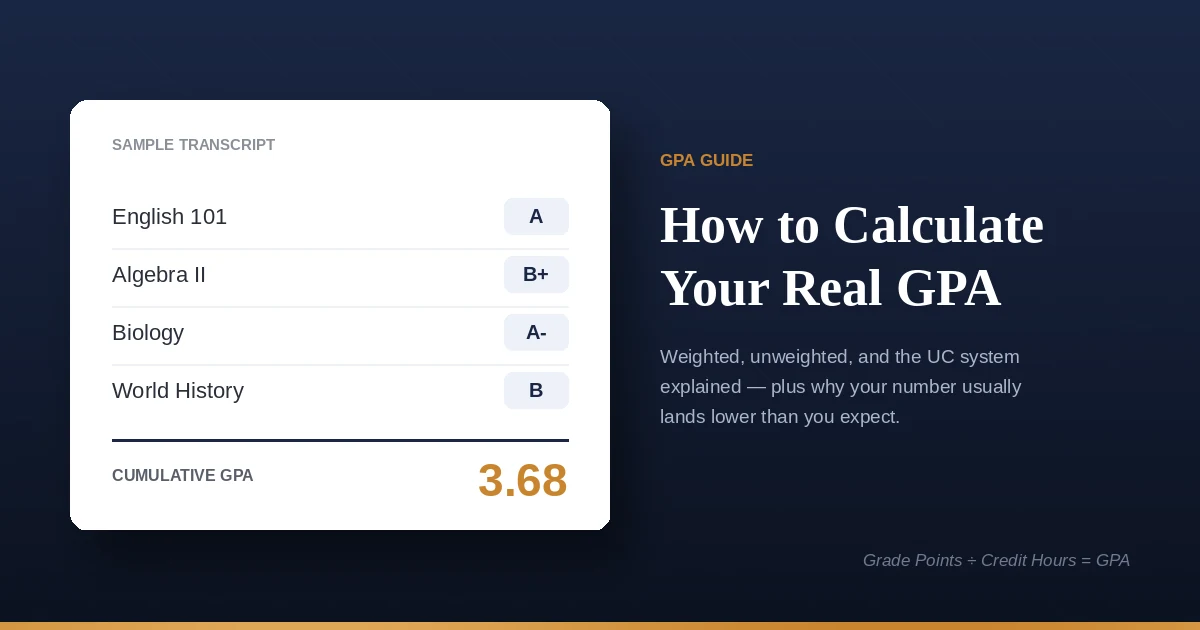
I’ve looked at more transcripts than I can count, and the same conversation happens almost every time. A student does quick mental math and lands on a number that doesn’t match their report card, then asks the question nobody says out loud at first: “Why is my GPA lower than I thought it’d be?”
That gap between expectation and transcript is what this guide actually fixes. Most GPA articles stop at the formula, but the formula was never the hard part. The hard part is understanding what’s quietly dragging your number down and how to read your transcript the way an admissions officer will.
So here’s the plan: the real math for high school and college GPA, weighted and unweighted, semester and cumulative, then California’s UC system specifically, since it runs on different rules than most states. Then the part almost nobody writes about honestly: the common reasons GPAs end up lower than expected.
If you landed here from our guide on the highest GPA possible, think of this as the working-out-the-math version of that conversation. That article tells you the ceiling. This one tells you how the number underneath it gets built.
Table of Contents
Quick Answer: How Do You Calculate GPA?
Add up the grade points for every class, divide by the number of classes (or credit hours, in college), and that’s your GPA. The formula is:
Total Grade Points ÷ Total Classes or Credit Hours = GPA
That’s the one-line version. The rest of this guide is everything that formula doesn’t tell you, like how weighting changes it, how credit hours change it, and why two students with “the same grades” can end up with different numbers entirely.
What GPA Actually Measures
GPA, or grade point average, converts every letter grade you’ve earned into a number and averages those numbers into one figure, usually somewhere between 0 and 4.0, sometimes higher if your school weights advanced classes.
It matters for a few concrete reasons. Admissions offices use it as an early filter, often before a human reads your essay. Scholarship boards frequently set a GPA floor; fall under it and you’re not in the pool, regardless of your other accomplishments. Some majors, nursing and engineering especially, set a minimum GPA just to stay enrolled in the track. And while fewer employers lean on it than they used to, it still shows up on your first résumé out of school.
None of that makes GPA destiny. I’ve seen students with a 3.2 get into schools that students with a 3.9 didn’t, because the rest of the application told a more convincing story. But you can’t make smart decisions about your transcript if you don’t understand how the number is built, which is where most students get stuck.
The GPA Scale: How Letters Become Numbers
Every GPA calculation starts here. Most U.S. high schools and colleges use a 4.0 unweighted scale:
| Letter Grade | Grade Points |
| A / A+ | 4.0 |
| A- | 3.7 |
| B+ | 3.3 |
| B | 3.0 |
| B- | 2.7 |
| C+ | 2.3 |
| C | 2.0 |
| C- | 1.7 |
| D+ | 1.3 |
| D | 1.0 |
| D- | 0.7 |
| F | 0.0 |
A few details that trip people up: some schools score A+ as 4.3 instead of capping at 4.0, so two students with identical report cards can post slightly different GPAs depending on their school’s scale. And grades like P (pass), NP (not pass), I (incomplete), and W (withdrawal) typically don’t enter the formula at all. They sit on your transcript, but they’re skipped in the average, which is also why withdrawing from a failing class can protect your GPA even though it still shows up on your record.
How to Calculate GPA, Step by Step
Let’s run actual numbers, because a formula without an example rarely sticks. Say a student took five classes this semester and earned four A’s and one B:
| Course | Letter Grade | Grade Points |
| English | A | 4.0 |
| Algebra II | A | 4.0 |
| Biology | A | 4.0 |
| Physical Education | A | 4.0 |
| World History | B | 3.0 |
Step 1: Convert each letter grade to its point value, using the table above. Step 2: Add the grade points together. 4.0 + 4.0 + 4.0 + 4.0 + 3.0 = 19.0. Step 3: Divide by the number of classes. 19.0 ÷ 5 = 3.8 GPA.
That’s the entire process for a basic unweighted GPA. College adds credit hours into the mix, and weighted systems add bonus points for harder classes, but the underlying logic stays the same the whole way through: convert, total, divide.
High School GPA: Weighted vs. Unweighted
This is where most of the confusion actually starts, because “GPA” can mean two different numbers depending on how your school treats difficulty.
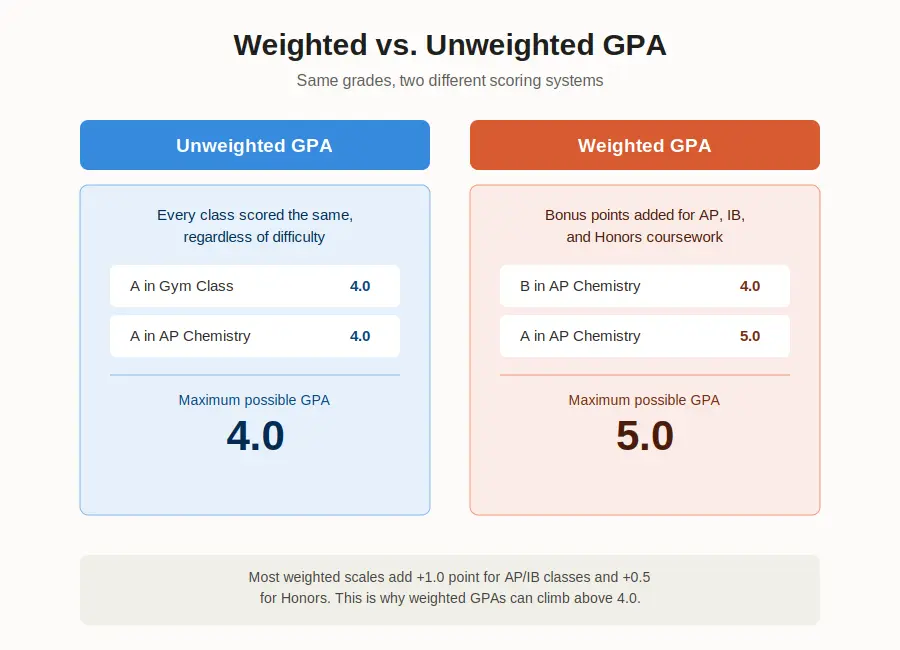
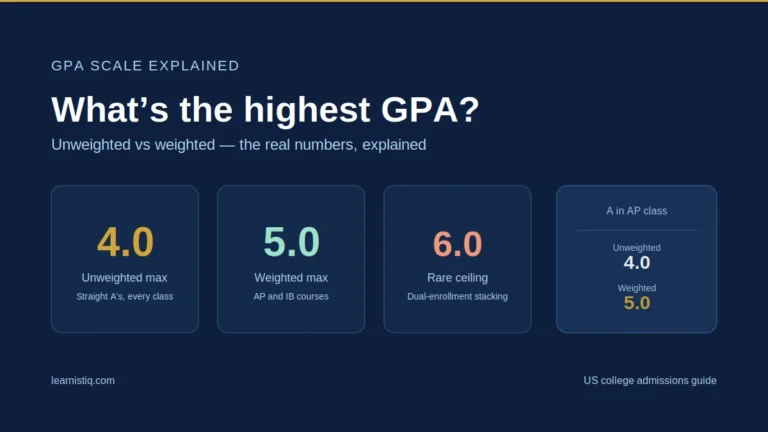
Unweighted GPA scores every class identically. An A in gym and an A in AP Chemistry both land at 4.0. Weighted GPA adds points for advanced coursework, commonly +1.0 for AP or IB classes and +0.5 for honors, which is why weighted GPAs can climb past 4.0. Under that system, a B in an AP class equals 4.0, the same as an A in a regular class, and an A in an AP class hits a full 5.0.
Here’s a student with a heavier load: two AP classes, one honors class, two regular classes.
| Course | Letter Grade | Grade Points (Weighted) |
| AP English | B | 4.0 |
| AP Algebra | A | 5.0 |
| Honors World History | A | 4.5 |
| Physical Education | A | 4.0 |
| Chemistry I | B | 3.0 |
Total: 4.0 + 5.0 + 4.5 + 4.0 + 3.0 = 20.5. Divide by 5 classes: 4.1 weighted GPA, even with two B’s on the transcript.
This is exactly why colleges often recalculate GPA themselves instead of trusting the number your school reports. A 4.1 from one school might reflect two AP classes; a 4.1 from another might reflect none at all. Admissions readers know this, which is why they read your transcript alongside the GPA, never as a replacement for it.
College GPA: Where Credit Hours Come In
College GPA uses the same point system but folds in credit hours, since a 4-credit lab science class should count for more than a 1-credit seminar. The formula becomes:
(Grade Points × Credit Hours, per class), totaled, then divided by Total Credit Hours
A typical first semester:
| Course | Grade | Points | Credits | Total Points |
| English 101 | A | 4.0 | 3 | 12.0 |
| Algebra 101 | B | 3.0 | 3 | 9.0 |
| Biology 101 | B | 3.0 | 4 | 12.0 |
| Computer Science 101 | B | 3.0 | 4 | 12.0 |
| Psychology 101 | A | 4.0 | 3 | 12.0 |
Total points: 12.0 + 9.0 + 12.0 + 12.0 + 12.0 = 57.0. Total credits: 3 + 3 + 4 + 4 + 3 = 17. Divide: 57 ÷ 17 = 3.35 GPA.
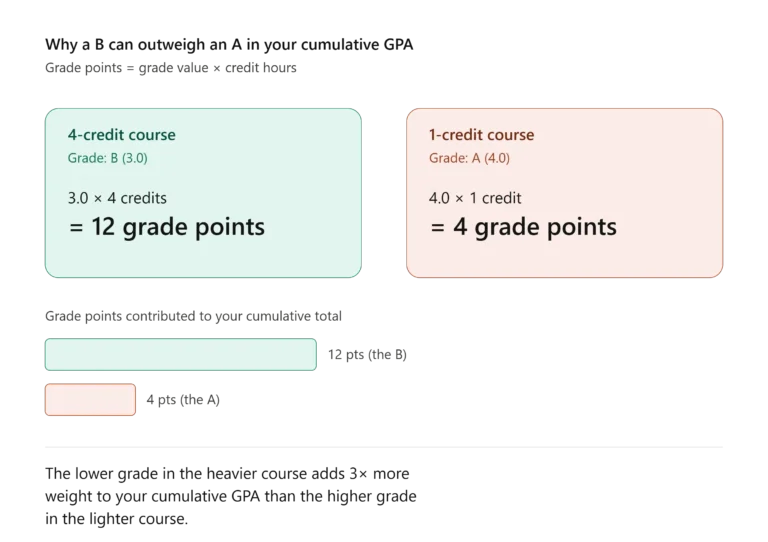
Notice Biology, a B at 4 credits, contributes exactly as many total points as English, an A at 3 credits. That’s the whole purpose of credit weighting: a solid grade in a heavier class pulls just as hard as a strong grade in a lighter one, and a weak grade in a heavy class can do real damage for the same reason.
Cumulative GPA vs. Semester GPA
Your semester GPA reflects one term. Your cumulative GPA reflects everything, properly averaged together, and it’s the number that ends up on your final transcript.
The most common mistake here is averaging semester GPAs directly, adding 3.6 + 3.5 + 3.8 + 3.7 and dividing by 4. That’s wrong, because it ignores that you probably carried a different number of credits each term. The correct method goes back to total points and total credits across every semester:
| Semester | GPA | Credit Hours | Total Points |
| Fall, Year 1 | 3.6 | 12 | 43.2 |
| Spring, Year 1 | 3.5 | 13 | 45.5 |
| Fall, Year 2 | 3.8 | 12 | 45.6 |
| Spring, Year 2 | 3.7 | 16 | 59.2 |
Total points: 43.2 + 45.5 + 45.6 + 59.2 = 193.5. Total credits: 12 + 13 + 12 + 16 = 53. Divide: 193.5 ÷ 53 = 3.65 cumulative GPA.
This is the figure colleges, scholarship committees, and employers actually look at, since it reflects your full academic record instead of one good or rough stretch.
California’s GPA System Works Differently
If you’re applying to a University of California campus, the GPA on your transcript and the GPA UC actually evaluates are frequently two different numbers, and this catches students off guard constantly.
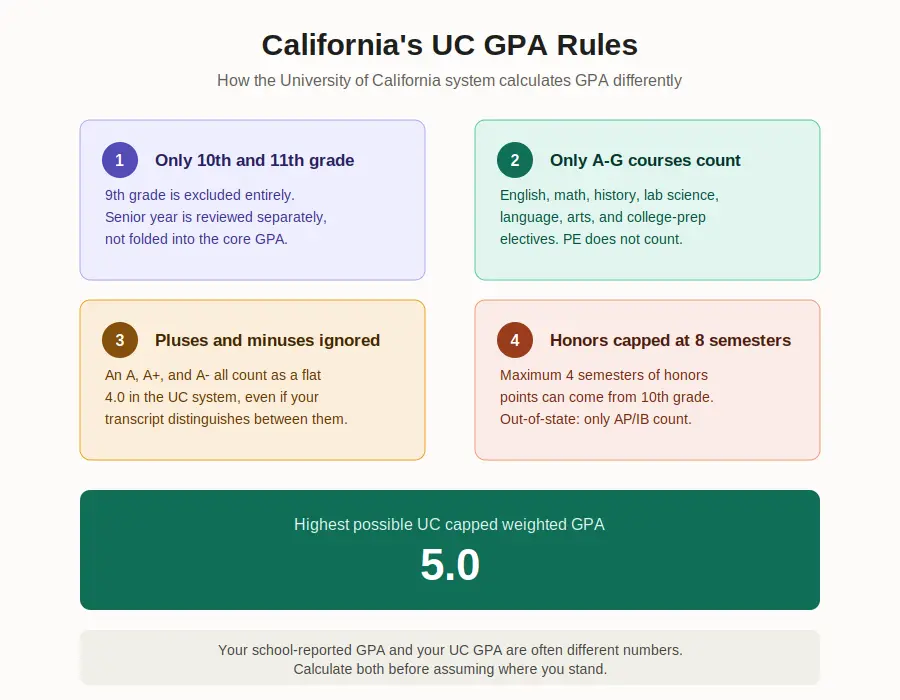
UC calculates its own “capped weighted GPA,” and the rules diverge from a typical school-reported GPA in a few key ways. Only 10th and 11th grade classes count; 9th grade isn’t included, and senior-year grades get reviewed separately in context rather than folded into the core number. That’s genuinely good news if your 9th grade year was rocky.
Only “A-G” courses count: English, math, history/social science, lab science, a language other than English, visual/performing arts, and college-prep electives. PE and non-A-G electives don’t factor in. Pluses and minuses are ignored completely; an A, A+, and A- all register as a flat 4.0, even if your school’s transcript distinguishes between them.
Honors weighting caps at 8 semesters total, no more than 4 from 10th grade. California residents get the extra point for both UC-certified honors and AP/IB classes. Out-of-state and international applicants only get weighting for AP and IB, not school-designated honors. Because of the cap, the highest possible UC capped weighted GPA is 5.0, requiring straight A’s across every A-G course in 10th and 11th grade with the maximum weighted classes applied.
If you need your real UC standing, walk through your own 10th and 11th grade A-G courses using these exact rules rather than trusting your school transcript’s number. The gap between the two can run several tenths of a point in either direction, which matters if you’re sitting right at a campus’s typical admitted range.
The Real Reasons Your GPA Is Lower Than You Expected
This is the part most GPA guides skip, and it’s usually the actual question behind the question. Here’s what quietly pulls GPAs down, roughly in order of how often I see each one.
Heavy courses without matching weight. A student takes four AP classes, earns three B’s and an A, and ends up looking worse on paper than a friend who took easy electives and got straight A’s. The math isn’t broken; an unweighted system just doesn’t reward the harder load. If your school offers a weighted GPA and it’s not showing up anywhere, ask your counselor directly.
One bad semester sitting inside the average permanently. Cumulative GPA is a running average, so a single rough term, illness, a class that didn’t click, stays in the math for years unless your school allows grade replacement.
Not retaking a low grade when the option exists. Many schools let you retake a class and replace the old grade in your GPA, even though the original still appears on the transcript. Students who don’t know this option exists just carry the lower grade forward.
Credit-hour mismatches in college. A C in a 4-credit lab science hurts more than a C in a 1-credit seminar, because the math weights it more heavily.
Comparing unweighted to weighted without realizing it. A 3.6 unweighted and a 3.6 weighted aren’t the same achievement, and a lot of “why is my friend’s GPA higher” frustration comes down to comparing two different scales.
Inconsistent effort across the term instead of at the end. Final grades usually reflect cumulative performance, not just a strong final exam, so a slow start that’s never fully corrected shows up in the number regardless of a strong finish.
None of these mean you’re a bad student. They’re mechanical, and most are fixable once you know which one applies to you.
What’s the Highest GPA You Can Actually Get?
“Highest GPA” depends entirely on which scale your school uses, which is exactly why we cover the full mechanics of it in our highest GPA guide.
On an unweighted scale, 4.0 is the hard ceiling: straight A’s, nothing more, regardless of difficulty. On a weighted scale, the ceiling shifts based on how your school structures bonus points, most commonly capping at 5.0 for AP, IB, and sometimes honors. A handful of schools don’t cap weighting at all, which is how you occasionally hear about a GPA above 10, built by stacking an unusual number of weighted classes in a system with no ceiling.
For nearly every student, the realistic answer is one of two numbers: 4.0 if your school doesn’t weight grades, or somewhere between 4.5 and 5.0 if it does.
Why Is Carson Beck’s GPA Trending?
If you landed here expecting college football instead of a calculator, here’s the short version. Miami quarterback Carson Beck went viral after telling reporters, ahead of the College Football Playoff National Championship, that he hadn’t taken a class in two years since graduating from the University of Georgia in 2023. It set off debate about NCAA eligibility rules and what counts as a “student” athlete in the NIL era.
Neither Georgia nor Miami released his college GPA. What resurfaced was his high school GPA, a 3.8, pulled from a 2020 recruiting profile he submitted as a baseball prospect at Providence High School in Jacksonville, where he described himself as a well-rounded student-athlete in advanced honors coursework.
It’s a fun headline, but it’s about eligibility rules, not GPA mechanics. If you’re trying to work out your own number, the sections above are where that answer lives.
Frequently Asked Questions
What is a good GPA?
3.5 or above is generally strong for four-year college admissions. The national average high school GPA sits around 3.0, so anything meaningfully above that puts you ahead of most applicants. Selective schools tend to see admitted students cluster closer to 3.8–4.0 unweighted.
What is the average GPA in the U.S.?
Roughly 3.0 for high school, trending upward over the past two decades. First-year college GPA runs a bit lower, typically 2.7 to 3.0, partly because college grading is stricter and the workload jump catches freshmen off guard.
Does a 4.0 GPA mean all A’s?
On an unweighted scale, yes. On a weighted scale, a 4.0 can include a B or two if those grades came from AP or honors classes that added points elsewhere.
Can your GPA go above 4.0?
Only with weighting. Unweighted GPA caps at 4.0 by definition. Weighted GPA can exceed it because harder classes get higher point values, often 4.5 for honors and 5.0 for AP/IB.
Do colleges look at weighted or unweighted GPA?
Usually both, and many recalculate it with their own formula instead of relying entirely on the school’s report, exactly how UC’s capped weighted GPA works.
Can a low GPA be fixed?
Often, yes, depending on the cause. Grade replacement, taking on more weighted courses, and a strong upward trend across semesters can all shift a cumulative number meaningfully, especially with time left before applications go out.
If GPA stress is genuinely weighing on you, that’s worth taking seriously rather than pushing through it alone. A school counselor, a trusted teacher, or a mental health professional is a reasonable place to start.
-
Cumulative GPA: The Quiet Number That Decides Scholarships, Probation, and Admissions
Sarah found out she’d lost her scholarship in an email that took four lines to say it. Not a phone call. Not a meeting with her advisor. Four lines, sent on a Tuesday afternoon in March, informing her that her cumulative GPA had landed at 2.94 — six hundredths of a point under the 3.0 … Read more
-
What is the Highest GPA? The Real Numbers Behind 4.0, 5.0, and Beyond
Ask a school counselor what the highest GPA is, and she’ll answer with a question of her own: weighted or unweighted? That’s not her dodging the question. That’s the whole answer. 4.0 caps the unweighted scale, full stop. A weighted scale blows past it, usually landing at 5.0. Sometimes higher than that. Most students run … Read more
-
What You Actually Pay at Columbia, Harvard, Yale, and Princeton in 2026
Most families look at Columbia University $96,990 annual cost of attendance and close the browser. That reaction is understandable. It is also, for millions of American families, completely wrong. The Ivy League financial aid system does not work the way most people think. These schools award zero merit scholarships — no money for top GPAs, … Read more


Every article on Learnistiq is written by Shahzaib Khan — an education
researcher who has spent years studying university admissions,
scholarship systems, and online education across Pakistan, the USA,
the UK, and Germany.
Shahzaib started Learnistiq because he saw students making expensive
mistakes — choosing the wrong university, missing scholarship deadlines,
or believing myths about online degrees. This platform exists to fix that.
No AI-generated filler. No copy-paste from official university websites.
Every guide is researched, fact-checked, and written to actually help
you make a better decision.