
Sarah found out she’d lost her scholarship in an email that took four lines to say it. Not a phone call. Not a meeting with her advisor. Four lines, sent on a Tuesday afternoon in March, informing her that her cumulative GPA had landed at 2.94 — six hundredths of a point under the 3.0 her scholarship required. She hadn’t failed a class. She hadn’t even gotten a C that semester. She’d simply had one rough sophomore year buried in an otherwise solid transcript, and the cumulative number didn’t forgive it.
That six-hundredths-of-a-point gap is the entire reason this article exists. Most students think of GPA as one number. It isn’t. There’s your semester GPA, which forgets everything except the last few months. There’s your cumulative GPA, the figure that carries every grade you’ve ever earned, term after term, and refuses to let a strong semester fully erase a weak one. And buried under both of those is a quieter question almost nobody Googles correctly: how do you actually figure out your cumulative GPA in the first place, before a registrar’s portal does it for you? Understanding the math behind the meaning is what separates losing a scholarship in a four-line email from never coming close to that letter at all.
Table of Contents
So What Exactly Is a Cumulative GPA?
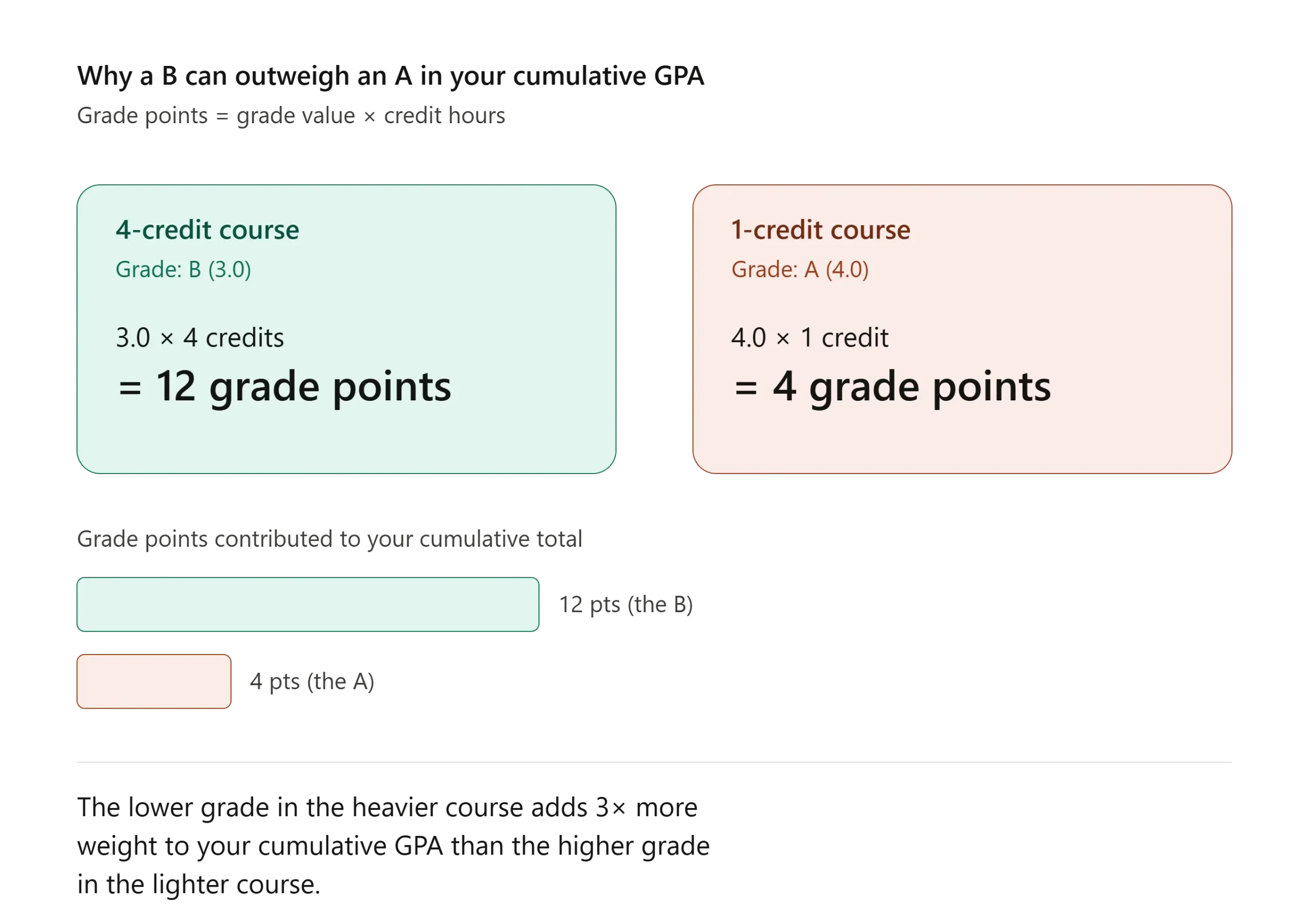
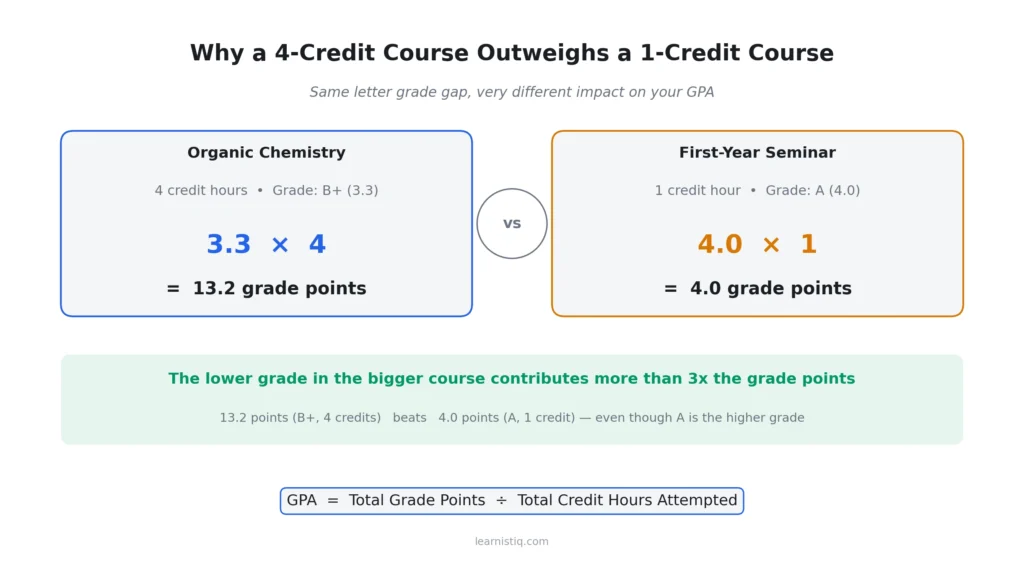
Strip away the jargon and the cumulative GPA meaning is simple: it’s the average of every grade you’ve earned across every term you’ve completed, weighted by how many credit hours each course was worth. Rutgers University’s registrar’s office lays out the actual math plainly — multiply the numerical value of each grade by the credit hours of that course, add up those totals across every class you’ve taken, then divide by the total number of credit hours attempted. Not the number of classes. The number of credit hours. That distinction trips up more students than almost anything else in this conversation, because it means a 4-credit chemistry course with a B pulls more weight on your cumulative GPA than a 1-credit seminar with an A.
This is what separates cumulative GPA from the semester GPA you see posted right after finals. A semester GPA is a snapshot — it only knows about the last four months. A cumulative GPA is a running total that goes back to day one. That’s also why a single brutal semester can dent your cumulative number for years. Pull a 2.1 semester GPA in your sophomore fall, and even three straight 3.8 semesters afterward will take time to drag your cumulative average back to where you want it. The math doesn’t reset. It only accumulates.
High schools and colleges both use the term, but they don’t always mean exactly the same thing by it. In high school, your cumulative GPA is essentially your entire academic record from freshman year through whatever point you’re at now — it’s the number colleges will eventually see on your transcript. In college, registrars sometimes draw a line between “cumulative GPA,” which may only count work taken at that specific institution, and “overall GPA,” which folds in transfer credit from community college or another university. The safest move, and one almost no other guide bothers to mention, is to never assume — check your specific registrar’s definition, because financial aid renewal and degree audits are calculated against whichever version your school actually uses.
A Conversation That Happens in Almost Every Dorm Hallway in October
Maya: Okay, I need you to explain something to me because I think I’m panicking over nothing. I got a 3.6 this semester. That’s good, right? But my advisor’s portal still says my GPA is 3.1. Did the system glitch?
Devon: It didn’t glitch. That 3.1 is your cumulative GPA — it’s everything since freshman year, not just this semester. Your 3.6 this semester gets averaged in with whatever you had before, it doesn’t replace it.
Maya: So my freshman year is just… following me around forever?
Devon: Pretty much, yeah. Remember that 1.9 GPA semester you had when your mom was in the hospital? That’s still sitting in there. A 3.6 this term moves the average up, but it’s one good semester pulling against three semesters of an already-built average. It’s not erasing anything — it’s diluting it, slowly.
Maya: That feels unfair. I’m a completely different student now than I was freshman year.
Devon: I get why it feels that way, but think about why schools built it this way in the first place. If one good semester wiped the slate clean, cumulative GPA would basically just become semester GPA with extra steps. Scholarship committees, grad schools, employers — they’re not just trying to see “where are you right now.” They’re trying to see your full track record, consistency included. The whole point of the number is that it’s hard to fake with a single good stretch.
Maya: Okay but here’s my actual fear. I’m on the Dean’s scholarship and I think it needs a 3.25 cumulative to renew. I’m at 3.1. Am I about to lose it?
Devon: That’s the real question, and it’s one you can’t guess your way through — every school sets its own number, and a lot of students assume it’s the same everywhere. It isn’t even close. I’ve seen renewal floors as low as 2.5 and as high as 3.7 depending on the scholarship.
What an Education Researcher Would Actually Tell You Here
This is the exact moment where a generic GPA explainer trails off into vague reassurance — “talk to your advisor, you’ll be fine.” That advice is technically true and almost completely useless. What you actually need is the range of what’s normal, drawn from real institutional policy, so you know whether your situation is a five-alarm fire or a manageable dip.
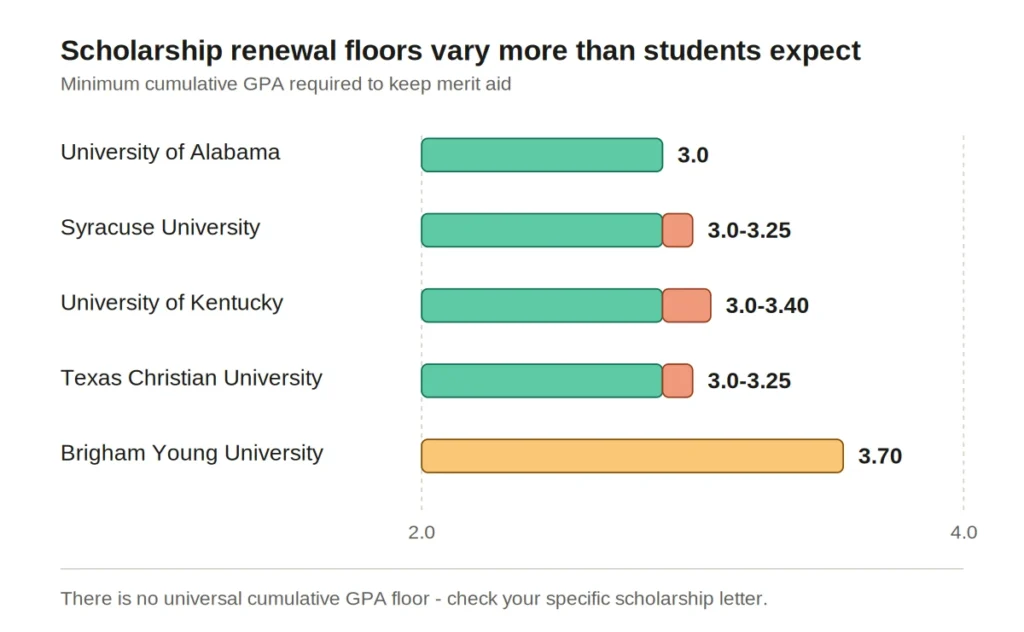
Renewal thresholds vary more than most students expect. Syracuse University requires students to hold a 3.0 cumulative GPA each semester just to keep most university-funded scholarships, climbing to a 3.25 cumulative average for full renewal of certain merit awards. The University of Kentucky sets a 3.0 cumulative floor for its major renewable scholarships, but pushes that to 3.40 for its more competitive Singletary Scholarship. Texas Christian University scales the requirement by class year — a 3.0 cumulative GPA covers first-year students, but sophomores and juniors need 3.25 to renew the same award. And on the far end of the spectrum, Brigham Young University requires a 3.70 cumulative GPA to maintain its multi-year scholarships, a threshold that would be unreachable trivia at most other schools and a baseline expectation at that one.
That spread is the whole lesson: there is no universal cumulative GPA number that keeps you safe everywhere. Maya’s 3.25 floor might be unusually generous or unusually tight depending entirely on her specific scholarship letter — which is the one document almost nobody actually rereads after freshman orientation.
There’s a second, quieter threshold sitting underneath all of this, and it matters even if you’re not chasing a merit scholarship at all. Federal financial aid — Pell Grants, subsidized loans, work-study — runs on its own standard called Satisfactory Academic Progress, and that standard typically requires nothing more than a 2.0 cumulative GPA, the equivalent of a flat C average. It sounds low compared to the merit-scholarship numbers above, and it is. But it’s also the floor that determines whether you stay enrolled at all, not just whether you keep a bonus award. The Pell Grant program alone served roughly 6.1 million students in the 2023–24 academic year, which means a 2.0 cumulative GPA isn’t some rare academic emergency — it’s a number directly tied to enrollment continuation for millions of students every single year.
A Real Case That Shows How Quietly This Number Can Derail a Student
Most advice articles describe scholarship loss in the abstract — a hypothetical student, a vague warning. What actually happens is more specific, and arguably more useful to understand, because it shows exactly where students get blindsided.
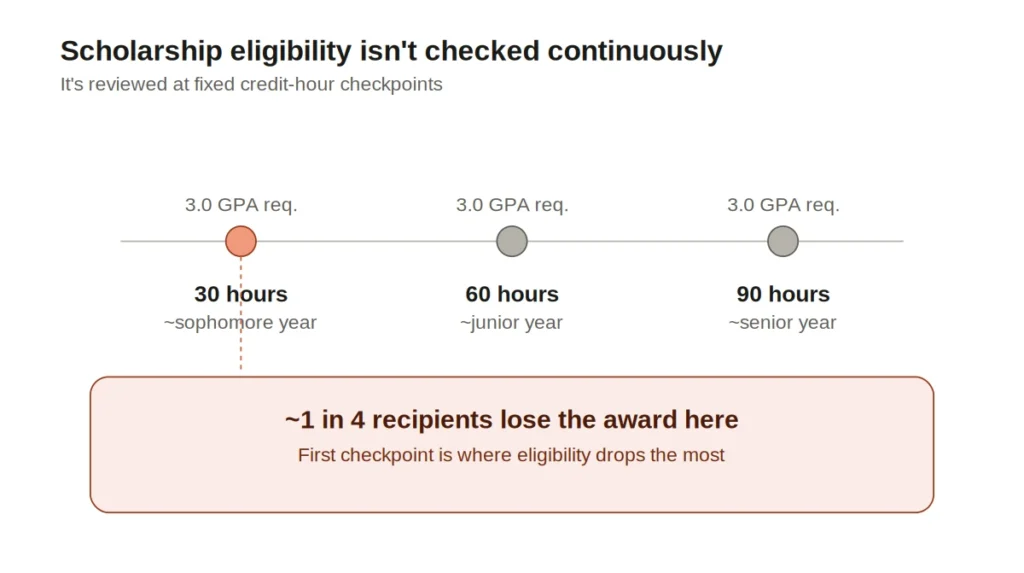
Georgia runs one of the largest state-funded merit scholarship programs in the country, a lottery-funded award that has paid out billions of dollars to in-state students since the early 1990s. The mechanism behind it is the part most students never fully grasp until it’s almost too late: eligibility isn’t reviewed continuously. It’s reviewed at fixed checkpoints — once a student has attempted roughly 30 credit hours, again near 60, again near 90, and additionally at the end of every spring term regardless of how many credits a student has taken. At each of those checkpoints, the state recalculates a student’s cumulative GPA across every degree-level course attempted since high school graduation, at every institution attended, and compares it against a strict 3.0 floor. Fall short by even a fraction of a point, and the award is suspended for the following semester.
Independent analysis of the program’s own outcome data, published by a Georgia-based policy research group, found that close to a quarter of students who start college holding this scholarship lose it at that very first checkpoint — the 30-credit-hour mark, typically reached partway through sophomore year. One of the researchers behind that analysis had lived through it personally as an undergraduate, watching his own award disappear at that same first checkpoint before he later built a career studying the policy that had tripped him up. The same research traced a clear pattern in who gets caught by the cliff-edge design: students balancing paid jobs alongside coursework, and students without consistent financial support from family, showed up disproportionately among those who lost their funding.
The lesson here isn’t really about Georgia specifically — it’s about how cumulative GPA checkpoints behave everywhere, even when a program is generous and well-funded. A threshold that looks forgiving on paper (a 3.0 average isn’t a brutal bar) becomes far less forgiving once it’s tied to a hard checkpoint with no partial credit for “almost.” A student carrying a 2.97 cumulative GPA at the 30-hour mark loses exactly the same award as a student carrying a 1.9. The number doesn’t grade on effort or circumstance; it grades on the math. Knowing that checkpoints exist, and knowing roughly when your own school or scholarship program reviews them, is the single most actionable piece of information in this entire guide — because it tells a student exactly when to be paying closest attention, instead of finding out after the fact.
Where the Real Danger Zone Starts: Academic Probation
Scholarships aside, every public university has a formal cumulative GPA floor for staying enrolled in good standing, and at the overwhelming majority of schools, that floor sits at 2.0. Drop below it and you don’t get dismissed immediately — you get a warning system first, though the exact mechanics differ by school in ways that genuinely matter. At the University of Arkansas, falling below a 2.0 cumulative GPA at the end of any term triggers academic probation immediately, and a student stays on probation, required to post at least a 2.0 semester GPA every term, until the cumulative number climbs back above the line. The City University of New York’s School of Professional Studies gives students a longer runway: continued probation after a second consecutive semester below 2.0, with dismissal only after a third straight semester still under the threshold. Boise State University and the University of Maryland both follow a similar probation-then-dismissal structure, but with their own specific credit-hour tables determining exactly what GPA a student needs at each stage of enrollment.
The practical takeaway buried in all of that policy language: one bad semester almost never ends a college career, but consecutive bad semesters do. Schools build in deliberate recovery windows because they know cumulative GPA, by its very design, is slow to move — a single semester at 3.8 cannot instantly undo a cumulative average that’s spent three semesters sliding downward. That’s exactly why probation systems give students one to three terms to climb back out, rather than demanding instant recovery the way a panicked student often assumes they need to.
Weighted, Unweighted, and Why Your High School Cumulative GPA Isn’t What You Think It Is
For high schoolers, there’s a layer of complication that college students don’t deal with: weighting. Most US high schools calculate two separate cumulative GPAs side by side — an unweighted version on the standard 4.0 scale, where an A in gym and an A in AP Chemistry count identically, and a weighted version, typically on a 5.0 scale, that adds bonus points for the difficulty of Honors, AP, and IB coursework.
Here’s the detail that actually changes how a student should think about course selection: a meaningful share of selective colleges explicitly recalculate every applicant’s GPA using their own internal formula rather than trusting the weighted number a transcript reports. Their reasoning is consistency — not every high school offers AP or IB classes, some schools add a full point for an AP course while others add only half a point for the same difficulty level, and a handful don’t weight at all. A 4.3 weighted GPA from one school and a 4.3 from another can represent completely different levels of academic rigor, so admissions offices read the full course list and grade pattern directly instead of trusting the single weighted number to mean the same thing everywhere.
What that means practically: chasing the highest possible weighted cumulative GPA by stacking easy AP electives is a weaker strategy than it looks on paper. Admissions readers are trained to see through it. A solidly built schedule with real rigor in core subjects, reflected honestly in both the weighted and unweighted cumulative GPA, reads as far more credible than a transcript engineered to inflate one number.
How Do You Figure Out Your Cumulative GPA? A Walkthrough
Before closing this out, it’s worth walking through the actual arithmetic once, because most students who think they understand cumulative GPA have only ever seen it pre-calculated on a portal, never built it themselves. Figuring cumulative GPA by hand sounds intimidating, but it comes down to three repeatable steps.
Take a simple example: a student takes a 3-credit course and earns an A (4.0 grade points), a 4-credit course and earns a B (3.0 grade points), and a 3-credit course and earns a C (2.0 grade points). First, multiply each grade’s point value by its credit hours — 4.0 × 3 = 12 grade points, 3.0 × 4 = 12 grade points, 2.0 × 3 = 6 grade points. Second, add those totals together for 30 total grade points. Third, divide by the total credit hours attempted, which is 10, and the result is a 3.0 GPA for that term. Repeat the same three steps across every term ever completed, using running totals rather than restarting each semester, and the result is the cumulative GPA.
The credit-hour weighting is what catches people off guard when they try figuring cumulative GPA on their own for the first time. A 1-credit pass/fail seminar and a 4-credit core course don’t move the needle by the same amount, even with identical letter grades, because the heavier course carries four times the grade points into the total. Students chasing a GPA bump sometimes load up on light, low-credit electives expecting a big jump — and end up disappointed when the math barely shifts, because a 1-credit A simply can’t outweigh a 4-credit course sitting at a B or C.
The Bottom Line
Sarah, the student from the opening of this article, didn’t get her scholarship back that semester. But she understood, for the first time, exactly why six-hundredths of a point had mattered so much — and exactly what it would take, semester by steady semester, to never be that close to the edge again.
That’s really what a cumulative GPA rewards: not a single brilliant semester, and not panic in response to a single bad one, but a track record built one steady term at a time. Know your specific school’s renewal floor, know where the 2.0 probation line sits, know when your own checkpoints land, and build toward the number with patience instead of trying to outrun it in a single semester. The students who treat their cumulative GPA as a long game, rather than a crisis to be solved overnight, are consistently the ones who end up nowhere near that four-line email.
External Links
- Rutgers University – Computation of Grade Point Average
https://sasundergrad.rutgers.edu/resources/policies/rutgers-university-guideline/computation-of-grade-point-average - Federal Student Aid Handbook (US Dept. of Education) – School-Determined Requirements
https://fsapartners.ed.gov/knowledge-center/fsa-handbook/2024-2025/vol1/ch1-school-determined-requirements - Georgia Budget and Policy Institute – Keeping and Losing HOPE
https://gbpi.org/keeping-and-losing-hope/ - CUNY – Satisfactory Academic Progress, Student Eligibility
https://www.cuny.edu/financial-aid/student-eligibility/satisfactory-academic-progress/ - Cornell University – Federal Satisfactory Academic Progress
https://finaid.cornell.edu/resources/federal-satisfactory-academic-progress
Frequently Asked Questions
Is cumulative GPA weighted or unweighted?
It depends on which version your school reports — a cumulative GPA can be calculated either way. Most US high school transcripts list both: an unweighted cumulative GPA on the standard 4.0 scale, and a weighted cumulative GPA on a 5.0 scale that adds bonus points for AP, IB, and Honors courses. College registrars typically default to unweighted unless stated otherwise.
How to figure your cumulative GPA?
Multiply each course’s grade points by its credit hours, add those totals together, then divide by the total credit hours attempted across every term. For example, a B in a 4-credit course contributes 12 grade points (3.0 × 4), while an A in a 1-credit course contributes only 4 grade points (4.0 × 1). The total never resets — every term’s grade points and credit hours feed into the same running average.
Does a GPA calculator for high school need to handle weighting?
Yes. A reliable high school GPA calculator needs to separate Honors, AP, and standard-level courses, since schools assign different bonus weights — some add a full point for an AP course, others add only half a point. Because weighting isn’t standardized nationally, two students with identical grades at different high schools can get different weighted GPAs depending on their school’s specific weighting scale.
What’s the difference between cumulative and weighted GPA?
They describe two different things, not two alternatives. Cumulative GPA refers to time span — every grade across every term, instead of just one semester. Weighted GPA refers to scale — a GPA with bonus points added for harder courses, instead of the standard 4.0 scale. The two combine: a student can have both a weighted cumulative GPA and an unweighted cumulative GPA at the same time, and most transcripts report both side by side.
-
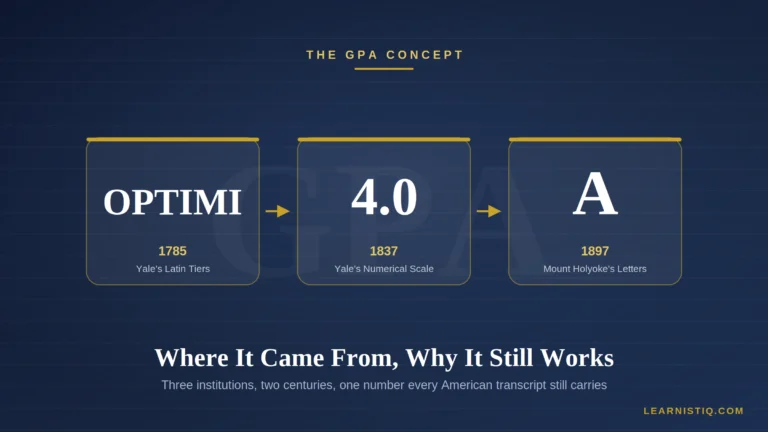
The GPA Concept: Where It Came From and Why It Still Works This Way
A high school senior named Marcus once asked his guidance counselor a question that stopped her mid-sentence: “Who actually invented the GPA?” She had answered thousands of questions about scholarship cutoffs and weighted scales over eighteen years on the job. Nobody had ever asked her where the number came from in the first place. She … Read more
-
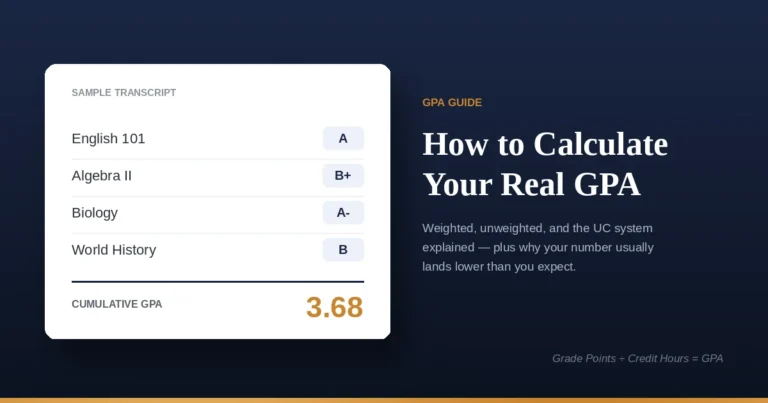
How to Calculate Your GPA (And Why It’s Lower Than You Think It Should Be)
I’ve looked at more transcripts than I can count, and the same conversation happens almost every time. A student does quick mental math and lands on a number that doesn’t match their report card, then asks the question nobody says out loud at first: “Why is my GPA lower than I thought it’d be?” That … Read more
-
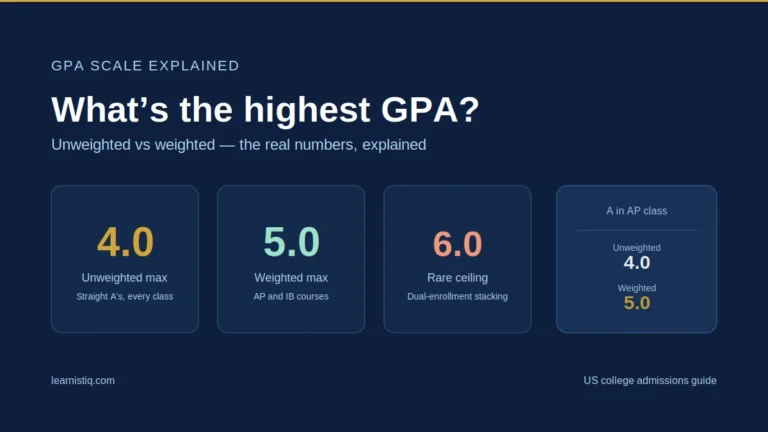
What is the Highest GPA? The Real Numbers Behind 4.0, 5.0, and Beyond
Ask a school counselor what the highest GPA is, and she’ll answer with a question of her own: weighted or unweighted? That’s not her dodging the question. That’s the whole answer. 4.0 caps the unweighted scale, full stop. A weighted scale blows past it, usually landing at 5.0. Sometimes higher than that. Most students run … Read more

Every article on Learnistiq is written by Shahzaib Khan — an education
researcher who has spent years studying university admissions,
scholarship systems, and online education across Pakistan, the USA,
the UK, and Germany.
Shahzaib started Learnistiq because he saw students making expensive
mistakes — choosing the wrong university, missing scholarship deadlines,
or believing myths about online degrees. This platform exists to fix that.
No AI-generated filler. No copy-paste from official university websites.
Every guide is researched, fact-checked, and written to actually help
you make a better decision.