
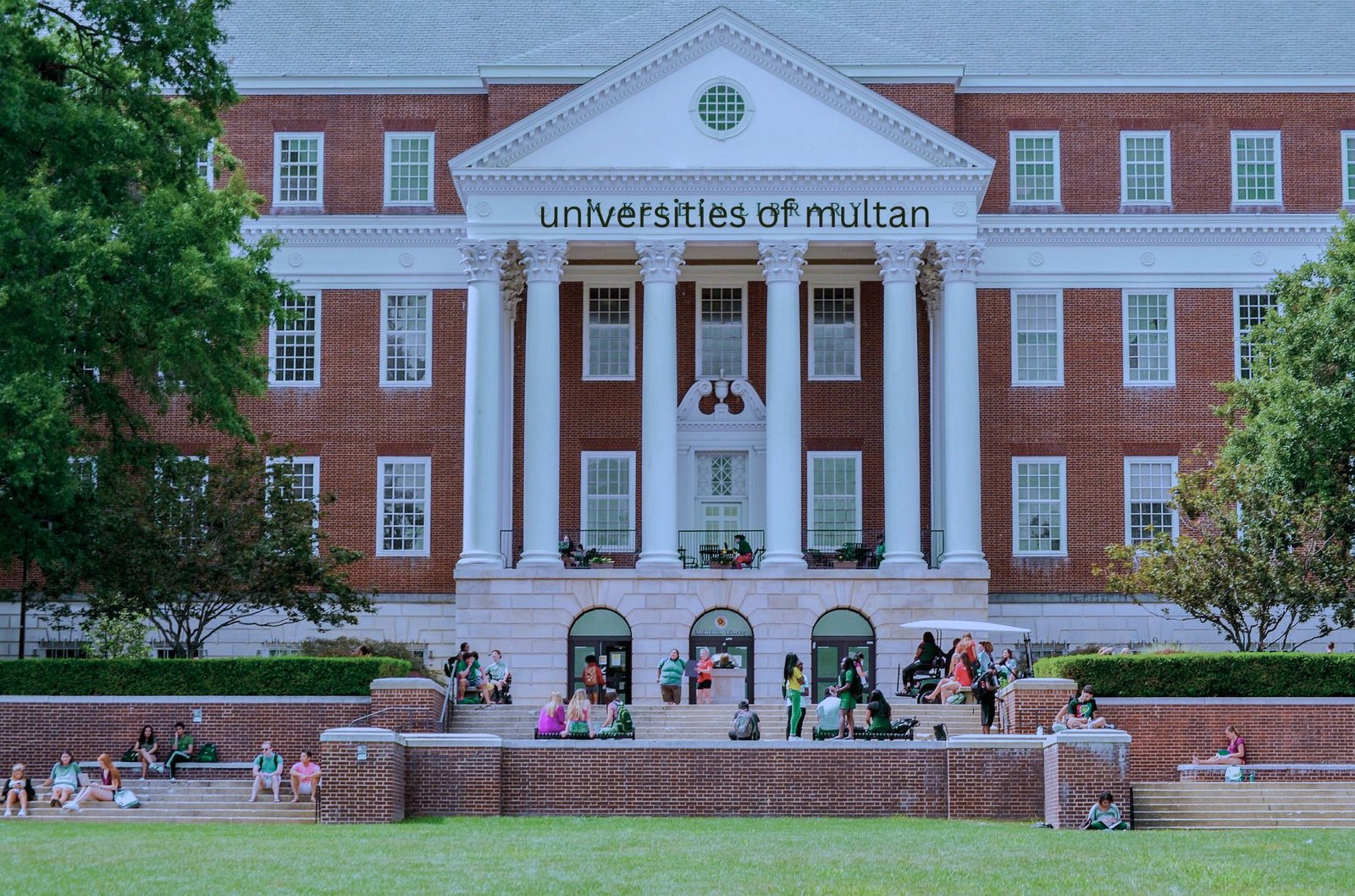
Every year students pick the wrong universities in Multan — no practical training, no industry connection, four years wasted. Learnistiq researched the best universities in Multan covering real research data, programs, fees, merit and honest gaps — check everything before you apply.
Best Universities in Multan 2025 — The Complete Guide Before You Apply
Multan is not a city that needs its students to leave. That sentence would have been a stretch thirty years ago. Today it is a fact supported by data. South Punjab has universities that appear in global ranking systems, a medical institution whose graduates sit licensing exams in the United States and the United Kingdom, and engineering colleges built around the specific industries that make this region’s economy run. What it also has — and this is the part nobody publishes — are institutions that are still building what they promised, gaps between reputation and delivery, and programs that serve some students extremely well and others not at all.
Learnistiq went through the actual research numbers, the programme structures, the admission realities, and the honest limitations of each institution. This is what we found.

Bahauddin Zakariya University
BZU did not start as a university. It started as a problem that needed solving.
In 1975, South Punjab had no institution capable of granting degrees to its own students. A region covering millions of people, fertile agricultural land, and a growing textile economy was sending its students to Lahore because there was nothing credible closer to home. BZU was founded in 1975 as Multan University, beginning operations in rented buildings with eight departments. The purpose was direct — bring higher education to the people of South Punjab so they did not have to leave to access it. Fifty years later, the numbers tell a story that most people outside this city have not read carefully enough. BZU is ranked 9th in Pakistan and 2,630th globally in the 2025 EduRank rating, with 13,619 academic publications and 234,708 citations — scoring in the top 50 percent across 91 research topics. Those numbers come from OpenAlex and CrossRef data — not from a marketing department. Research output of that volume, accumulated from a regional public university in South Punjab, reflects five decades of faculty who took their academic work seriously even when the infrastructure around them was still catching up.
The subject-level picture is specific. BZU ranked 8th in Pakistan for Chemistry with 8,383 publications and 177,892 citations. In Environmental Science, it ranked 7th in Pakistan with 7,981 publications and 158,750 citations. In Biology, it ranked 9th nationally with 9,531 publications and 187,759 citations. These are not general claims about research culture — they are citation counts by field that place BZU in direct competition with institutions that have far more resources and far more visibility.
What you can study: Agriculture, Pharmacy, Biochemistry, Chemistry, Environmental Sciences, Law, Computer Science, Business Administration, Textile Engineering, Soil Sciences, Plant Pathology, Livestock and Poultry, Engineering, Education, Social Sciences, and more — , 81 departments, 99 undergraduate programmes, 70 graduate MS programmes, and 47 PhD programmes, taught by 643 faculty members of whom 495 hold PhD degrees. And its is a better choise.
What it costs: Public university fees — genuinely affordable across all programmes. The affordability was deliberate. The institution was built to serve students who could not afford to relocate to Lahore, and it has maintained that access by design.
Admission and merit: Entry test required alongside FSc marks. Chemistry, Pharmacy, and Computer Science close at competitive aggregates. Law and Social Sciences are more accessible. Sub-campus seats in Lodhran and Vehari provide a pathway for students from surrounding districts whose aggregate falls just below the main campus closing merit.
Where it falls short: Infrastructure across the main campus is uneven. Some departments have properly equipped labs that reflect decades of investment. Others feel left behind. Industry linkages are genuine in agriculture and textile engineering — less so in Business Administration and Computer Science, where students report building their own professional networks rather than benefiting from institutional pipelines. Administrative response is slow, a function of institutional scale that BZU has not yet resolved.
Nishtar Medical University
The founding of Nishtar was not a government initiative. It was a demand from the people it was built to serve.
The idea of establishing a medical institution in Multan was first proposed in 1945. After Pakistan’s creation in 1947, the departure of Hindu doctors created a vacuum in the availability of medical professionals. On 31st December 1950, at a public meeting in Multan, Governor of Punjab Sardar Abdur Rab Nishtar announced the establishment of a medical college and hospital. That founding act of collective investment is not a historical footnote. It explains why this institution has survived every administrative challenge and every period of resource constraint for over seventy years — because it was built with money that the community of Multan raised themselves, and that sense of ownership has never fully left it.
The international trust it earned is specific and measurable. Nishtar graduates are eligible to sit the United States Medical Licensing Examination and the UK’s Professional and Linguistic Assessments Board test. That eligibility requires the institution to meet standards set by external bodies in two of the world’s most demanding healthcare systems — NMU meets those standards. Nishtar Medical College graduates have a strong alumni presence in North America, with the Nishtar Medical College Alumni Association of North America funding one major project at the institution every year. Graduates who left Multan for the United States decades ago still send money back to improve the institution that trained them. That relationship does not exist without genuine quality.
What you can study: MBBS, BDS, BS Nursing, Allied Health Sciences, and postgraduate medical specializations’. The primary clinical training site is Nishtar Hospital — a 1,700-bed facility providing extensive hands-on experience. That bed count is not a minor detail. Most private medical colleges in Pakistan affiliate with hospitals a fraction of that size. The clinical volume and diversity of cases available to Nishtar students during training years changes the quality of doctor produced in ways that a smaller affiliated hospital cannot replicate.
What it costs: For the 2025-26 session, tuition fees including all ancillary charges are capped at PKR 1.89 million following Pakistan Medical Commission guidelines. Private medical colleges regularly exceed that cap. For families in South Punjab where Lahore or Karachi for MBBS means adding four years of living costs to an already significant degree investment, Nishtar removes that calculation entirely.
Admission and merit: Selection criteria: Matriculation 10%, FSc Pre-Medical 40%, MDCAT 50%. The MDCAT carries the heaviest weight — a student with strong FSc marks and serious MDCAT preparation has a genuine shot regardless of where their matriculation aggregate landed. Closing merits are consistently competitive.
Where it falls short: Physical campus infrastructure — lecture theatres, library facilities, residential accommodation — has not kept pace with the institution’s academic reputation. Some postgraduate departments report resource constraints that affect research output. Administrative processes for non-clinical programmes move slower than recently established institutions. These are real gaps that a prospective student should investigate before committing.
MNS University of Engineering and Technology
South Punjab was growing its industrial base for decades before the region had an engineering institution capable of supplying technically qualified graduates to serve it. Students from Multan who wanted engineering drove to Lahore because there was nothing credible at home. MNS-UET was built specifically to close that gap.
It is a young institution — established in 2012. Being young comes with a genuine advantage: the curriculum was designed around what South Punjab’s economy needs from engineers in 2025, not around what it needed when the institution was founded thirty or fifty years ago. It also comes with a limitation that all new institutions carry — the alumni network is smaller, industry relationships are still developing, and research output is still establishing its baseline.
What you can study: Electrical Engineering, Mechanical Engineering, Civil Engineering, Chemical Engineering, Computer Science, and Architecture — all PEC-accredited. That accreditation is not optional for professional engineering practice in Pakistan. MNS-UET’s programmes carry full professional validity from graduation.
What it costs: Public university fees — meaningfully lower than private engineering colleges in the region. For students from Multan and surrounding districts, proximity removes the accommodation costs that studying engineering in Lahore would add to the total investment.
Admission and merit: Entry test required alongside FSc Pre-Engineering marks. Civil and Electrical Engineering are most competitive. Computer Science has drawn increasing applicants as Pakistan’s technology sector has grown.
Where it falls short: In sectors where employer relationships are built on decades of hiring the same university’s graduates, MNS-UET is still establishing those relationships. Students in Electrical and Mechanical Engineering need to build industry connections more proactively than counterparts at older institutions where the pipeline already exists. Research infrastructure is still developing. Faculty at doctoral level is still growing — which matters for postgraduate programme quality.
NFC Institute of Engineering and Technology
NFC-IET exists because of a specific gap — South Punjab’s chemical and fertiliser industry needed engineers who understood the industrial context they were entering, not just the theoretical underpinning of chemical engineering in the abstract. General engineering universities produce the second type. NFC-IET was built to produce the first.
The NFC connection — to the National Fertilizer Corporation — is an active industry relationship that shaped the curriculum from the beginning. It continues to shape where graduates go when they finish. For the student going into Pakistan’s fertiliser, agro-chemical, or food chemistry sector, the specificity that makes NFC-IET a narrow choice is exactly the specificity that makes it the right one.
What you can study: Chemical Engineering, Electrical Engineering, Mechanical Engineering, Civil Engineering, Environmental Engineering, and Architecture — PEC-accredited across all disciplines.
What it costs: Public university fees comparable to MNS-UET. Same PEC-accredited professional validity at public institution pricing.
Admission and merit: Entry test alongside FSc Pre-Engineering. Chemical Engineering is most competitive given the industry network behind it. Environmental Engineering has been drawing stronger applicants as Pakistan’s regulatory environment around industrial emissions and water management has tightened.
Where it falls short: Outside the chemical and fertiliser sector, NFC-IET’s name recognition among employers is still developing. Students in Electrical and Mechanical Engineering whose career paths lead beyond NFC’s specific industry network may find the alumni pipeline thinner than what older and larger engineering institutions offer. Research output is modest — this is a teaching-focused institution that has not yet built the research depth of a university twice its age.
Institute of Southern Punjab
ISP arrived as the first chartered private university in South Punjab. It offers modern programmes aligned with market trends and is known for its student-focused learning environment. Being first in a category matters — ISP established relationships with local businesses, built its private-sector alumni network, and developed understanding of South Punjab’s job market before competitors arrived.
The institution is responsive in ways that larger public universities are not. Curriculum updates happen faster. Prospective students can get direct answers about placement rates and programme structures in conversations that BZU’s administrative scale makes difficult. For a specific type of student — one whose career direction is firmly in South Punjab’s private sector and who values institutional responsiveness — that difference is real.
What you can study: Computer Science, Software Engineering, Business Administration, Management Sciences, Electrical Engineering, Civil Engineering, Law, and Social Sciences.
What it costs: Private university fees — meaningfully higher than BZU, NMU, and the public engineering institutions. Financial aid is available and consistently under-applied for. Most students who needed support and did not receive it never asked. The admissions office is accessible — asking the question directly costs nothing.
Admission and merit: Entry test alongside FSc marks. More accessible than BZU’s competitive departments while maintaining genuine academic standards.
Where it falls short: The alumni network is younger and less activated than BZU’s across South Punjab’s professional landscape. Research output is limited — ISP is a teaching institution at its current stage rather than a research university. For students whose plans involve research, postgraduate study, or academic careers, the public university research environments are stronger options.
The Honest Picture
Multan’s best universities are not trying to replicate what Lahore offers. The ones that perform best stopped trying and built their own identity around what South Punjab actually needs — and the research data, clinical outcomes, and employment records of their graduates show that identity producing real results.
BZU covers more academic ground than most institutions twice its size, with citation numbers across Biology, Chemistry, and Environmental Science that place it in the top 10 in Pakistan by field. Nishtar Medical University was built by the community it serves and has spent seventy years earning international trust one licensed doctor at a time. MNS-UET and NFC-IET are young institutions building engineering programmes specifically around South Punjab’s industrial economy — with the limitations that youth brings and the relevance that specificity provides. ISP fills the private-sector responsiveness gap that public institutions move too slowly to close.
The student who chooses any of these knowing clearly what it offers — and what it does not — will spend four years building something real.
That clarity is what Learnistiq is here to give you.
Do Multan universities actually provide practical training or is it all theory sitting in a classroom for four years?
The answer is genuinely different by institution and by programme — which is why this question deserves a specific answer rather than a general reassurance. At Nishtar Medical University, the practical training through Nishtar Hospital is real from early in the programme — the case volume and clinical diversity are among the highest in Pakistan and the practical exposure is the strongest part of the degree. At MNS-UET and NFC-IET, the applied engineering curriculum was designed with South Punjab’s industrial sector in mind — but the industry placement pipelines are still being built and students need to be more proactive than their counterparts at institutions with thirty years of employer relationships behind them. At BZU, practical quality varies sharply by department — the Science labs are functional and research-active, the Agriculture faculty has genuine field exposure, but the Business Administration and Computer Science programmes rely heavily on classroom delivery without the industry connections that would make the practical component meaningful. Knowing this before you choose your programme at any of these institutions is exactly the kind of information Learnistiq exists to give you
Is BZU degree actually respected by employers outside Multan — or does it only work if you stay in South Punjab?
This is the question students from Multan ask quietly because they are afraid the answer confirms what they already suspect. The honest answer is that it depends entirely on which department you graduated from and which sector you are entering. BZU’s Chemistry, Pharmacy, Environmental Science, and Agriculture graduates are respected by employers and research organisations well beyond South Punjab — because those departments have over 13,000 published research papers and 234,000 citations behind them, and the companies that hire in those fields read the academic output before they read the city of origin. In Business Administration and Computer Science, the BZU name carries less weight outside the region — and graduates in those fields consistently report that their skills and portfolio matter more than their institution’s name when applying in Lahore, Karachi, or internationally. Knowing which category your programme falls into before you enrol is the difference between a degree that travels and one that does not.
-
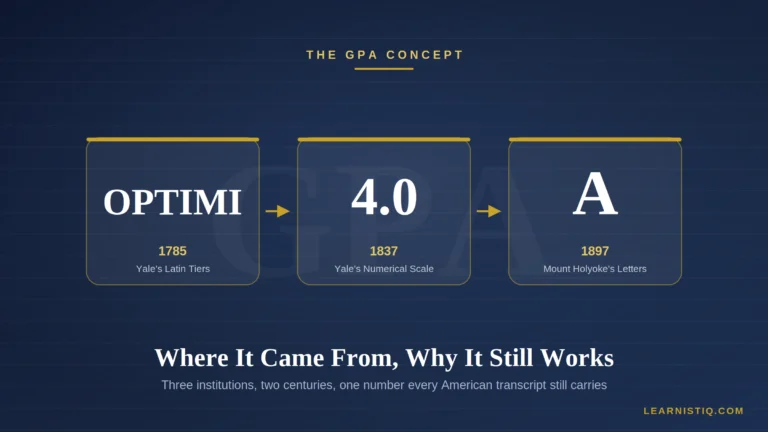
The GPA Concept: Where It Came From and Why It Still Works This Way
A high school senior named Marcus once asked his guidance counselor a question that stopped her mid-sentence: “Who actually invented the GPA?” She had answered thousands of questions about scholarship cutoffs and weighted scales over eighteen years on the job. Nobody had ever asked her where the number came from in the first place. She … Read more
-
Cumulative GPA: The Quiet Number That Decides Scholarships, Probation, and Admissions
Sarah found out she’d lost her scholarship in an email that took four lines to say it. Not a phone call. Not a meeting with her advisor. Four lines, sent on a Tuesday afternoon in March, informing her that her cumulative GPA had landed at 2.94 — six hundredths of a point under the 3.0 … Read more
-
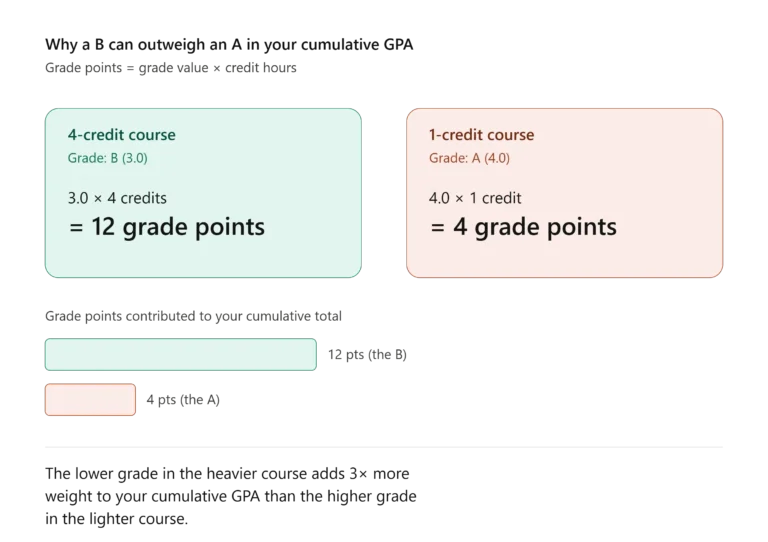
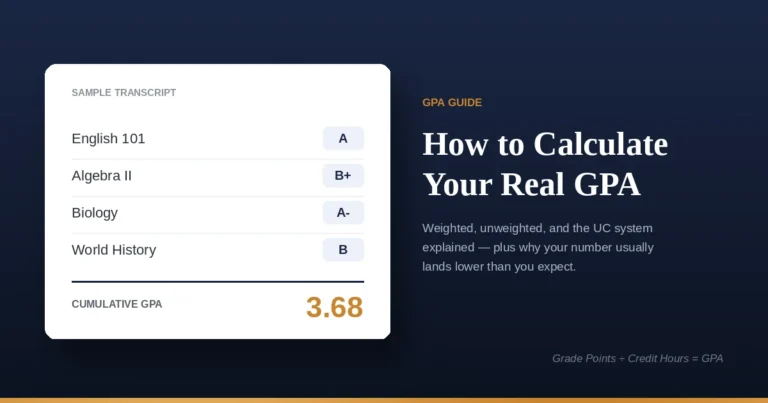
How to Calculate Your GPA (And Why It’s Lower Than You Think It Should Be)
I’ve looked at more transcripts than I can count, and the same conversation happens almost every time. A student does quick mental math and lands on a number that doesn’t match their report card, then asks the question nobody says out loud at first: “Why is my GPA lower than I thought it’d be?” That … Read more
-
What is the Highest GPA? The Real Numbers Behind 4.0, 5.0, and Beyond
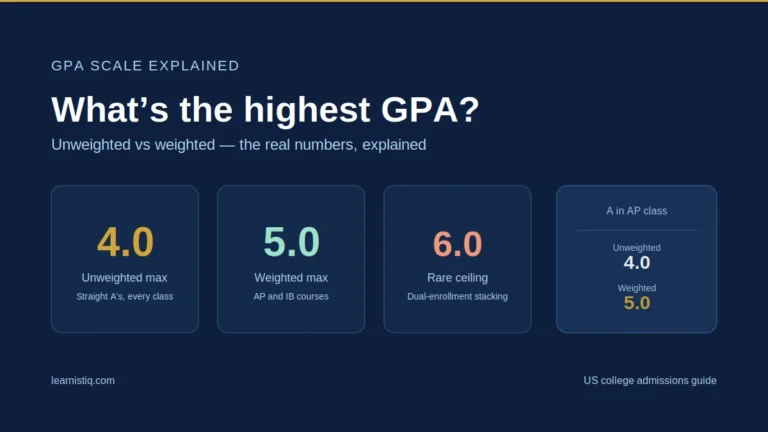
Ask a school counselor what the highest GPA is, and she’ll answer with a question of her own: weighted or unweighted? That’s not her dodging the question. That’s the whole answer. 4.0 caps the unweighted scale, full stop. A weighted scale blows past it, usually landing at 5.0. Sometimes higher than that. Most students run … Read more
-
What You Actually Pay at Columbia, Harvard, Yale, and Princeton in 2026
Most families look at Columbia University $96,990 annual cost of attendance and close the browser. That reaction is understandable. It is also, for millions of American families, completely wrong. The Ivy League financial aid system does not work the way most people think. These schools award zero merit scholarships — no money for top GPAs, … Read more
-
Yale University: The Complete Guide (2025–2026)
There are universities, and then there is Yale. Sitting in the heart of New Haven, Connecticut, this private research university does not just educate — it shapes the world. As a member of the Ivy League, Yale carries a weight that few institutions can match. Founded in 1701 by Congregationalist clergy of the Connecticut Colony, … Read more


Every article on Learnistiq is written by Shahzaib Khan — an education
researcher who has spent years studying university admissions,
scholarship systems, and online education across Pakistan, the USA,
the UK, and Germany.
Shahzaib started Learnistiq because he saw students making expensive
mistakes — choosing the wrong university, missing scholarship deadlines,
or believing myths about online degrees. This platform exists to fix that.
No AI-generated filler. No copy-paste from official university websites.
Every guide is researched, fact-checked, and written to actually help
you make a better decision.