
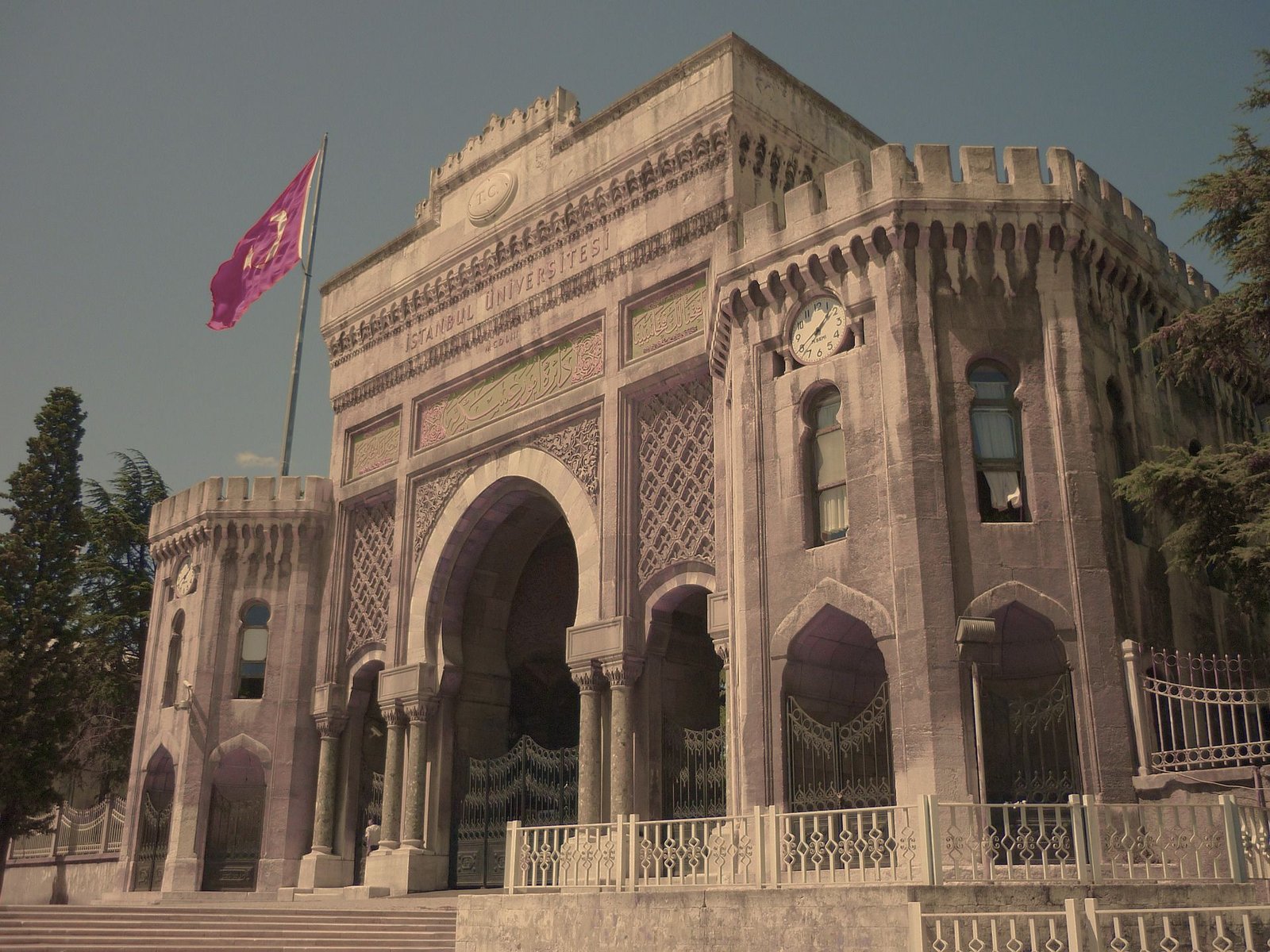
Thousands of students pick the wrong universities in Faisalabad every year — no practical training, no industry connection, four years wasted. Learnistiq researched the top 5 universities covering development history, real programs, fees, admission process and five year performance — so you check everything before you apply.
Read This Before You Fill Any Form
Faisalabad does not sleep. The textile mills run through the night. The food processing plants operate in shifts. The pharmaceutical sector keeps growing. The agricultural supply chains that feed half of Punjab run through this city. And every single year, students who live inside this industrial giant somehow manage to graduate from universities that have no meaningful relationship with any of it.
That is not bad luck. That is a research failure — and it happens before admission, not after.
Learnistiq spent time going through the actual performance data of every university in Faisalabad — when it was founded, how it developed over time, what programs it genuinely delivers, what fees look like in the second and third year not just the first, what merit is realistically needed, and what the last five years of ranking and research data actually shows about each institution’s direction. This article is the result of that work.
AI can collect any university’s basic data — programs, fees, rankings, and founding year — but the real picture of whether a university actually delivers practical training, maintains genuine industry connections, or keeps its fee structure honest across all four years exists on only one page. Learnistiq.com researches every university beyond the numbers, covering what it genuinely delivers, where it falls short, and whether it is the right match for you — because the difference between data and honest guidance is exactly the difference between choosing right and spending four years finding out you chose wrong.

Here are the five universities in Faisalabad that are worth your time.
Here you can read most important things which a universities can not tells to their incoming students about their degree worth or most any more things which create matters in their personal life.
Click Here
University of Agriculture Faisalabad — The Institution That Literally Fed Pakistan
Before you read a single ranking number, understand what this university actually did. UAF graduates created the poultry industry which is the second largest sector of Pakistan’s economy since the 1970s and revolutionized cotton cultivation which has underpinned the textile industry — Pakistan’s largest export sector — since the 1980s. That is not a historical footnote. That is two of Pakistan’s most economically significant industries built by people who studied on this campus. When you walk into UAF, you are walking into the institution that helped figure out how to feed and clothe a nation of 230 million people. That context matters when you are deciding where to spend four years of your life. UAF traces its legacy back to 1906 as the Punjab Agriculture College and Research Institute, evolving into a university in 1961, with its roots in the early days of canal colonies that played a vital role in ensuring food security in a famine-prone region. More than a century of agricultural research on one campus — and that accumulated knowledge shows up in the quality of its departments in ways that newer institutions simply cannot replicate. UAF is ranked 654th in QS World University Rankings 2026 — placing it among the small group of Pakistani universities with genuine international ranking presence. In agriculture specifically, it is first in Pakistan and among the top institutions in South Asia. The Islamic Development Bank awarded UAF its Science and Technology prize in 2012 based on its contribution to promoting science and technology — an international recognition that went largely unreported in Pakistan.
What you can study: Agriculture, Agronomy, Food Technology, Food Science, Biotechnology, Biochemistry, Veterinary Science, Plant Breeding and Genetics, Animal Sciences, Agricultural Engineering, Soil and Environmental Sciences, Computer Science, Business Administration, Statistics, and Mathematics. The range extends further than most students expect from an agriculture university — and the Business Administration program through the Institute of Business and Management delivers quality comparable to private business schools at a fraction of the cost.
What it will cost you: UAF runs a scholarship program that covers up to 100 percent of tuition for qualifying students based on both need and academic merit. The base fees for a public research university are affordable by any standard. Apply for the scholarship at the exact same time as your admission application — not after. Most students who miss it miss it for that one reason.
Admission and merit: UAF has a selective admission policy based on entrance examinations and past academic records — the acceptance rate sits in the 30 to 39 percent range, making it a genuinely selective institution. Food Technology and Agronomy aggregates close above 75 percent in competitive years. Computer Science and Business programmers are somewhat more accessible but still require serious preparation. One practical note that nobody publishes: the UAF admission portal historically crashes on the final day. Submit your application at minimum 72 hours before the deadline.
Last five years: UAF has signed 142 international, 29 national and 41 private Memoranda of Understanding to strengthen research culture and promote faculty and student exchange programmes. The institution is not resting on its historical reputation. It is actively building new partnerships while maintaining the academic standards that made those partnerships worth having. UAF partners with the University of California, Davis in research and exchange programmes — a collaboration that gives students access to one of the world’s leading agricultural research environments
Government College University Faisalabad — A Century of Academic History at Public University Prices
Here is something that almost never appears in the conversation students have about Faisalabad universities. In the Times Higher Education World University Rankings published in October 2025, GCUF is ranked 601 globally. Global top 601. A public university in Faisalabad. That number deserves to be read twice. GCUF’s journey started as a primary school in 1897, promoted to High School in 1905, Intermediate College in 1924, degree level in 1933, postgraduate disciplines in 1963, and finally granted university status in October 2002. Over a century of educational history accumulated at one address before the institution even became a university. The academic culture, the departmental depth, and the faculty standards at GCUF were not assembled quickly — they developed slowly and with continuity, which is exactly what produces the kind of institutional quality that rankings reflect.
GCUF is ranked 761 to 770 in QS World University Rankings 2026 and appeared in the Nature Index Health Sciences Rankings in June 2025. Two different global ranking systems — one measuring academic reputation and research output, one measuring the quality of publications in the world’s most selective scientific journals — both include a public university in Faisalabad that most students walk past on the way to applying somewhere with better marketing.
What you can study: Computer Science, Information Technology, Business Administration, Commerce, Chemistry, Biochemistry, Biotechnology, Bioinformatics, Botany, Zoology, Applied Psychology, Home Economics, Mathematics, Statistics, Physics, English, Urdu, Islamic Studies, Education, Fine Arts, Fashion Design, Law, and Geography. The range reflects a century of adding programmes as the city’s needs evolved — which is why GCUF serves a broader student population than any other institution in Faisalabad.
What it will cost you: GCUF has the lowest semester fees of any university in Faisalabad. For students where financial sustainability matters — and in most Pakistani families it matters enormously — GCUF removes the fee pressure entirely and lets four years of education be about learning rather than managing debt. The evening shift programmes reduce hostel costs further for students commuting from surrounding districts.
Admission and merit: GCUF’s admission process is fully online — the university offers BS, MS, MPhil and PhD programmes based on merit, with an entry test required for all programmes. The minimum requirement for bachelor programmes is intermediate or equivalent with 45 percent marks in the relevant field. The minimum is not the practical closing merit — competitive programmes close significantly higher. The entry test preparation matters as much as the FSc aggregate.
Last five years: The ranking trajectory tells the clearest story — a public university that was previously known only locally now appears in multiple global ranking systems and is moving upward across all of them. Research output is growing. Faculty credentials are improving. The institution is not standing still.
National Textile University — The Only University Built for the Industry That Built Faisalabad
There is an argument that NTU should have been the most obvious university choice for students in Faisalabad for decades. The city’s economy runs on textiles. NTU is the only university in Pakistan dedicated exclusively to textile engineering and technology. That alignment between institution and economy should make the decision simple — and for students who understand what they are looking at, it does.
NTU was established on Sheikhupura Road, Faisalabad, specifically because this city needed an institution that could supply technically qualified graduates to an industry that was growing faster than general engineering universities could serve. The relationship between NTU and Faisalabad’s textile sector is not incidental — it is the entire reason the university exists, and it creates a direct pipeline from graduation to employment that general engineering institutions in the city simply cannot replicate.
What you can study: Textile Engineering, Textile Design, Apparel Manufacturing Technology, Fashion Design, Garment Manufacturing, Computer Science, Software Engineering, Business Administration, and Applied Sciences. The textile-specific programmes carry a technical depth and industry currency that cannot be replicated by a textile engineering module inside a general engineering curriculum at a university whose primary identity is something else entirely.
What it will cost you: Public university fees — affordable relative to the career value the degree carries in Faisalabad’s export-oriented industrial sector. For postgraduate program, a GAT Subject or General test is required alongside a minimum CGPA of 2.5 out of 4.0 at undergraduate level. The fee structure is published annually on the official NTU website and has remained moderate relative to private engineering institutions.
Admission and merit: NTU runs its own entry test for undergraduate programs. FSc Pre-Engineering is the standard entry requirement for engineering programs. Textile Engineering is the most competitive programme given its direct industry pipeline and limited seats. Computer Science and Business Administration are more accessible without being less demanding once you are inside the curriculum.
Last five years: NTU has been systematically expanding its industry partnerships with Faisalabad’s major textile exporters and manufacturers. Companies come to NTU for recruitment rather than the other way around — because the university’s location inside the industrial belt of Pakistan’s textile capital makes that relationship structural and self-sustaining.
The University of Faisalabad — The Private Option With a Real Research Record
Most private universities in cities the size of Faisalabad are primarily fee-collection operations with adequate classrooms and inadequate research infrastructure. TUF is genuinely different — and the difference shows up in data rather than in marketing.
TUF holds the W-4 category from HEC — the highest grade awarded to any university for meeting criteria covering faculty qualifications, programme quality, infrastructure, resources, laboratories, training facilities, and endowment fund. It secured first position in Pakistan among HEC-ranked universities for 2013 based on teaching quality, research, and quality assurance systems. The University of Faisalabad ranks first in Faisalabad in the University Guru meta-ranking composed of 108 separate university rankings. One hundred and eight independent ranking assessments. First in the city across all of them combined. That composite result is meaningful precisely because no single methodology produces it — it reflects consistent performance across a wide range of criteria over a sustained period.
What you can study: Medicine, Pharmacy, Allied Health Sciences, Nursing, Physical Therapy, Computer Science, Software Engineering, Electrical Engineering, Business Administration, and Education. The health sciences faculty is the most comprehensively resourced part of this institution — built around genuine clinical infrastructure and hospital affiliations rather than classroom-only delivery.
What it will cost you: Private university fees — higher than the three public institutions on this list. For health sciences programmes specifically, the clinical infrastructure and hospital affiliations that come with those fees represent real value that a cheaper classroom-only medical programme does not provide. For Computer Science and Engineering, TUF’s programmes do not carry the same employer recognition as FAST or NTU — which is worth knowing clearly before paying private fees for a degree in a field where public alternatives are stronger and better connected to industry.
Admission and merit: Selective entry process for medical programmes with FSc Pre-Medical marks and entry test results determining admission. Allied Health Sciences and Pharmacy have more accessible merit requirements than Medicine while still being genuinely competitive. The admissions office publishes programme-specific merit lists — check these against your aggregate before applying.
Last five years: Two universities from Faisalabad appear in the CWTS Leiden Ranking of October 2025 — TUF is among them. The Leiden Ranking is a pure research quality index with no room for reputational inflation — appearing in it at all represents genuine research output. The upward research trajectory at TUF over the past five years is real and measurable
FAST-NUCES Chiniot-Faisalabad — The Tech Degree With a National Network Behind It
FAST opened a campus in the Chiniot-Faisalabad corridor because the demand was there — students in this region wanted a credible Computer Science education without relocating, and no existing institution in the city was delivering it at the level the technology industry actually respects. The campus is newer than FAST’s main locations in Lahore, Islamabad, and Karachi. The academic standards, the curriculum, and the degree-awarding system are identical across all campuses. FAST-NUCES alumni hold senior engineering positions at Arbisoft, Systems Limited, and multiple firms based in Silicon Valley. The FAST Alumni Association actively facilitates job referrals for fresh graduates — which partly explains the consistently high placement rate across all campuses.
That alumni network does not distinguish between campuses. A FAST degree from Chiniot-Faisalabad feeds into the same professional community that makes the Lahore and Islamabad campuses valuable for employment outcomes. The geographic difference in where you studied does not change the network you gain access to upon graduation.
What you can study: Computer Science, Software Engineering, Electrical Engineering, Business Administration, Data Science, and Artificial Intelligence. The curriculum is regularly updated for AI and Machine Learning — which in 2025 means the difference between a CS degree that prepares graduates for the industry as it currently exists and one that prepares them for how it existed five years ago. That gap matters to employers and it matters to career trajectories in the first five years after graduation.
What it will cost you: Annual fees between PKR 250,000 and 350,000 depending on the programme. Higher than every public institution on this list. FAST regularly updates its scholarship programme — submit the financial aid application at the exact same time as your admission application. The students who receive scholarships are not exceptional outliers. They are students who applied on time with complete documentation.
Admission and merit: The NU Test — FAST’s own entrance examination — covers mathematics, English, and analytical reasoning. The Chiniot-Faisalabad campus has more accessible closing merits than the Lahore and Islamabad campuses while maintaining identical academic standards once you are enrolled. Students whose aggregate was borderline for the larger campuses often find a clearer path here. Preparation for the NU Test needs to be specific and sustained — it is different in structure from standard FSc examination preparation.
Last five years: The Chiniot-Faisalabad campus has been building industry connections specific to this region — engaging with the technology and manufacturing needs of Faisalabad’s industrial base rather than simply transplanting a generic CS curriculum from a larger city. The local industry engagement adds a layer of practical relevance that the national FAST reputation alone does not provide.
What Learnistiq found: The honest decision between FAST Chiniot-Faisalabad and the public CS options in the city comes down to a single question — how seriously do you take the alumni network, and how far does your career plan extend beyond Faisalabad itself? If you are building toward Pakistan’s national technology industry or toward international employment in software engineering, AI, or data science, the FAST alumni pipeline provides access that no public university in Faisalabad currently matches. If your career is firmly regional and the industrial sector of Central Punjab is where you intend to work long-term, UAF’s business programmes or NTU’s technical programmes will connect you more directly to local employment. Both are legitimate paths. The right one depends on where you actually want to go.
The One Thing Learnistiq Wants You to Take From This
Faisalabad is not a city where you choose a university based on which name sounds most impressive. It is a city with a specific industrial identity — agriculture, textiles, food processing, pharmaceuticals — and the universities that serve their students best are the ones that have built genuine, sustained connections to what this city actually does.
UAF exists because Pakistan needed food security and had to build the science to achieve it. NTU exists because Faisalabad’s textile industry needed engineers and had nowhere to train them. GCUF exists because this city needed broadly educated graduates across every discipline for over a century before it had a university to call its own. TUF exists because the region needed health sciences education that did not require families to send their children to Lahore. FAST Chiniot-Faisalabad exists because the technology sector grew to a size where having no credible CS institution in the city became a gap worth filling. Every institution on this list has a reason for existing that is larger than its fee structure and more durable than its ranking position. Find the one whose reason connects most directly to where you are going — and go there with that clarity.
What is the minimum merit for UAF Faisalabad in 2026 and how is it calculated?
UAF uses an entry test-based admission system with merit calculated from your academic record and entry test performance combined. Food Technology and Agronomy — the most competitive programmes — have been closing above 75 percent aggregate in recent years. Business Administration and Computer Science are somewhat more accessible but still require serious preparation rather than a casual application. The acceptance rate across all programmes sits in the 30 to 39 percent range, which means UAF rejects more applicants than it accepts — a selective institution that most students underestimate until they are sitting the entry test unprepared. One critical practical note: the UAF admission portal has a consistent pattern of crashing in the final hours before the deadline. Submit your application a minimum of 72 hours before the closing date. The students who miss deadlines at UAF almost always miss them for this exact reason.
Which university in Faisalabad will actually get you hired — and which one just gives you a certificate?
Every university in Faisalabad will give you a degree. The difference shows up two years after graduation when one person is working inside their field and another is still sending out applications wondering why their degree is not opening anything. The separation happens at the point of industry connection — whether the companies that matter in your field actually visit that campus, whether the alumni in senior positions actively refer graduates, and whether the practical training you received during four years prepared you for work that is real rather than theoretical. UAF graduates run agricultural supply chains. NTU graduates manage textile production floors. FAST graduates build software products that reach international markets. GCUF graduates teach, research, and serve in government institutions across Punjab. The certificate is the same shape from every institution
Is there any university in Faisalabad where the practical training is genuinely real — not just listed on a brochure?
Yes — but the answer is field-specific rather than institution-specific. UAF’s agricultural and food science labs are active research environments where students work on projects that have commercial applications in Pakistan’s farming and food processing sectors. The practical is not simulated — it is connected to actual industry problems. NTU’s workshops and production labs are built around real textile engineering equipment because the industry the university serves demanded that from the beginning. TUF’s health sciences clinical training runs through hospital affiliations that give students genuine patient exposure from early in their programme — not the fourth-year clinical attachment that most medical colleges in smaller cities treat as sufficient. FAST’s project culture means students are building functional software from semester one rather than writing code exercises that no one will ever use. The institutions where practical training is real are the ones where the industry that uses that training helped design the curriculum in the first place. That connection is what separates a brochure promise from an actual experience.
-
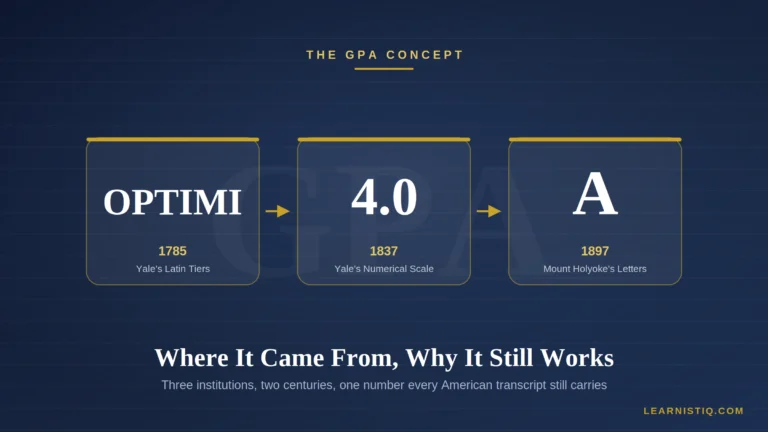
The GPA Concept: Where It Came From and Why It Still Works This Way
A high school senior named Marcus once asked his guidance counselor a question that stopped her mid-sentence: “Who actually invented the GPA?” She had answered thousands of questions about scholarship cutoffs and weighted scales over eighteen years on the job. Nobody had ever asked her where the number came from in the first place. She … Read more
-
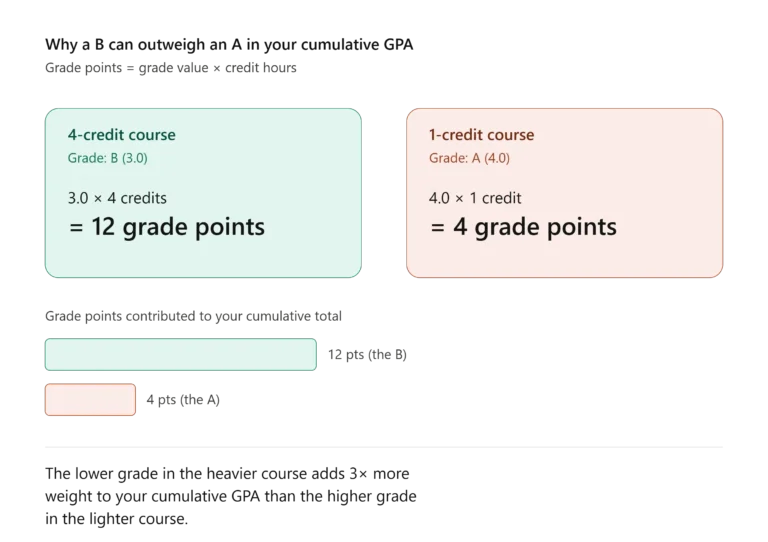
Cumulative GPA: The Quiet Number That Decides Scholarships, Probation, and Admissions
Sarah found out she’d lost her scholarship in an email that took four lines to say it. Not a phone call. Not a meeting with her advisor. Four lines, sent on a Tuesday afternoon in March, informing her that her cumulative GPA had landed at 2.94 — six hundredths of a point under the 3.0 … Read more
-
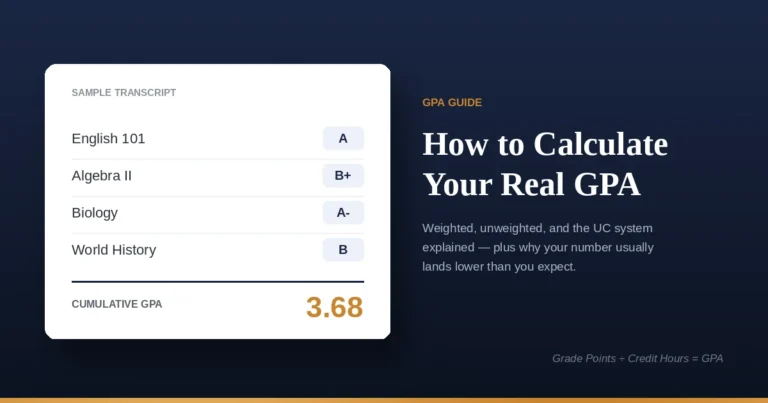
How to Calculate Your GPA (And Why It’s Lower Than You Think It Should Be)
I’ve looked at more transcripts than I can count, and the same conversation happens almost every time. A student does quick mental math and lands on a number that doesn’t match their report card, then asks the question nobody says out loud at first: “Why is my GPA lower than I thought it’d be?” That … Read more

Every article on Learnistiq is written by Shahzaib Khan — an education
researcher who has spent years studying university admissions,
scholarship systems, and online education across Pakistan, the USA,
the UK, and Germany.
Shahzaib started Learnistiq because he saw students making expensive
mistakes — choosing the wrong university, missing scholarship deadlines,
or believing myths about online degrees. This platform exists to fix that.
No AI-generated filler. No copy-paste from official university websites.
Every guide is researched, fact-checked, and written to actually help
you make a better decision.