
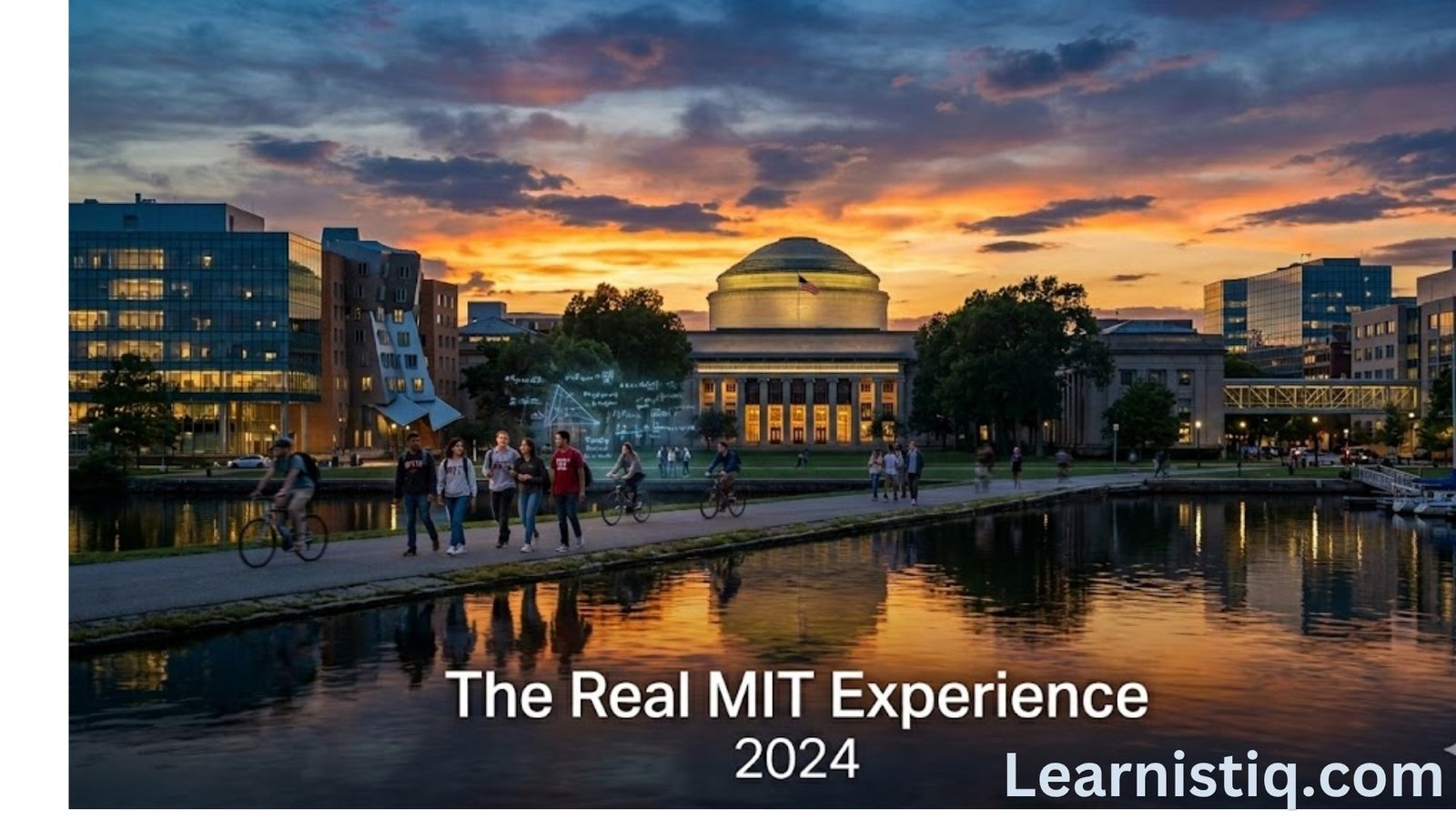
Search for MIT university online and you will find hundreds of articles telling you the same things. Number one in the world. Brilliant faculty. Incredible research. Apply if you dare.
None of that is wrong. But none of it actually helps you decide anything.
The real questions students have are different. What is it actually like to study there every day? Is the mental health situation as bad as people say? What do students hate about it? Is the degree worth the stress? How much do people really pay after financial aid?
This review is built to answer those questions — using MIT’s own official data alongside what real students have written in reviews, discussions, and alumni accounts. Not marketing. Not rankings summaries. The actual picture.
Table of Contents
2. What MIT Actually Is
The Massachusetts Institute of Technology is a research university in Cambridge, Massachusetts. It is located beside the Charles River just minutes from Boston. MIT was founded in 1861 on a simple idea that was radical at the time: the idea that science and technical knowledge should be used to solve real problems, not just be learned in classrooms. MIT still follows this principle today. The Massachusetts Institute of Technology has 4,638 undergraduate students and around 7,000 graduate students. These are numbers for a university like MIT which has a great reputation. This is part of the reason why the culture at MIT feels the way it does.
The important thing to understand before applying to MIT is that it is mainly a research institution. It also teaches students who are pursuing their degrees. This is different from a university that focuses on teaching and also does some research. At MIT new knowledge is being created all the time.. You, as a student, are often a part of it. This makes life at MIT feel really unique.
3. MIT Rankings 2025–2026
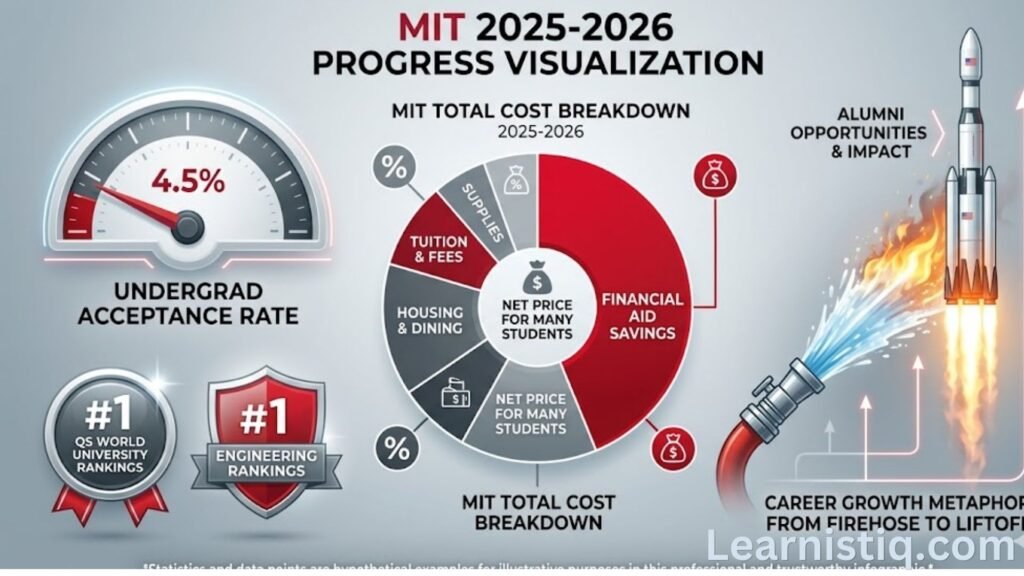
MIT topped the QS World University Rankings again in 2026. It’s usually #1 or #2 in most major global lists, #1 on Niche’s Best Colleges ranking, and dominates engineering and computer science categories. But rankings miss the daily reality. They won’t tell you that the workload is brutal, that mental health struggles are common, or that the same place producing Nobel laureates can also make you cry in your dorm at 3 a.m. during finals.
MIT scored perfectly in six QS ranking areas:
* reputation
* employer reputation
* ratio of faculty to students
* citations per faculty member
* faculty
* employment outcomes, after graduation.
MIT is the university to have achieved this. The rankings show that MIT is doing well in areas.
But here is what rankings do not tell you.
The people at MIT do not tell you that the amount of work you have to do is probably going to be the thing you have ever done. The people at MIT do not tell you that a lot of students cry during their few months. The people at MIT do not tell you that the same place that produces MIT students who win Nobel Prizes also makes students feel so overwhelmed that the counselors at MIT have a time helping all of them.
The rankings say that MIT is really great. The rankings do not tell you if MIT is a fit for you. The rest of this review will tell you about MIT. Help you figure that out.
4. The Real Academic Experience at MIT
This is the section that matters most and the one most guides skip.
When you look at what students are saying about MIT on websites like Niche and Quora and on forums for people who used to go there you see the same things coming up over and over. MIT is really something.. It is also really tough.
Students and people who used to go to MIT all say that going to school there is like trying to drink water from a firehose. This is something that Jerome Weisner, a president of MIT said a long time ago. The students liked this way of describing it because it is really true. The schoolwork at MIT is fast paced, there is a lot of it. It just keeps coming. This is not like other universities in the country. MIT is different from schools because of how much work you have to do and how hard it is.
Every week, in nearly every class, students complete what they call “upsets” — problem sets of five to eight hard problems that routinely take hours. Not one class. Multiple classes. Multiple upsets. Every week. All semester. One student on Niche described it: “Excellent academics, but as the students say, it really is drinking from a firehose.”
The love-hate relationship with this environment is so universal that students gave it its own acronym: IHTFP. It stands for two things simultaneously — “I Hate This Place” and “I Have Truly Found Paradise.” Depending on the week, sometimes the hour, both can be true at once.
What saves most students is something that surprises outsiders: the collaboration. MIT has a deeply cooperative academic culture. Students work through upsets together at two in the morning in dormitory lounges. Study groups form organically because individual survival is genuinely harder than collective survival. One Quora alumnus put it this way: “Very nice fellow students if you like brilliant oddballs. Tough coursework but great cooperation among students. MIT grads have the kind of bond you often see with war veterans — you’re all kind of amazed you survived.”
The mental health reality deserves naming directly because students name it directly in their reviews. The stress is real and sustained. MIT has significantly expanded its counseling services in recent years — adding peer support networks like MIT Peer Ears and Nightline, drop-in counseling hours, and telehealth options.. Students want to study more than we can handle. The culture of trying to be perfect and doing things on your own means some students do not ask for help until things get really bad. MIT knows this is a problem and is working on it.
* One student currently at MIT said on Niche:
“The classes here are really tough. They move quickly and make you think hard. The teachers are super smart. I really care about students doing well. Sometimes it can all feel too much.”
” Another was more direct: “Do not let Campus Preview Weekend inform your ideas of MIT. It is the best display of college marketing in the country. MIT is not like that weekend.”
If you are someone who gets energized by hard problems, Fwho thrives in a group of driven and slightly obsessive people, who wants to be pushed past what you thought you could do — this environment will feel exactly right. If you need a slower pace or strong external structure to stay mentally healthy, that is genuinely worth knowing before you commit to applying.
5. MIT Programs
Top Programs
MIT’s strongest areas include:
- EECS — World leader in AI, quantum computing, and robotics.
- Mechanical Engineering — Hands-on building from year one with strong ties to NASA, Boeing, etc.
- Physics & Math — Legendary departments with frequent Nobel and Fields Medal winners.
- Economics — Highly quantitative and policy-focused.
- Sloan — Excellent for tech entrepreneurship.
Double majors and cross-disciplinary work are common and encouraged.
One thing worth highlighting: MIT genuinely encourages interdisciplinary study. Double majors across very different fields are common. Engineering and economics. Computer science and linguistics. Architecture and urban data science. The structure supports it and the culture rewards it.
6. MIT Acceptance Rate 2025–2026
For the class of 2026 MIT got a lot of applications. 29,282 To be exact. They admitted 1,324 students. That means 4.5 percent of students who applied got in. Students who applied early had a better chance. 5.98 Percent or 721 out of 12,053 applications were admitted. MITs acceptance rate for early action applicants was higher than the rate.
These numbers mean that for every 100 people who apply, about 95 are rejected. Including many students with near-perfect records.
Which raises the real question: if grades alone are not enough, what does MIT actually want?
MIT uses the word “doers” deliberately and repeatedly in its admissions communications. Not students who excel because they are disciplined. Students who built something because they could not stop themselves. A student who identified a gap in their community and spent two years filling it. A student who went so deep into a programming project that they published it before finishing high school. A student who asked a question in class that the teacher had never been asked in twenty years of teaching.
Test scores establish the floor. Admitted students typically score between 1550 and 1600 on the SAT and 34 to 36 on the ACT. Strong mathematics performance specifically is expected. But MIT has been unusually explicit: scores tell them you can handle the work. Everything after that determines whether you actually belong there.
MIT’s essays are designed specifically to reveal personality. They ask what you do for fun, what has genuinely challenged you, how you have contributed to a community. The worst thing applicants do is write what they imagine MIT wants to hear — polished, ambitious, professionally worded. The admissions team reads tens of thousands of exactly those applications. What stands out is honesty, specificity, and a real voice.
The Massachusetts Institute of Technology also has an interview with alumni. This interview is done by Massachusetts Institute of Technology graduates who live over the country. Massachusetts Institute of Technology students who did these interviews were more likely to get into the Massachusetts Institute of Technology in the few years. If you get a chance to do a Massachusetts Institute of Technology alumni interview you should take it seriously.
7. MIT Cost of Attendance 2026 —
Published undergraduate tuition at MIT for 2025–2026 is $61,990 per year. When I add housing, meals, health insurance, books and personal expenses the estimated full cost of attendance at MIT reaches $86,230, per year.
Those numbers are real. And for a family paying without financial aid, they are genuinely large.
But — and this is a critical but — the published cost and the actual cost most MIT students pay are very different numbers. The difference is explained in the next section.
8. MIT Financial Aid
MIT has a great financial aid program. It is one of the best at any university in the country. The program is based on an idea: if you get into MIT they will make sure you can pay to go there.
Starting from the 2025–2026 year students from families that make less than $200,000 per year with normal assets can go to MIT for free. For families that make more than $100,000 per year MIT pays for everything. MIT pays for tuition and also for housing and dining and fees and books. The amount that the family is expected to pay is zero. MIT financial aid program is very helpful for students from families that make more than $100,000 per year. MIT financial aid program is also great for students from families that make more than $200,000, per year.
In 2024–2025, about 57 percent of MIT undergraduates received need-based scholarships. The median scholarship was $69,777 for the year — money that is a grant, not a loan and does not get repaid. MIT is distributing $176 million in need-based aid during 2025–2026.
The practical result: the median amount actually paid by students who received MIT financial aid in 2024–2025 was $10,268 for the entire year. Not per semester — the whole year.
The people in the MIT Class of 2025 did well. A lot of them, 88 percent, finished school without owing any money. The ones who did have to borrow money the middle amount they owed when they graduated was $20,288. This is a lot less than what people from four-year universities owe on average when they finish school.
MIT follows a need-blind admissions policy, meaning your financial situation has no effect on whether you get in. All aid is need-based, not merit-based. And MIT meets 100 percent of demonstrated need for every admitted student.
For graduate students, most PhD programs come with research or teaching assistantships that cover tuition entirely and provide a monthly living stipend. The majority of MIT PhD students pay nothing for their education.
Learnistiq.com have much data about Top universities and colleges.
9. MIT Campus Life —
The campus runs along the Charles River in Cambridge with Boston accessible by subway in minutes. The location is really great for students because it is close to hospitals, museums, tech companies and concerts. This city has a lot of universities so you can feel the energy of all the people around you.
The campus is pretty cool too. It has stone buildings that look very classic and then it also has modern buildings that are really bold. These buildings are connected by a path that MIT calls the Infinite Corridor. This path goes all the way through the middle of the campus and it is inside so you can walk around without going. The Great Dome over Building 10 is the most recognized landmark, partly because students have been placing elaborate engineering-based pranks on it for generations. Previous hacks have included a full-size functioning police car with lights on top of the dome, and a Tetris-playable version of the Green Building. The things that people call “hacks” at MIT are really a part of the culture. They show that MIT is a place where people do work and also have a lot of fun. MIT has around 4,638 undergraduate students and 7,000 graduate students. The students at MIT come from all 50 states in the United States and from more than 100 countries, around the world. When students first come to MIT they are guaranteed a place to live on campus. They can keep living on campus for all four years of college.
Each dormitory has its own distinct culture — some known for being loud and creative, others quieter and more academically focused.

Over 500 student clubs and organizations exist on campus, covering robotics, journalism, entrepreneurship, theatre, music, debate, and essentially everything else. MIT fields 31 varsity sports teams, which surprises people who assume the academic culture crowds everything else out. And MIT undergraduates can cross-register for courses at Harvard, just across the river, adding an extraordinary range of options to an already exceptional curriculum.
Reading actual student reviews, though, the campus life picture is genuinely mixed. Not negative — mixed. Some students describe finding their closest friendships and their intellectual community at MIT. Others, especially those who are naturally more social or extroverted, describe finding the peer culture harder to navigate than expected. One reviewer wrote: “For some students the culture here can be difficult. I personally found a lot of my peers to be under socialized and struggling with their own things.” Another wrote the opposite: “I love MIT. Everyone is so passionate and interesting. I don’t think there is any place like it.”
Both of these descriptions are talking about the place. The experience you have at this institution is really going to depend on the kind of person you’re. It also depends on how much you put yourself there and build connections with other people. If you are the type of person who likes to get involved and meet people then you will probably have a very different experience than someone who does not do these things. The institution is the same, for everyone. The experience you have there is going to be different based on your own actions and personality. You have to be proactive and build these connections for yourself; they will not just happen on their own.
10. MIT Research — Why It Changes Your Career
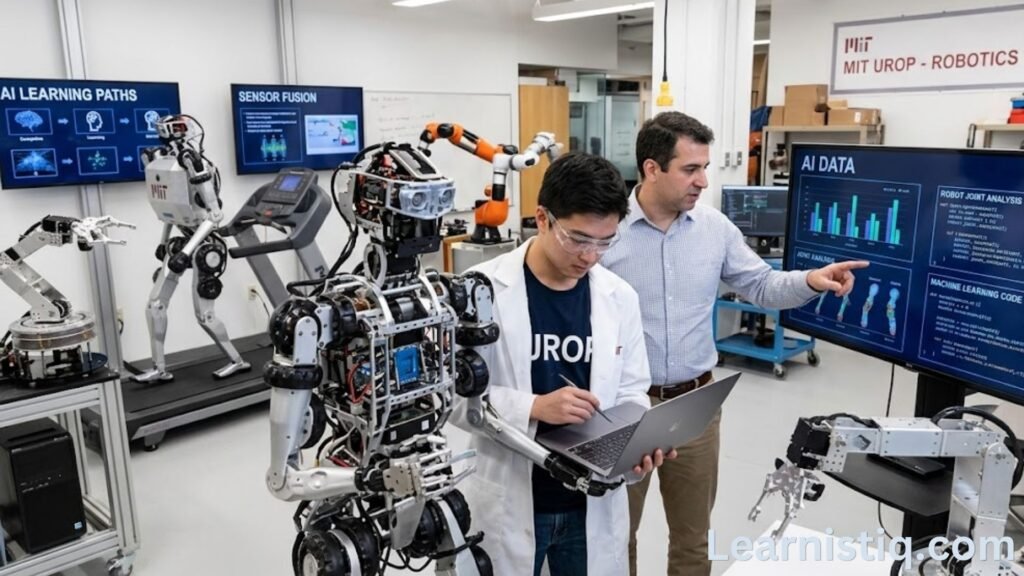
The Massachusetts Institute of Technology is a great place for research and one thing that makes it special for undergraduate students is the Undergraduate Research Opportunities Program or UROP for short. The Undergraduate Research Opportunities Program allows undergraduate students to join research groups and work on actual projects that are currently going on and they can start doing this as early as their first semester.
This is not about following someone around and watching what they do.
Undergraduate students who participate in the Undergraduate Research Opportunities Program actually do work, such as writing computer code, running experiments and looking at data to see what it means. In a lot of cases undergraduate students who participate in the Undergraduate Research Opportunities Program even get to be listed as co-authors on papers that are published in journals where other experts review the work before it is published.
In 2025 researchers at MIT created a robot called SPROUT. It is designed to move through buildings that have collapsed to find people who’re trapped. Another team made fibers that can be put into clothes. These fibers help keep track of a person’s health. They can even find out if someone is getting sick before they start feeling symptoms.The MIT research team focused on SPROUT robot. The SPROUT robot helps in rescue missions.These programmable fibers can be woven into clothing to monitor health. The fibers detect illness. A third produced a nanomaterial breakthrough with major implications for next-generation night vision. Several teams published advances in AI reliability that directly address one of the biggest problems in current large language models.
MIT graduates have founded companies that collectively generate $1.9 trillion in annual revenue and support 4.6 million jobs worldwide. That number is larger than Russia’s entire GDP, produced by alumni of a single university.
For a student planning to go into research, a PhD program, or start a company, the UROP experience and the network access at MIT are genuinely difficult to replicate anywhere else in the country.
11. MIT vs Harvard vs Stanford vs Caltech
This comparison comes up constantly and deserves a direct answer.
MIT vs Harvard. Both are in Cambridge, walking distance apart. Harvard is broader — exceptional across law, medicine, government, humanities, and social sciences alongside its sciences. If your intellectual interests span both literature and chemistry, or politics and biology, Harvard’s breadth serves you well. MIT is narrower in focus but deeper in STEM. For engineering, computer science, physics, and mathematics specifically, MIT’s culture of building and doing is unmatched. MIT does not have a law school or a medical school. Harvard does. That matters depending on where you are headed.
MIT vs Stanford. Both are STEM-dominant and both produce enormous numbers of startup founders. Stanford is in Silicon Valley. This is a place where startup culture’s really big. Stanford has been a part of this culture from the beginning. MIT is in Cambridge. Cambridge has its tech scene that is really thriving.. It feels different from Silicon Valley. People often say that Stanford is more relaxed when it comes to culture. The Stanford culture is not as intense as some places. Silicon Valley and Stanford are closely tied together. MIT is more intense. Both descriptions are generalizations but both contain truth. Graduates from both schools end up at similar companies and in similar careers — the distinction often comes down to coast preference and personal fit.
MIT vs Caltech. Caltech is a small school and it really focuses on the science part. Some people think it is just as good as MIT when it comes to being serious about learning. At Caltech there are not a lot of students for each teacher so you get to work closely with the people who are doing the research. Caltech is not well known to most companies as MIT is but the people who work in science and academics think it is just as good. If you know you want to do research, in physics or chemistry you should really think about going to Caltech. It is worth considering, like MIT. .
The honest framework for choosing between them: if building things, engineering culture, and applied science are your focus — MIT. If you want breadth across disciplines — Harvard. If you want to be embedded in Silicon Valley startup culture — Stanford. If you want the most intense pure-science environment in the country — Caltech.
12.Pros and Cons (Straight from Students)
Pros:
- Insanely smart, motivated peers
- Research access most schools don’t offer undergrads
- Strong collaboration and alumni network
- Excellent financial aid
- “Firehose” pushes you to grow
Cons:
- Brutal workload and stress
- Mental health challenges
- Can feel isolating or undersocial
- Campus isn’t the prettiest
- Food is… not great
13. Who Should Apply to MIT —
Apply to MIT if:
You think about problems even after the class is over because you really like solving them, not just because you have an exam coming up. You have already made something, written something, fixed something or helped with something. You did it because you just had to do it. You are okay with working hard for a long time without getting too stressed out. You want to have a job like doing research, starting your own company or being a technical leader and you want to meet the right people and get the right experience to make it happen. You want a career in research. You want to start your own startup or you want to be a technical leader and you want to build the network and credentials to get one of these jobs.
Think carefully before applying if:
You are applying primarily for the name or because it is what smart people do. You have not yet developed an internal motivation for technical work beyond performing well in school. You struggle significantly with stress management and do not yet have strategies that work. You want a broad liberal arts education that includes strong science — Harvard or a top liberal arts college may serve you better.
This is not about being smart enough. Many people who can do well at MIT are not a fit, for its culture. Knowing this before you apply and before you decide to go can save a lot of stress.
14. Famous MIT Alumni
Buzz Aldrin went to MIT. Got a doctorate degree in astronautics. He even walked on the moon when he was part of the Apollo 11 mission in 1969. The things he learned about mechanics at MIT really helped the people on the Apollo 11 mission.
Richard Feynman was a student at MIT before he won the Nobel Prize in Physics. You can still watch his lectures on the internet and people, over the world like to watch them.
Robert Noyce got his PhD from MIT. He helped invent the integrated circuit. This is a big deal because the integrated circuit is what makes computers and phones and all sorts of other electronic devices work. Some people call Robert Noyce the Mayor of Silicon Valley because of all the things he did.
Drew Houston finished school at MIT where he studied computer science and that was in 2006. He used to get really upset when he lost his files because he forgot his USB drives. This problem actually helped him come up with Dropbox, which’s something that hundreds of millions of people all around the world use now.
Kofi Annan, who used to be the UN Secretary-General and also won the Nobel Peace Prize went to MIT Sloan for a management program.
Ray Kurzweil graduated from MIT a time ago in 1970. After that he worked on a lot of things like speech recognition and optical character recognition and music synthesizer technology. Now Ray Kurzweil is in charge of developing intelligence at Google, which is Dropbox competitors main company but Ray Kurzweil is working on artificial intelligence and Drew Houston is working on Dropbox and Ray Kurzweil is still working on artificial intelligence at Google.
Shirley Ann Jackson was a big deal. She was the African-American woman to get a PhD from MIT in theoretical physics. This happened in 1973. Time magazine said Shirley Ann Jackson is maybe the important person that women in science look up to today.
The community around MIT is pretty amazing. It includes 97 people who won Nobel prizes, 26 people who won Turing Awards, 58 people who got the National Medal of Science and 8 people who won Fields Medals.
15. Frequently Asked Questions
Is MIT the number one university in the US? In QS World Rankings 2026, MIT is ranked first globally. Niche’s 2026 Best Colleges in America list also ranks it first nationally. US News ranks it second among national universities and first for undergraduate engineering. By most measures, yes.
Is MIT worth the cost? For students the cost of attending school is a lot lower than what you see at first. The student who gets aid usually pays around $10,268 for the whole 2024–2025 academic year. A big percentage of the Class of 2025 which is 88 percent finished school without owing any money. When students who graduated from MIT get a job they usually start with a salary of $145,820 per year. So when you think about money the answer is yes attending MIT is a deal, for students who get in and get financial aid.
What is MIT’s acceptance rate for 2026? For the Class of 2026, approximately 4.5 percent overall. Early Action applicants had a rate of about 5.98 percent.
Is MIT really that stressful? Yes, and students say so directly and consistently. The workload is intense by design. The culture is high-pressure. MIT has expanded mental health services significantly in recent years but the pace of the environment remains demanding. This is worth taking seriously before committing to apply.
What SAT score do you need for MIT? Students who get into this school usually have scores that’re between 1550 and 1600. However MIT has made it very clear that these scores are the minimum requirement, not the only thing they look at. What really matters after that is whether or not you have a love for learning and if you have done something really impressive outside of school. MIT wants to see that you have a passion for something and that you have actually accomplished something meaningful.
Does MIT offer merit scholarships? No. The Massachusetts Institute of Technology financial aid is based on need. They do not give out Massachusetts Institute of Technology merit scholarships. If you show that you need Massachusetts Institute of Technology aid and they accept you then the Massachusetts Institute of Technology will cover the difference between what your family can pay and the full cost of going to the Massachusetts Institute of Technology.
What Programs is MIT best known for? Computer Science and Electrical Engineering (EECS), Mechanical Engineering, Physics, Mathematics, and Economics are the most celebrated departments. MIT Sloan is world-class for business and management, particularly for technology entrepreneurship.
Can you transfer to MIT? MIT accepts a very small number of transfer students — typically fewer than 25 per year, with a transfer acceptance rate even lower than freshman admissions. The process is extremely competitive.
The Bottom Line
MIT is the best university in the world at what it does. That is not hype — it is the conclusion of every major independent ranking body and the consistent experience of students and employers for decades.
But “best in the world” does not mean right for everyone. The workload is real. The stress is real. The mental health challenges that come with that environment are real and documented by students themselves.
The students who do really well at MIT are the ones who already have a strong desire to learn. Not because of what other people think or what their parents want but because they really love working on things that interest the students at MIT. This inner drive is what helps the students at MIT get through the times at MIT.
-
Government College University Faisalabad (GCUF)
Every year, thousands of students from Faisalabad, Jhang, Chiniot, Toba Tek Singh, and Hafizabad ask the same question before applying to Government College University Faisalabad (GCUF): Is it actually worth it? This guide gives you the honest answer — not the official brochure version. We cover the complete GCUF admissions 2026 process, real fee structure, … Read more
-
UET Lahore Closing Merits 2026: Expected Aggregates & Merit Lists
(UET Lahore) The University of Engineering and Technology was started in 1921 as Maclagan Engineering College, in Lahore. That makes it older than Pakistan. For over a century it has produced the engineers behind the country’s dams, highways, power grids, and more recently its software export industry. The university is run by the Government of … Read more
-
IBA Karachi Admission 2026: Complete Guide — Last Date, Fee, Merit List & Eligibility
I have been counseling students and parents for nine years now, and every single year — without fail — I notice the same thing. When someone mentions LUMS university, students get impressed. When someone mentions NUST university, parents nod approvingly. But when IBA Karachi comes up, the room goes quiet. A different kind of quiet. … Read more



Shahzaib Khan is the founder of Learnistiq.com
and an independent education researcher based in
Rawalpindi, Pakistan. With over 8 years of
experience in student counseling and educational
guidance, he has personally helped hundreds of
Pakistani students choose the right universities
and career paths.
His research focuses on Pakistani university
admissions, online degree outcomes, and practical
career guidance for students who cannot afford
expensive counseling services. Every article on
Learnistiq is written from real experience and
verified information — not copied or AI-generated
content.
Shahzaib has been featured in student communities
across Pakistan and is committed to providing
honest, pressure-free guidance to students from
Rawalpindi, Lahore, Karachi, and beyond.