
Tomahawk Missile: How It’s Made, How Fast, and How Dangerous It Really Is
subject material
Introduction
Since its introduction in the the early 1980s, the Tomahawk missile has become one of the most well-known and strategically important long-range cruise missiles in modern military arsenals. It is prized for its precision, flexibility, and range, and has seen action in multiple conflicts. In this article, we will explore what a Tomahawk missile is, how it’s constructed and operates, its speed and range, what makes it dangerous, and the broader implications of its use.
This guide is intended to be comprehensive yet accessible to a broad audience interested in defense, technology, and geopolitics.
History & Background
Understanding where the Tomahawk came from helps explain why it is so widely used and continuously modernized.
Origins & Development
- The Tomahawk project was initiated by the U.S. Navy, with early development begun by General Dynamics / Applied Physics Laboratory.
- Early models included anti-ship and land-attack variants. Over time the land-attack role (TLAM, Tomahawk Land Attack Missile) became dominant.
- The missile entered service in the 1980s, with earlier variants including nuclear-capable versions (TLAM-N) which have since been retired or withdrawn per arms treaties. afarmamentmuseum.com+3AERONAUT.media+3Think Defence+3
Combat Use & Evolution
- The first operational combat use was during Operation Desert Storm (1991), where naval- and submarine-launched Tomahawks were used to strike Iraqi targets.
- Since then, Tomahawks have been used in numerous operations, such as in Iraq, Libya, Syria, and anti-terrorism missions. dote.osd.mil+3navair.navy.mil+3Navy+3
- Over time, newer “Block” variants have been introduced to improve guidance, flexibility, and targeting capabilities.
Block Variants & Modern Upgrades
- Block III: Introduced in the early 1990s; included improved guidance (GPS, DSMAC), better accuracy, and enhancements to extend its capabilities.
- Block IV / Tactical Tomahawk: Adds in-flight retargeting, two-way satellite data link, flexibility to loiter or change targets mid-flight.
- Block V (newer generation): Modernization efforts include better navigation, communications, and specialized warhead variants (for anti-ship, hard-target, multi-effects)
The U.S. Navy is working to convert older variants to the Block V standard and retire legacy blocks.
Design & Construction
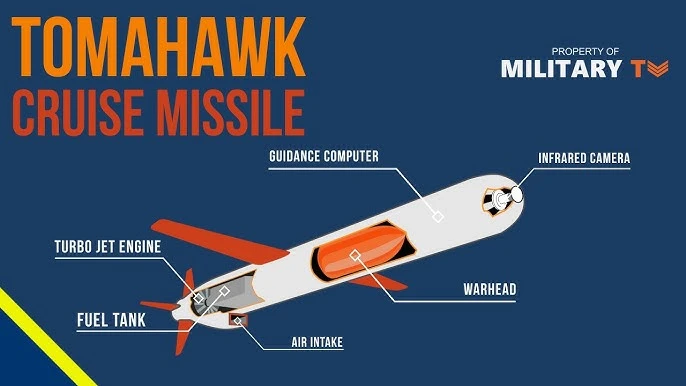
Let’s break down how a Tomahawk missile is built and the major subsystems that make it function.
Modular Architecture
The Tomahawk uses a modular design so different parts—warhead, guidance, propulsion—can be adapted or upgraded over time.
Key Components
| Component | Function / Description |
|---|---|
| Launch Booster / Initial Stage | A solid-propellant rocket booster gives the missile the initial thrust to exit the launch tube or vertical launcher. Once velocity is adequate, the booster is discarded. |
| Cruise Engine | After booster burnout, a turbofan engine (e.g. Williams F107 series) powers sustained flight. |
| Guidance & Navigation Suite | Several integrated systems: inertial navigation (INS), GPS, TERCOM (Terrain Contour Matching), DSMAC (Digital Scene Matching), and two-way satellite data link (in modern variants) to allow mid-course updates. |
| Warhead / Payload | Conventional high-explosive warheads are typical in modern Tomahawks. Earlier nuclear-capable versions used variable-yield warheads (e.g. W80) but those have largely been retired. |
| Aerodynamic Control Surfaces & Airframe | Wings, fins, and control surfaces assist in navigation, course corrections, and low-altitude flight. The airframe is designed to minimize detection (low radar cross-section) and support terrain-following flight. |
Flight Profile, Speed & Range
A key question is: How fast is a Tomahawk? And how far can it travel? Let’s unpack what’s known from public sources.
Speed
- Tomahawks travel at high subsonic speeds. They are not supersonic (faster than sound).
- Typical cruise speed is about 880 km/h (approximately Mach 0.75) in many sources.
- Older or more conservative figures also reference ≈ 550 miles per hour (≈ 885 km/h) in some sources.
Because it flies relatively slowly (compared to ballistic missiles), it cannot outrun fast interceptors, but its advantage lies in stealth, navigation, and lower-altitude flight.
Range
The range depends heavily on variant, mission profile, payload, and flight path. Public estimates vary:
- Some sources state ranges up to 1,500 miles (≈2,400 km) in favorable conditions.
- Other sources for more modern Block variants cite ranges of ~1,600 km or higher.
- The newer Block V upgrades may extend or optimize effective range via improved fuel efficiency and guidance, though exact classified ranges are uncertain.
Flight Path & Altitude
- Tomahawks fly very low (terrain-hugging) to avoid radar detection. Typical altitude = 30–50 meters (≈ 98–164 ft) above ground.
- Their route often includes programmed waypoints, zig-zag or evasive maneuvers, and switching guidance methods during phases.
- In modern variants, the missile can loiter or change course mid-flight if new targeting data becomes available.
Thus, though slower than ballistic missiles, the Tomahawk’s stealth, precision, and adaptive routing make it a formidable strategic weapon.
How Tomahawks Are Launched & Controlled
Launch Platforms
Tomahawks are launched from:
- Surface ships using vertical launch systems (VLS) such as the Mk 41 VLS.
- Submarines, either through vertical launch tubes or torpedo tubes (in earlier variants) with modifications.
- Some variants in the past considered or were adapted to land/ground launchers (e.g. GLCM / Ground Launched Cruise Missiles) but many of those versions have since been retired under arms control treaties.
Thousands of naval platforms are equipped to fire Tomahawks; over 140 ships and submarines are often cited as compatible.
Mission Planning & Fire Control
- The launch platform’s fire control system computes an initial flight path with waypoints, altitude curves, and speed profiles.
- The Tactical Tomahawk Weapons Control System (TTWCS) is used to manage mission planning, target data, retargeting, and multiple missile coordination.
- In-flight, some variants can receive updates via satellite/data link, change target mid-course, or adjust path based on evolving mission requirements.
- The missile’s guidance switches between INS/GPS, TERCOM, DSMAC, and sometimes onboard imaging to finalize targeting.
This flexibility means the missile is not “fire and forget” in all cases—it can adapt to battlefield intelligence.
Known Specs & Public Numbers
Here’s a consolidated list of widely reported or publicly estimated numbers for the Tomahawk missile (for reference):
| Parameter | Approximate Value / Range |
|---|---|
| Length | ~5.6 m (≈18.4 ft) |
| Diameter | ~0.52 m (52 cm) |
| Wingspan | ~2.67 m (≈8.8 ft) |
| Launch Mass | ~1,300 kg (≈2,900 lbs) (without booster or payload) |
| Speed | ~880 km/h (~Mach 0.75, high subsonic) |
| Range | Public estimates ~1,500–2,400 km (depending on variant & conditions) |
| Altitude (typical flight) | 30–50 m above ground (≈98–164 ft) |
| Accuracy | ~5 m CEP (approximate) |
| Warhead | Conventional explosive; older variants had nuclear potential (now largely retired) |
Risks, Ethics & Strategic Impacts
Beyond technical performance, the use of Tomahawks raises questions about risks, collateral damage, escalation, and geopolitical consequences.
Collateral Damage & Civilian Risk
- Despite being precision weapons, mistakes in targeting or intelligence can lead to civilian harm or unintended destruction.
- Warheads and blast effects remain powerful; any error in coordinate or timing can have serious consequences.
Escalation & Political Risk
- Using long-range strike weapons from stand-off platforms is inherently escalatory in conflicts.
- When deployed in contested zones, suppliers must consider retaliation, arms control constraints, and political blowback.
Proliferation & Control
- The Tomahawk is tightly controlled technology; few nations have access to it.
- Transferring Tomahawk systems (launchers, support, maintenance) carries strategic risk.
Defense Countermeasures
- Adversaries invest heavily in layered air defense systems, radar, interceptor missiles, jamming, and electronic warfare to counter cruise missiles.
- Ongoing upgrades on both offense and defense shape how effective Tomahawks remain.
Longevity & Future
- As defense systems evolve, Tomahawk upgrades (Block V, stealth variants, new propulsion) are necessary to maintain relevance.
- Research into supersonic / hypersonic cruise missiles is underway; some proposals aim to make a Tomahawk variant using ramjets to reach Mach 3 speeds, though limitations (like fitting into existing launch tubes) present engineering challenges.
- The continued viability of cruise missiles will depend on stealth, electronic warfare, communications resilience, and adaptability.
Summary
- The Tomahawk missile is a long-range, high-precision cruise missile first deployed in the 1980s, primarily used by the U.S. Navy for land-attack missions.
- It is built with modular subsystems: booster + turbofan engine, guidance systems (INS, GPS, TERCOM, DSMAC), warhead, and control surfaces.
- It flies at high subsonic speeds (≈ 880 km/h, Mach ~ 0.75) and low altitudes (30–50 m) over long distances (publicly estimated up to ~1,500–2,400 km depending on variant).
- What makes it dangerous is its precision, stealth, flexibility, and ability to strike deep inland from relatively safe launch platforms.
- Despite its strengths, it is not unstoppable — defenses, electronic warfare, and detection systems remain threats.
- The strategic, political, and ethical dimensions of its use are profound — deployment decisions must weigh collateral risk, escalation, and control.